
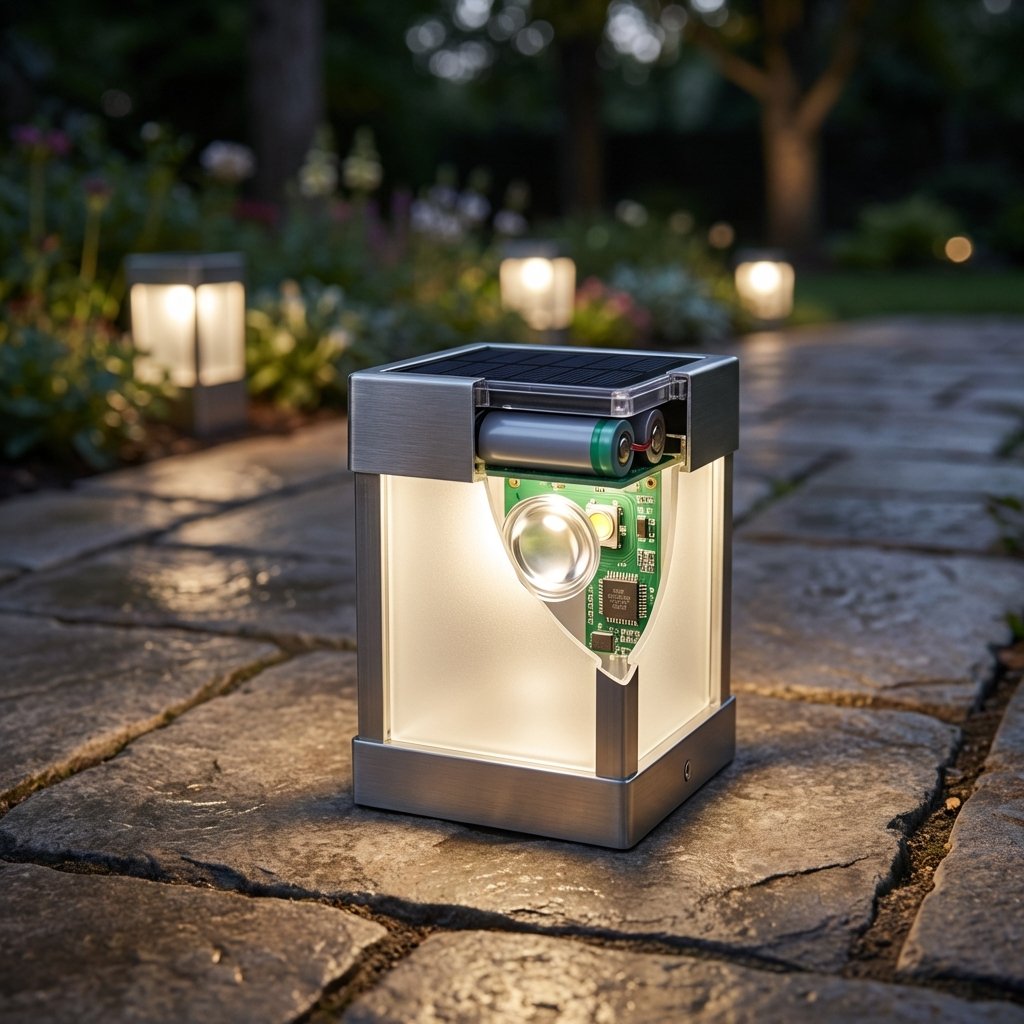
Solar Path Lights Technology and Innovations isn’t about “new and shiny.” It’s about whether your lights survive winter, charge in weak sun, stay bright past 9 PM, and don’t turn into dim blue sadness after 60 days. If you only remember one thing: the panel + battery + controller combo decides performance, and the optics + color temperature decide whether your yard looks expensive or like an airport runway.
Here’s the fastest way to pick smarter tech (use this as your decision filter):
- Low-sun area? Prioritize higher-efficiency panels, a decent controller (low-voltage protection), and larger usable battery capacity.
- Cold winters? Prioritize LiFePO4 or cold-tolerant battery management, sealed housings, and conservative brightness profiles.
- You care about “pretty” light? Prioritize optics (lens/diffuser), warm CCT (2700K–3000K), and glare control.
- You care about security? Prioritize motion boosting, beam shaping, and consistent runtime more than peak lumens.
Everything else is secondary. Now let’s break down what’s changing in the tech, what’s legit innovation, and what’s just packaging.
Table of Contents
- The real architecture of a solar path light
- Solar panels: small panel, big consequences
- Battery chemistry: the make-or-break component
- Controllers and charging: where good lights separate
- LEDs, optics, and color: the part you see
- Sensors and smart features: useful or useless?
- Weatherproofing, materials, and seals: why lights die
- Runtime math: the only honest lumen story
- Innovation trends: what changed and what’s next
- How to evaluate specs without getting played
- Installation and layout: technology only works when placed right
- Maintenance and troubleshooting like a pro
- FAQ
- Resources / Tools
The real architecture of a solar path light
A solar path light is a tiny off-grid power system pretending to be a decoration. That’s why most of them fail in predictable ways.
Every unit has six functional blocks:
- Solar module (panel + encapsulation) that converts light into DC power.
- Charge controller that decides how efficiently the battery charges and how safely it discharges.
- Battery that stores energy and defines how long the light can run.
- LED + driver that converts battery power into stable light output.
- Optics (lens/diffuser/reflector) that shapes the beam and prevents glare.
- Enclosure that has to survive UV, rain, insects, sprinklers, freeze/thaw, and garden tools.
Innovation usually happens in one of these blocks. Marketing, however, likes to talk about “lumens” like they’re a magic spell. Lumens matter, but only after you’ve got energy storage and power control that can support them.
Insider tip #1: If a light claims huge lumens but has a tiny top panel and no mention of battery type, it’s almost always “burst lumens” for a short time, then it throttles down hard. The tech isn’t “bad,” the claim is just framed to win clicks.
If you want the basic buying framework first, park this link for later: how to choose solar path lights that don’t disappoint at night.
Solar panels: small panel, big consequences
On path lights, the panel is small, often shaded, and rarely angled perfectly. That means panel efficiency and low-light behavior matter more than people think.
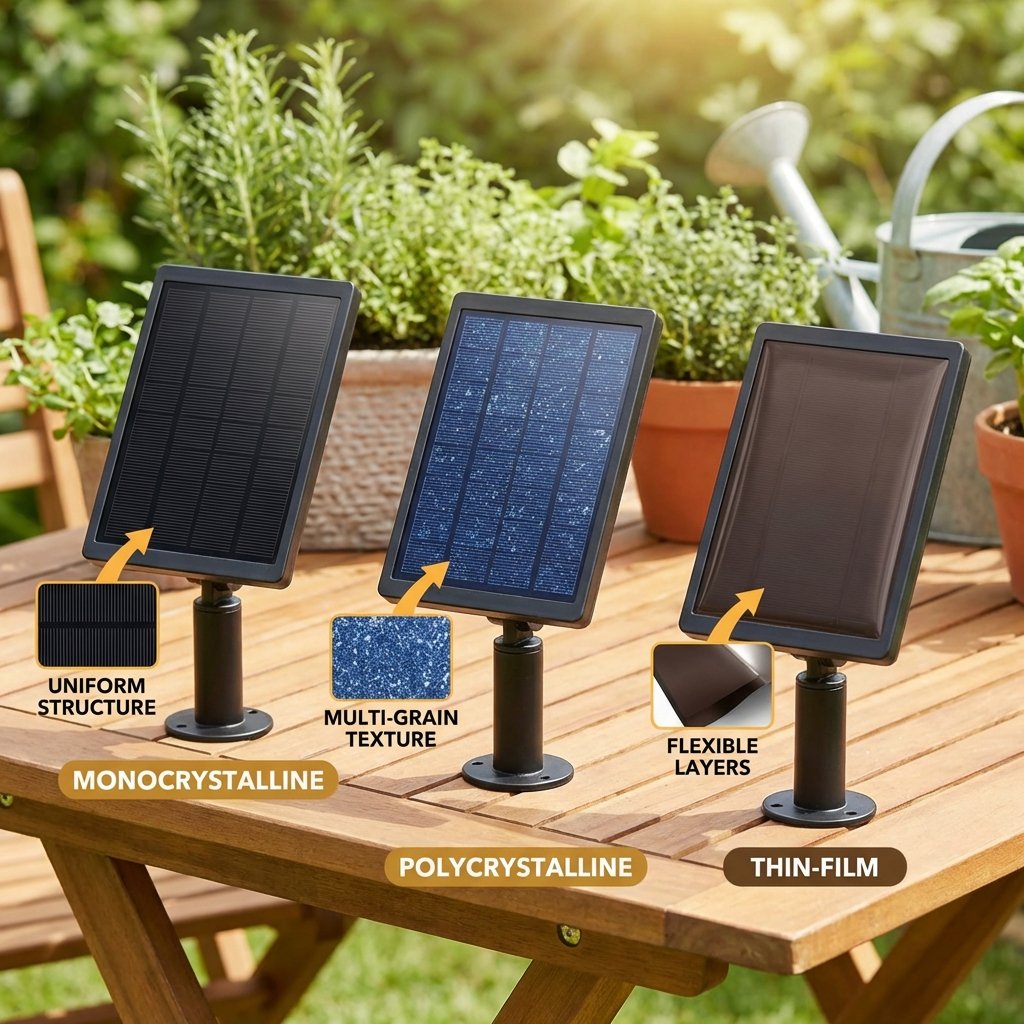
Monocrystalline vs. polycrystalline vs. thin-film
Monocrystalline panels are typically the best choice for path lights because you get more output per square inch. When your panel is the size of a coaster, that efficiency difference turns into real runtime.
Polycrystalline can be fine, but it tends to lose the spec war in small surface areas. It’s often used to hit a price point, not because it’s “better” for you.
Thin-film (amorphous) historically showed up in very cheap lights. Its advantage is better performance under certain diffuse conditions, but in path-light form factors, the execution is usually budget-grade. When thin-film is done well, it can be interesting—when it’s done cheaply, it’s basically “charges a little, looks busy.”
Panel encapsulation and why yellowing kills output
The cell tech is only half the story. The clear top layer (often plastic) gets punished by UV. Yellowing, haze, and micro-scratches reduce light transmission and lower charging current over time.
What to look for:
- Glass-covered panels (when available) tend to age better than cheap clear plastic.
- UV-stabilized polymers can be good—but brands rarely specify them clearly.
- A smooth, hard top surface usually stays clearer longer than a soft “rubbery” lens.
Common mistake #1: People blame batteries for “dim after 3 months,” but often the panel surface is already hazed from sun + dust + sprinkler minerals. Output drops, battery never reaches full charge, and runtime collapses.
Low-light and winter reality
Short days + low sun angle + cloud cover is the stress test. Solar path lights in winter aren’t “broken”—they’re energy-starved. Better tech handles it by being honest about power budgets: lower output, smarter dimming curves, motion boosting, and conservative cutoffs that protect the battery.
If you want the fundamentals of how PV converts light to power, the U.S. Department of Energy explains it clearly here: Solar Photovoltaic Technology Basics (energy.gov).
Battery chemistry: the make-or-break component
If solar path lights had a “single point of failure,” it’s the battery. Not because batteries are bad, but because cheap lights abuse them with poor charging logic and weak protection.
NiMH vs Li-ion vs LiFePO4
- NiMH (nickel-metal hydride): Common in older designs and some mid-range lights. It’s relatively tolerant, but energy density is lower. Good NiMH can be reliable; cheap NiMH feels like a candle by midnight.
- Li-ion (often 14500/18650 variants): Higher energy density, more runtime potential, but needs proper protection (overcharge/over-discharge) and sane thermal handling.
- LiFePO4 (lithium iron phosphate): Lower energy density than typical Li-ion, but strong cycle life and better thermal stability. For hot climates and “set it and forget it,” it’s one of the smartest battery choices when implemented properly.
Translation: if you’re buying “bright + long runtime + survives seasons,” a well-designed lithium-based system usually wins. If you’re buying “cheap and cheerful,” NiMH may be acceptable, but don’t expect miracles.
Replaceable vs sealed batteries
A lot of path lights are “sealed,” meaning battery replacement is annoying or impossible. That’s not innovation. That’s planned frustration.
Better designs do one of these:
- Tool-less battery access (cap twist-off, gasketed compartment).
- Standard cell formats (AA NiMH, 14500 Li-ion) instead of weird packs.
- Clear polarity and contact design that doesn’t corrode the first time it rains sideways.
Insider tip #2: If the light uses a standard battery and has a gasketed compartment, it’s often a signal the manufacturer expects the product to last beyond a season. It’s not guaranteed quality—but it’s a good sign.
Cold weather performance
Cold reduces usable capacity for most chemistries. The trick is not “a magical winter battery.” The trick is a controller that avoids deep discharge, plus an LED profile that doesn’t demand peak current all night.
Common mistake #2: People put the brightest lights in the shadiest spots (trees, hedges, north side) and then act surprised when they fail first. That’s not a defect. That’s basic energy math.
Controllers and charging: where good lights separate
The controller is the brains. It decides whether your panel energy becomes stored energy, and whether your battery gets protected or slowly murdered.
PWM vs MPPT in mini solar
In larger solar systems, MPPT (maximum power point tracking) is a big deal. In tiny path lights, full MPPT is less common, but the principle still matters: better controllers extract more usable energy, especially in weak light conditions.
What you’ll see in path lights:
- Basic PWM-style charging: cheap, works, wastes potential in marginal conditions.
- “MPPT-like” or optimized charging: sometimes real, sometimes marketing. The result you care about is better charging in cloudy days and better battery longevity.
Low-voltage protection and cutoffs
This is huge. Over-discharging a battery repeatedly kills it fast. Good controllers:
- Shut the LED down before the battery drops into damage territory.
- Use staged dimming instead of “bright until dead.”
- Handle battery temperature ranges more conservatively.
Insider tip #3: The best-looking runtime profiles feel “boring”: steady light, gentle dim, then off. The worst feel impressive for 90 minutes, then fall off a cliff.
Adaptive brightness curves
This is one of the most practical innovations: lights that manage brightness across the night based on stored energy.
Common patterns:
- Early-evening boost (when you’re outside) + late-night dim (when you’re asleep).
- Motion boost: low baseline glow, then ramps up when someone walks by.
- Seasonal auto-adjust: less aggressive output in winter so you still get light at 6 AM.
These aren’t gimmicks. They’re how small solar devices behave like they have bigger batteries than they actually do.
If you want a deeper buyer framework that compares these behaviors across categories, this is useful: solar path lights buyer’s guide and reviews.
LEDs, optics, and color: the part you see
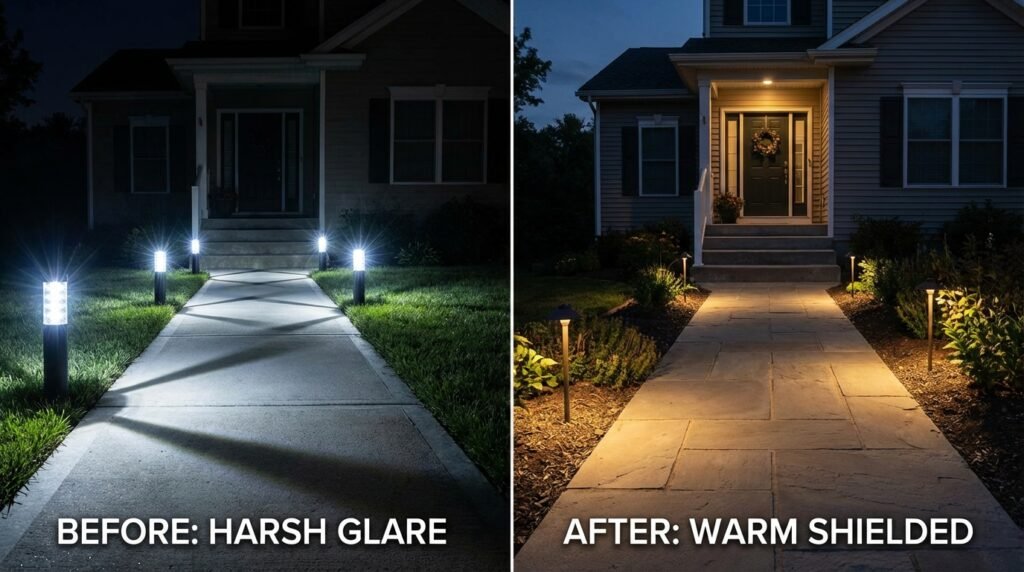
This is where “cheap” becomes visible. You can forgive a lot, but harsh glare and weird blue light makes your yard look like a parking lot. That’s not a vibe.
Lumens vs usable light
Lumens measure total light output. They don’t tell you:
- How the light is distributed (wide, narrow, blinding hotspot).
- Whether the light is aimed where you need it (path vs eyes).
- How long it stays near that output.
For path lighting, you often want controlled spill and low glare more than raw lumens.
Optics: lenses, diffusers, and glare control
Optics are underrated and they’re a legit innovation area. Better lights use:
- Diffusers to soften hotspots (and hide LED pinpoints).
- Shielding so you see the illuminated ground, not the emitter.
- Lens geometry to create a shaped beam (oval patterns for walkways can be great).
Bad optics are why some lights feel “bright” but still fail to light the path. They’re shining into your retinas or into the shrubs.
Color temperature (CCT) and why 2700K–3000K wins
Most residential landscapes look better in warm white. Cool white (5000K+) can be useful for security zones, but it’s harsh along walkways and tends to exaggerate glare.
My practical default:
- 2700K–3000K for front paths, gardens, and “welcome” lighting.
- 3500K–4000K for modern hardscapes if you want a crisp look without going clinical.
- 5000K+ only if you specifically want high alert visibility (and you can control glare).
If you care about efficiency and performance trends in LED lighting broadly, the U.S. DOE’s Solid-State Lighting program is a reliable reference point: DOE Solid-State Lighting (energy.gov).
Sensors and smart features: useful or useless?
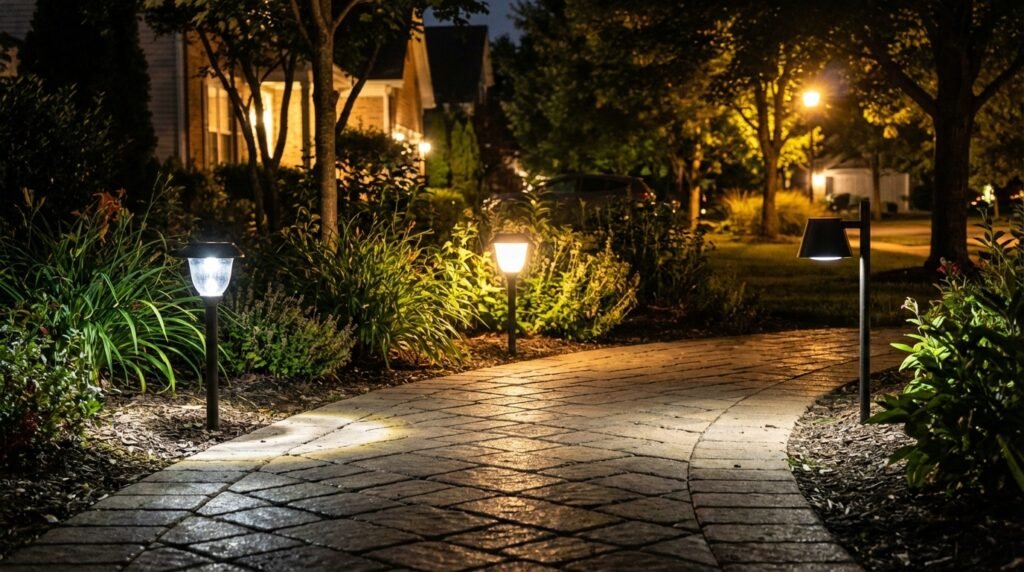
Smart features can be genuinely useful, but a lot of implementations are half-baked. You want features that support the energy budget and improve real-world usability, not features that drain the battery for a badge on the box.
Dusk-to-dawn sensors
Most lights use a simple light sensor to turn on at dusk. The good ones are calibrated to avoid false triggers from porch lights and to avoid flicker around twilight.
Watch for:
- Stable switching (no fluttering at dusk).
- Reasonable sensitivity (doesn’t turn off when a car passes).
Motion sensors: PIR vs microwave
PIR (passive infrared) is common and usually the best fit for path lights: low power draw, decent detection when aimed properly.
Microwave/radar sensors can detect movement differently (sometimes through thin materials), but they can be power-hungry and prone to false triggers depending on the environment.
Best practice: motion boost should be a brightness multiplier, not the only way the light looks decent. If baseline mode is basically off, you’ll hate it as path lighting.
Smart control, apps, and connectivity
Smart path lights usually fall into these buckets:
- Standalone + remote: simple, more reliable, fewer updates, less drama.
- Bluetooth control: fine for small yards, limited range, usually local-only.
- Wi-Fi control: convenient but can be brittle and adds power draw.
- Mesh ecosystems: can be excellent, but ecosystem lock-in is real.
What matters technically:
- Low standby power so the “smart” feature doesn’t eat your runtime.
- Local schedules that keep working when Wi-Fi is down.
- Grouped control so you’re not managing 18 lights one at a time.
Common mistake #3: Buying “smart” solar path lights and then placing them at the far end of the yard where they can’t reliably communicate—then concluding the whole concept is trash. The tech isn’t trash; the deployment is.
Weatherproofing, materials, and seals: why lights die
The fastest way to waste money on solar path lights is to ignore the enclosure. Electronics can be decent, but water ingress and UV damage will end the party early.
IP ratings and what they actually mean
IP ratings are about enclosure resistance to dust and water. For path lights exposed to rain and sprinklers, you want to see something like IP65 or better for meaningful protection (and you still want good seals).
For an authoritative explanation of IP ratings and the IEC standard behind them, see: Ingress Protection (IP) ratings (iec.ch).
Practical translation for path lights:
- IP44: splash-resistant-ish, often not enough for long-term outdoor abuse.
- IP65: protected against jets, generally a safer floor for exposed fixtures.
- IP67: immersion-resistant; great when real, but don’t assume a cheap light truly earns it.
Seals, gaskets, and drainage
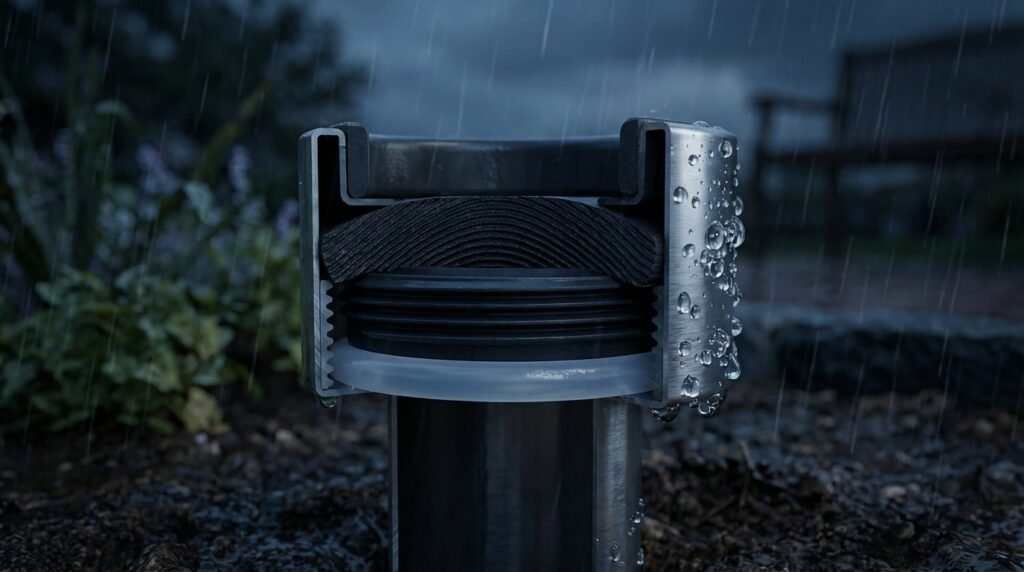
Good enclosures do two things at once: keep water out, and handle condensation that forms inside due to temperature swings.
Look for:
- Continuous gasket (not just a dab of glue).
- Compression design (screws/caps that evenly compress seals).
- Smart venting (in higher-end designs) to reduce fogging.
Materials: UV and corrosion
Plastic can be fine if it’s UV-stabilized. Metal can be great if it’s corrosion-resistant and designed to avoid galvanic corrosion at fasteners.
Weak points that kill lights:
- Cheap chrome plating that flakes and rusts underneath.
- Thin stakes that snap on first hard soil installation.
- Exposed screws that corrode and seize.
- Battery contacts that oxidize and create intermittent failures.
Runtime math: the only honest lumen story
Let’s do the reality check that packaging avoids: runtime is energy in vs energy out.
In simplified terms:
- Energy in depends on panel size, efficiency, sun hours, shading, and controller quality.
- Energy out depends on LED power draw, driver efficiency, brightness profile, and sensor behavior.
What this means in your yard:
- A “100 lumen” light that runs at 100 lumens all night needs a bigger battery and more charging than most compact designs can support.
- Most decent lights use variable output so they can look good early evening and still be on before sunrise.
Why lumens are often measured in ideal conditions
Many lights advertise peak lumens under a full charge and sometimes a fresh battery. After a week of cloudy days? Different story. After two months of panel haze? Different story. After winter nights? Different story.
So when a product claims big lumens, ask two questions:
- At what brightness profile? (steady vs staged vs motion-only)
- For how long? (peak, average, or minimum)
The most useful feature: motion boost done right
Motion boost is one of the best “innovation per dollar” features because it matches how humans use paths: you care most when someone is walking there.
Good motion boost behavior:
- Low, pleasant baseline glow so the path is still readable.
- Fast ramp to brighter mode when motion is detected.
- Slow fade back down (no flicker, no strobe behavior).
Innovation trends: what changed and what’s next
Some “innovations” are real improvements. Some are just new ways to claim a bigger number. Here’s what’s actually moving the needle in solar path lights.
1) Better energy management (not just bigger batteries)
The smartest trend is controller logic that behaves like a tiny energy management system:
- Adaptive dimming based on charge state.
- Battery protection with sane cutoffs.
- Stable LED current so output looks consistent (instead of slowly sagging).
This is boring engineering, which is exactly why it works.
2) Optics getting serious: downlight shields and beam shaping
More brands are finally admitting that glare is the enemy. You’ll see more:
- Shielded “cap” designs that hide the LED source.
- Structured diffusers that spread light evenly on the ground.
- Lens shaping that throws light forward along the path instead of in a circle.
This is especially important if you’re trying to make paths look premium instead of “random dots of light.”
3) Battery pack and BMS improvements
Better lights are adopting more robust protection circuitry (battery management systems) that prevents the two battery-killers: overcharge and deep discharge.
Some higher-end designs also handle cold/hot conditions more gracefully by reducing charge rate or output when it protects longevity.
4) Hybrid charging and backup options
Hybrid charging—solar plus a backup method—shows up in a few forms:
- USB charging to top up before a party or after a storm week.
- Replaceable battery packs so you can swap instead of waiting.
- External panel options (rare in path lights, more common in spotlights) that let you place the panel in sun and the light in shade.
For most homeowners, USB top-up is the most practical because it solves the “three rainy days” problem without requiring a full lighting redesign.
5) Dark-sky-friendly designs
Light pollution is becoming a real design consideration. Downward-directed light, warmer color temperatures, and controlled spill aren’t just aesthetics—they reduce glare and keep your yard calmer at night.
If you want a credible reference point for responsible outdoor lighting principles, the International Dark-Sky Association is a well-known organization: DarkSky guidance and programs (darksky.org).
How to evaluate specs without getting played
Most listings don’t lie—they just tell the truth in the most flattering way possible. Here’s the decision framework that cuts through it.
The five specs that actually predict performance
- Battery type and (realistic) capacity: If they don’t specify it, assume it’s the cheapest option available.
- Panel type and surface area: A tiny panel can’t power big numbers for long, no matter what the box says.
- Brightness mode behavior: Steady vs staged vs motion-only. This decides real-life satisfaction.
- Ingress protection / sealing: Especially if sprinklers hit them directly.
- Optical design: Shielded downlight and diffusion beats raw glare every time.
Spec traps (and how they show up)
- “X lumens” with no runtime context: peak numbers are easy; sustained numbers are expensive.
- “Waterproof” with no IP rating: “waterproof” is marketing, not engineering.
- “All-night” claims: ask “in what season?” because summer and winter aren’t the same product.
- “Fast charging”: if charging is too aggressive, it can shorten battery life unless the controller is good.
The cheap teardown checklist you can do without tools
You don’t need a lab. You need basic observation:
- Is the panel surface glass-like and clear, or soft plastic that scratches easily?
- Does the battery compartment have a real gasket or just a loose cap?
- Are the stakes thick enough to survive hard soil, or do they flex like a plastic fork?
- Is the LED source shielded from direct eye view?
- Do you see consistent output across multiple units, or do some look weaker out of the box?
If you want a quick list of what to look for by use-case (decorative vs security vs smart), here’s a handy reference: best solar path lights for walkways, gardens, and driveways.
Installation and layout: technology only works when placed right
You can buy great lights and still get mediocre results if placement is wrong. Solar is picky. Light optics are picky. Here’s how to install like you’ve done it before.
Panel exposure wins over everything
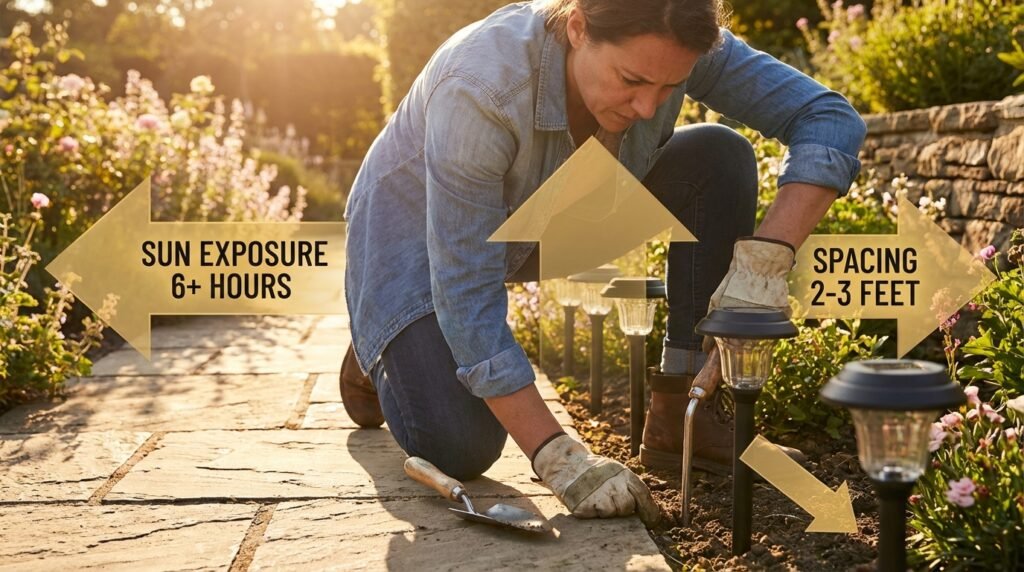
Rule of thumb: if the panel doesn’t see the sky, the battery won’t see a full charge.
Placement moves that matter:
- Avoid placing lights under dense shrubs or tree canopies.
- Watch for house shadows—especially in winter when the sun angle is low.
- Keep panels clean: dust and sprinkler mineral spots are silent performance killers.
Spacing for function vs spacing for look
For most walkways:
- Function-first spacing: closer spacing yields smoother visibility and fewer dark gaps.
- Look-first spacing: wider spacing can be elegant if each fixture has good optics and enough output.
Don’t over-light. Too many bright points create glare and visual clutter. If you want the path to read clearly, you want even illumination, not a runway of hotspots.
Stakes and soil: how to avoid snap-city
- Pre-drill hard soil with a spike or screwdriver before pushing stakes in.
- Don’t hammer plastic stakes. If it needs hammering, the soil needs pre-drilling.
- In loose soil, consider adding a compact base (small gravel bed) for stability.
Maintenance and troubleshooting like a pro
Solar path lights are low-maintenance, not no-maintenance. A five-minute routine a few times a year keeps performance stable.
Cleaning the panel and lens
- Wipe panels with a damp microfiber cloth.
- If you have hard water sprinklers, use a mild vinegar-water mix on mineral spots (don’t soak the seals).
- Clean the diffuser/lens too—dirty optics reduce usable light.
Battery refresh and seasonal handling
- If the lights are replaceable-battery models, consider swapping batteries every 12–24 months depending on climate and usage.
- In extreme winters, expect reduced runtime. If you want consistent winter performance, choose conservative brightness profiles or consider hybrid charging options.
Symptoms and fixes
- Turns on late or flickers at dusk: sensor confusion from nearby lights; relocate or shield from direct porch light.
- Dim after a few hours: battery not charging fully (shade, dirty panel, winter sun) or battery aging.
- Dead unit: check switch (yes, really), check battery contact corrosion, swap battery if replaceable.
- Water inside lens: seal failure—dry it out, but plan replacement; repeated moisture usually corrodes contacts and board traces.
For a broader understanding of how solar electricity is generated (helpful when diagnosing weak-charge issues), the U.S. Energy Information Administration has a straightforward overview: Photovoltaics and electricity (eia.gov).
FAQ
Why do my solar path lights look bright at first, then get dim after a few weeks?
Most often: the panel gets dirty/hazy, the battery never fully charges, and the controller drops output earlier. Clean the panel and lens first; if it’s still weak, the battery may be low-grade or aging fast.
Is a higher lumen number always better for path lighting?
No. Bad optics can waste lumens into glare. For walkways, controlled downlight and even distribution usually beats brute brightness.
What’s the best color temperature for a normal home walkway?
2700K–3000K warm white is the safest bet for a welcoming look with less glare. Cooler whites can look harsh unless you’re intentionally going for “security lighting.”
Do solar path lights work in winter?
Yes, but performance drops: shorter days, low sun angle, and cold reduce available energy and usable battery capacity. Better lights manage this with staged dimming and battery protection.
What IP rating should I look for?
For exposed yards and sprinklers, IP65 or better is a solid target. “Waterproof” without an IP rating is vague and often meaningless.
Are LiFePO4 batteries worth it in solar path lights?
When implemented well, yes—especially for longevity and heat tolerance. But the controller and sealing still matter; a great battery won’t survive a wet enclosure.
Why do some lights turn off even when the battery isn’t dead?
Good controllers cut off before the battery is deeply discharged. That protects lifespan. The alternative is “stays on longer today, dies permanently sooner.”
Do motion sensor solar path lights save battery?
They can—if they keep a low baseline and only boost on motion. If the sensor is too sensitive or the baseline is basically off, they’re annoying as path lights.
Can I leave solar path lights out in heavy rain?
Only if the enclosure and seals are good. Even then, repeated sprinkler jets and freeze/thaw cycles expose weaknesses. If you notice fogging inside, you’ve got a seal problem.
What’s the most overlooked “innovation” that improves real-world performance?
Adaptive brightness profiles. It’s not flashy, but it’s the difference between “looks great at 7 PM” and “still usable at 5 AM.”
Resources / Tools
Below are practical Amazon-searchable products that support better performance, cleaner installs, and longer life for solar path lights. These aren’t “magic upgrades,” but they solve common real-world problems: weak charging, ugly glare, snapped stakes, fogged lenses, and dead batteries.
- Rechargeable AA NiMH batteries (high quality)
Benefit: Improves reliability for lights that use AA cells; reduces early dimming.
Best for: Path lights with replaceable AA batteries.
Check price on Amazon - 14500 Li-ion rechargeable batteries (for compatible lights)
Benefit: Higher energy density than AA-sized NiMH when the light is designed for 14500 cells.
Best for: Lights explicitly rated for 14500 lithium cells (don’t “upgrade” blindly).
Check price on Amazon - Battery charger for NiMH/Li-ion (smart charger)
Benefit: Proper charging extends battery life and avoids weak performance from undercharged cells.
Best for: Anyone maintaining replaceable-battery solar lights.
Check price on Amazon - Microfiber cloths for panel cleaning
Benefit: Keeps panels clearer without scratching; improves charging consistency.
Best for: Dusty areas and sprinkler-heavy yards.
Check price on Amazon - Outdoor-rated silicone sealant (clear)
Benefit: Helps reinforce minor gaps on budget fixtures (not a fix for bad designs, but can extend life).
Best for: Small repairs, wire pass-throughs, and minor seal reinforcement.
Check price on Amazon - Garden soil spike / pilot hole tool
Benefit: Prevents snapped stakes by pre-drilling hard soil.
Best for: Clay soil, compacted ground, rocky edges.
Check price on Amazon - Landscape edging staples / anchor pins
Benefit: Adds stability in loose soil and helps keep lights aligned in straight runs.
Best for: Long walkway installations and soft ground.
Check price on Amazon - Replacement stakes for solar path lights
Benefit: Extends the life of good fixtures after a stake breaks (common failure point).
Best for: Anyone with broken stakes but working heads.
Check price on Amazon - Outdoor-rated electrical contact cleaner
Benefit: Removes oxidation from battery contacts and restores intermittent power.
Best for: Flickering/dying lights with visible corrosion on contacts.
Check price on Amazon - Warm-white solar path lights (2700K–3000K search)
Benefit: Targets models that look better in residential landscapes and reduce harsh glare.
Best for: Front paths, gardens, “welcoming” curb appeal.
Check price on Amazon - Solar path lights with motion sensor (boost mode search)
Benefit: Helps you find models that use motion boost for better perceived brightness without destroying runtime.
Best for: Driveways, side yards, and paths where people actually walk at night.
Check price on Amazon
As an Amazon Associate I earn from qualifying purchases.
All technology guides
- Do Solar Path Lights Work With Matter Yet? (2026)
- AI-Powered Solar Path Lights: Do They Really Work?
- Smart Solar Path Lights With App Control: I Tested 12 Models So You Don’t Waste Money
- Solar Path Lights Sensor Not Working? Get It Working Again
- Solar Path Lights Coastal Corrosion: Proven Secrets
- Solar Path Lights Ip Rating: Ip65 vs Ip67 Guide
- Best Solar Path Lights for Walkways, Gardens, and Driveways
- How to Choose Solar Path Lights That Don’t Disappoint at Night