
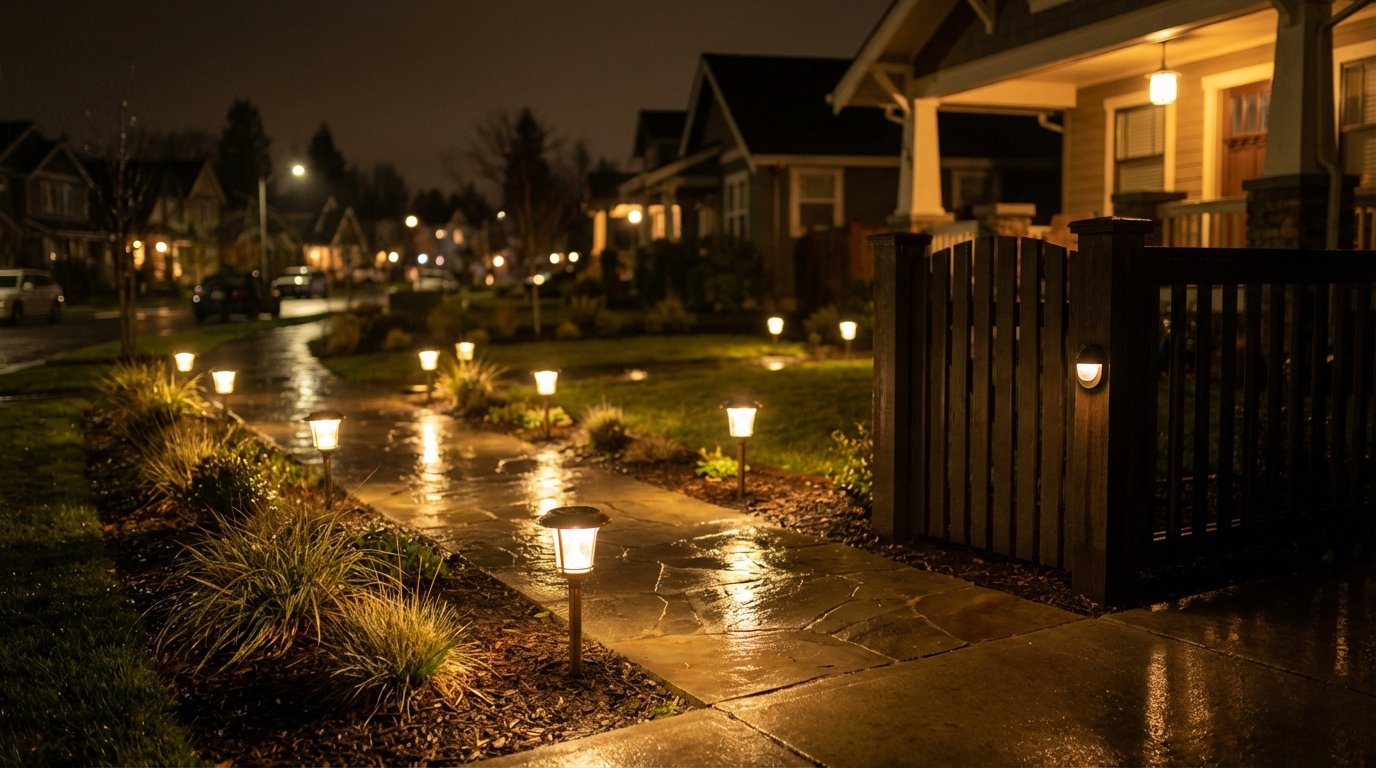
Solar Path Lights Safety and Security isn’t about buying “brighter lights” and calling it a day—it’s about placing the right light, in the right spots, with the right behavior so your home is safer and your lighting actually works when it matters.
If you do just three things this week: (1) light the “decision points” (gates, turns, steps, door approaches), not the whole yard, (2) eliminate glare and dark pockets by using shorter, shielded lights in a consistent rhythm, and (3) treat the battery + water seal like the failure points they are. That combo prevents trips, reduces “easy hiding zones,” and stops the classic solar-light disappointment: dead fixtures exactly when you want them.
Table of Contents
- What “safe and secure” lighting actually means
- Risk-map your property in 15 minutes
- Placement that prevents falls and bad surprises
- Security strategy: deter, detect, and don’t create new problems
- Brightness, color, and glare: the rules most people break
- Motion vs dusk-to-dawn: when each wins
- Weatherproofing, durability, and vandal resistance
- Battery, charging, and fire safety (yes, it matters)
- Privacy, neighbors, and wildlife: avoid the drama
- Maintenance that keeps them working all year
- Real-world layouts you can copy
- FAQ
- Resources / Tools
What “safe and secure” lighting actually means
Most people buy solar path lights for vibes. Then they get annoyed when the lights are dim by midnight, or they create weird shadows that feel creepier than darkness. Here’s the more useful framing:
Safety outcomes (what you’re trying to prevent)
- Trips and falls on steps, uneven pavers, garden edging, hoses, and low curbs.
- Missed hazards at transitions: driveway-to-walkway, gate latches, stair landings, tight turns.
- Glare blindness (your eyes can’t adjust, so everything beyond the light becomes a black void).
- False confidence—a lit path that dies early can be worse than no plan at all.
Security outcomes (what you’re trying to influence)
- Deter: reduce concealment, make approach routes feel exposed, remove easy “work zones” near doors and windows.
- Detect: help you and cameras see faces, hands, and direction of movement.
- Signal occupancy: consistent, intentional lighting suggests someone pays attention.
Outdoor lighting is also tied to broader impacts—energy use, light pollution, and visibility comfort. The U.S. Department of Energy has good context on why outdoor light should be purposeful instead of excessive, including impacts of light at night. DOE: Light at Night
Insider tip #1: The “security boost” from path lights doesn’t come from brute brightness. It comes from predictability and coverage—no dark pockets next to entry points, and no glare that wrecks your own night vision.
Risk-map your property in 15 minutes
If you want Solar Path Lights Safety and Security to be more than a shopping hobby, do this quick mapping exercise once. It keeps you from randomly sticking lights wherever the stake fits.
Step 1: Walk the property like a stranger would
At dusk, walk from the street to every entry point you care about: front door, side gate, garage access door, back patio slider. Note:
- Where you naturally slow down (decision points)
- Where you turn your head to locate a latch or step
- Where you feel unsure of footing
Step 2: Circle “injury zones”
- Steps and stair landings
- Uneven stone / cracked concrete
- Slopes and gravel transitions
- Garden borders that steal toes
- Areas that get slick (sprinklers, algae, leaf mush)
Step 3: Circle “privacy and concealment zones”
- Dense shrubs near windows
- Alcoves by porches
- Side-yard corridors
- Places where a person could crouch unseen from inside
Step 4: Decide your lighting roles
Every light should have a job. For most homes, you want three roles:
- Guidance lighting: low, consistent path markers.
- Task lighting: brighter light exactly where hands/feet need it (steps, locks, gates).
- Event lighting: motion-triggered bursts at approach routes and dead zones.
That’s the blueprint. Now the “how” becomes obvious, and you spend less money chasing the wrong fixtures.
Placement that prevents falls and bad surprises
Path lights are supposed to make walking easier. Bad placement does the opposite: glare in your eyes, shadows across steps, and random bright dots that hide the actual hazards.
Spacing: consistent beats “more”
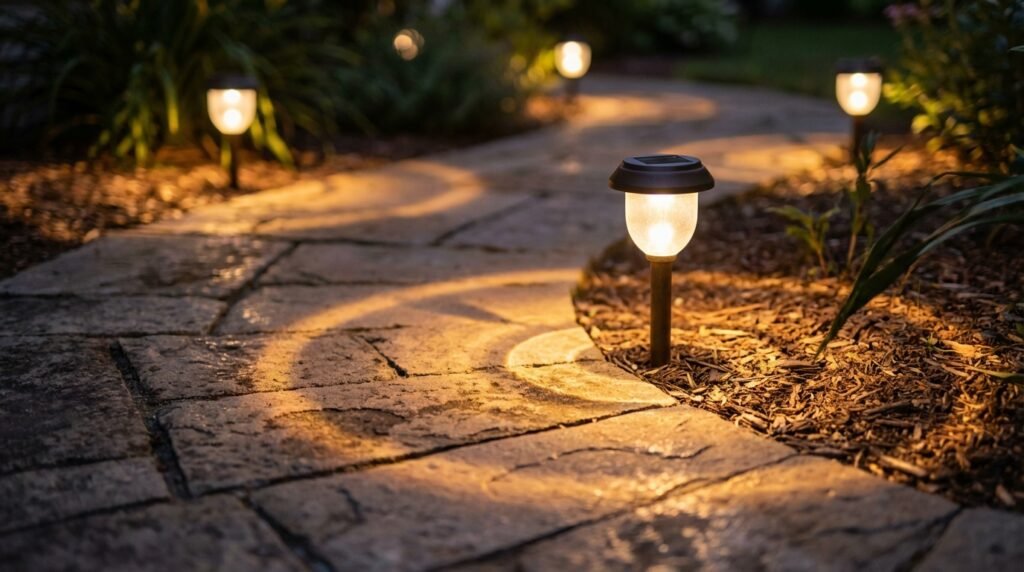
As a baseline, place standard path lights in a steady rhythm. Typical spacing lands around 6–10 feet (about 2–3 meters), but the correct answer depends on fixture height and beam spread. Your goal is overlap—soft pools of light that connect—without creating bright “islands” separated by darkness.
Offset placement: don’t line them up like runway lights
If you line lights perfectly opposite each other on a narrow path, you often create harsh cross-shadows. A small offset (staggering) usually gives smoother coverage and fewer black stripes across the walkway.
Steps and transitions: light the edges, not your eyeballs
- Put lights before the first step and after the last step so your eyes pre-adapt.
- Avoid aiming light straight toward the approach direction. Glare at a stair is how people misjudge depth.
- Consider short “downcast” fixtures or step-specific solar lights for stair noses.
Common mistake #1: Installing a super-bright path light at the bottom of stairs “for safety,” then wondering why the steps above disappear. You blinded yourself. Reduce glare first; brightness second.
Gates, locks, and latches: give your hands light
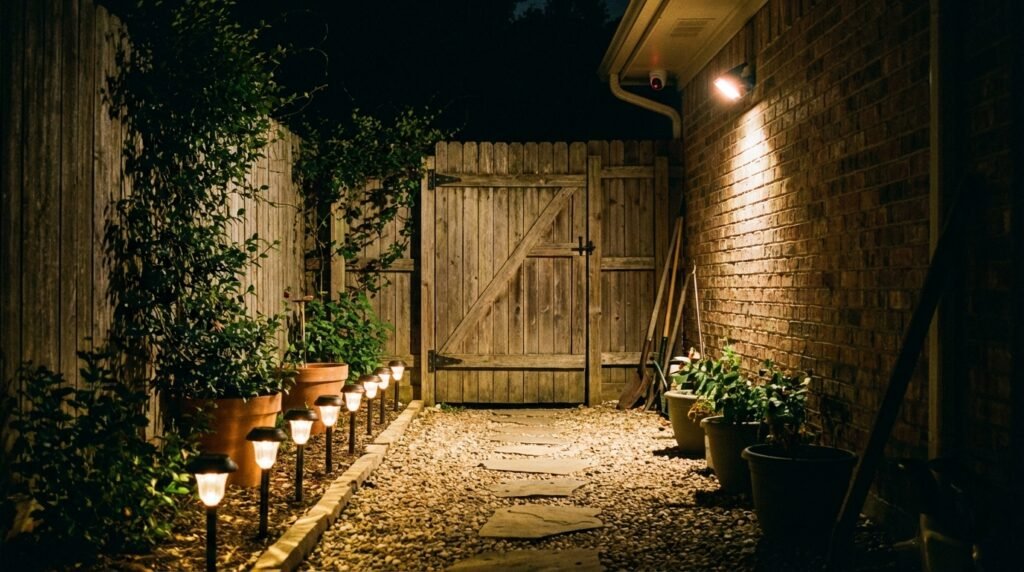
It’s not enough to see the gate. You need light where the latch is. A small solar spotlight or a motion-activated fixture placed off-axis can illuminate the latch without shining into neighbors’ windows.
If you’re building a full site structure, connect this topic to your broader install content. See solar path light placement rules that prevent glare for a tighter “do this, not that” layout checklist.
Driveways and garage edges: prevent the ankle-breaker zone
That driveway-to-walkway seam is a classic trip point. Put low guidance lights along the edge you actually walk—not the edge that looks prettiest from the street.
Corner turns: light the “turn cue”
People trip when they turn and their feet land on something unexpected. Place a light slightly before the corner, not after. It cues the turn while you still have stable footing.
Security strategy: deter, detect, and don’t create new problems
Let’s be blunt: path lights alone are not a security system. But they can remove “easy mode” conditions—dark approach routes, concealment pockets, and camera footage that’s basically a ghost story.
Deter: expose approach routes, not the whole yard
Think like someone trying to approach unseen. They choose:
- Dense landscaping near windows
- Side yards and narrow corridors
- Dark gaps between porch light and street light
Your job is to reduce concealment on those routes. That doesn’t require floodlights. It requires coverage where bodies move and where hands work (doors, gates, windows).
Detect: make your cameras smarter without upgrading your cameras
Cameras love stable, non-glare light. Cheap solar lights that flicker or create hotspots can actually make night video worse because the camera keeps adjusting exposure.
- Use warm, even, downward light near camera zones.
- Avoid pointing bright lights directly into the camera’s field of view.
- Prioritize lighting at face height indirectly (bounce off ground/walls) instead of blasting from eye level.
Signal occupancy: consistency beats random “on sometimes” lighting
If half your solar lights are dead or dim, your home looks unattended. One well-maintained row beats twelve sad, mismatched stakes.
Insider tip #2: For security, I’d rather have fewer fixtures that are bright until late evening (when most households are active) than a big set that fades early and turns the property into a patchy “guess where the shadows are” game.
A balanced approach: path + motion + a real porch light
Path lights handle guidance. Motion lights handle surprise and attention. A proper wired porch light handles reliable illumination when you need it most. Solar can support security, but expecting it to replace wired lighting is how you end up frustrated.
For practical exterior lighting design—especially on avoiding excessive brightness and using controls like sensors and timers—this DOE resource is one of the few that stays grounded. DOE: Lighting Design
Brightness, color, and glare: the rules most people break
Brightness is emotional. You think brighter equals safer. But glare and contrast can make you less safe while you feel more safe. So let’s separate “useful light” from “annoying light.”
Glare is the enemy of both safety and security
Glare reduces your ability to see beyond the light. It also creates hard shadows where someone can stand unseen. Good path lighting is usually downcast and shielded.
Color temperature: warmer is usually smarter
Very cool white light (the icy-blue look) can increase perceived harshness and can cause more discomfort glare. Warm-white light tends to be more visually comfortable and neighbor-friendly, while still providing functional visibility.
If you want a clean set of principles for responsible outdoor lighting—useful, targeted, low-level, controlled, warm-colored—DarkSky lays them out simply. DarkSky: Five Principles for Responsible Outdoor Lighting
Evenness beats peak brightness
For walking safety, the goal is to reduce sudden contrast changes. Extreme bright spots next to darkness make it harder to read surfaces. Even, overlapping light helps you see texture, steps, and edges.
Reflective vs illuminated: cheat when you can
Not everything has to be lit. Reflective markers, address numbers, and step-edge tape can improve wayfinding without adding brightness or battery load. This is especially useful on long paths where you want guidance without energy waste.
Common mistake #2: Buying “1000-lumen” solar stakes marketed like tactical gear. Most of that output is short-lived, poorly controlled, and aimed in ways that create more glare than clarity.
Motion vs dusk-to-dawn: when each wins
There’s no universal “best.” But there is a best for your layout.
Dusk-to-dawn path lights: best for guidance and consistency
Use dusk-to-dawn along primary walking routes where you want predictable navigation—front walkway, steps, driveway edge to the door.
- Pros: Always on when you need orientation; simple; great for guests.
- Cons: Battery drain; can fade late night; less attention-grabbing for security events.
Motion-activated solar lights: best for approach routes and “event moments”
Motion lights are high leverage when placed at:
- Side gates
- Side-yard corridors
- Back patio entries
- Areas cameras cover (but avoid blasting the lens)
- Pros: Brighter “when it matters”; better battery management; attention effect.
- Cons: False triggers; can annoy neighbors; can startle guests if overused.
Hybrid setups: the sweet spot
My go-to layout for Solar Path Lights Safety and Security:
- Low, steady path lights for navigation
- Motion solar spotlights at gates/side yards
- Reliable porch light at the primary entry
Weatherproofing, durability, and vandal resistance
Solar lights live outside. Outside is violent. UV cooks plastic, sprinklers soak seals, and winter condensation quietly kills circuits. If you want lights that don’t turn into junk by next season, focus on durability signals—not marketing claims.
Water resistance: treat seals like a wear item
Water intrusion is a top failure mode. Look for:
- Gaskets that look substantial (not thin foam)
- Battery compartments with tight closure
- Lens fitment that doesn’t rattle
- Drain channels or design cues that shed water
UV resistance: the silent killer
Clear plastic lenses yellow; cheap housings turn brittle. Metal or UV-stabilized polymers last longer. If you’re in intense sun, prioritize quality housings even if the solar panel specs look similar.
Wind and soil: stakes fail more than lights
A surprising number of “broken lights” are actually “loose stakes.” In soft soil, stakes wobble, water gets in, and alignment gets bad (more glare, worse coverage). Options:
- Use longer stakes or reinforced stakes
- Compact soil and add gravel base where needed
- For premium setups, use small ground sleeves or mount bases
Theft and vandalism: make it annoying
If theft is a concern, don’t put your nicest lights right at the sidewalk edge with a quick-pull stake. Use:
- Heavier fixtures with screw-down bases where possible
- Placement slightly inside landscaping (still effective, less grab-and-go)
- Motion lighting near the most accessible fixtures
If you’re planning broader upgrades, link your durability decisions to a buying framework. This pairs well with how to choose long-lasting solar path lights so your “security plan” doesn’t depend on flimsy hardware.
Battery, charging, and fire safety (yes, it matters)
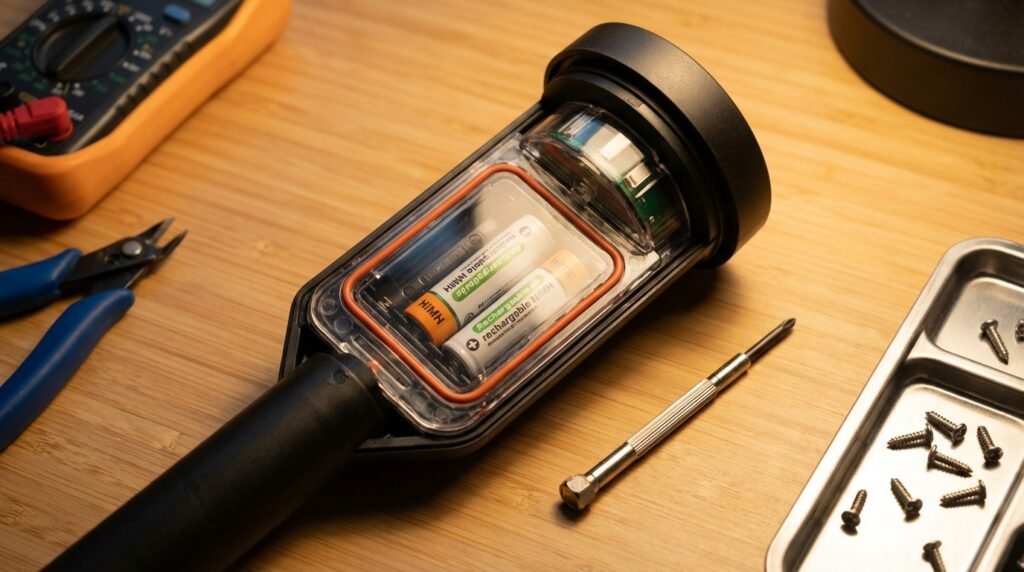
Most solar path lights use rechargeable batteries. Many are low-risk, low-capacity cells. Some higher-output models use lithium-ion packs. Regardless, battery safety is not theoretical—battery failures cause fires, especially when charging, damaged, or poorly manufactured.
Basic rules you should actually follow
- Don’t keep using a light if the battery compartment looks swollen, smells odd, or the light gets abnormally hot.
- Don’t mix battery types or random replacements that “kind of fit.”
- Don’t charge or store spare cells near flammable clutter.
- Use manufacturer-recommended replacement batteries when possible.
The National Fire Protection Association has straightforward consumer guidance on lithium-ion battery safety, including warning signs and safer charging/storage behavior. NFPA: Lithium-Ion Battery Safety
Recalls are real—check them
If you buy off-brand solar lights (especially ultra-cheap bundles), you’re betting on quality control. At minimum, check recall databases for known hazards. The U.S. Consumer Product Safety Commission maintains recall listings. CPSC: Product Recalls
Common mistake #3: Swapping in “stronger” batteries without matching chemistry, size, and protection requirements—then acting surprised when runtime improves briefly and the unit dies (or worse). Battery mismatch is a quiet way to create heat and failure.
Heat and cold: your battery has limits
Cold temperatures reduce battery performance. Heat accelerates aging. Practical implications:
- In winter climates, expect shorter runtimes and consider fewer, higher-quality fixtures rather than many weak ones.
- In extreme heat, place lights so the battery compartment isn’t baking against dark surfaces all day.
- Keep solar panels clean so the battery reaches full charge earlier, reducing stress.
Privacy, neighbors, and wildlife: avoid the drama
Security lighting that annoys everyone becomes a liability. You want lighting that improves visibility on your property without turning your place into the neighborhood’s midnight headache.
Light trespass: keep it on your property
Use shielded fixtures and aim light downward. If your path lights are shining sideways into a neighbor’s window, you didn’t “increase safety”—you started a feud.
Control matters: timers and motion reduce impact
Lighting that runs at full output all night increases sky glow and disrupts the nighttime environment. If you want a bigger-picture reference on lighting and light pollution, the National Park Service includes practical guidance and points to established standards and resources. NPS: Lighting Standards and Guidance
Warm, targeted, controlled: the simple formula
This is where those DarkSky principles are genuinely useful. It’s not about moral purity; it’s about functional lighting that doesn’t cause side effects. DarkSky: Lighting Principles
Security without broadcasting your routines
One overlooked security angle: overly consistent, overly predictable lighting patterns can make routines obvious (“they always leave that area dark”). Mix steady guidance lights with motion-triggered zones so the property doesn’t present a single, static pattern.
Maintenance that keeps them working all year
Solar path lights fail slowly, then suddenly. The good news: most “dead lights” are recoverable if you treat them like outdoor equipment instead of lawn jewelry.
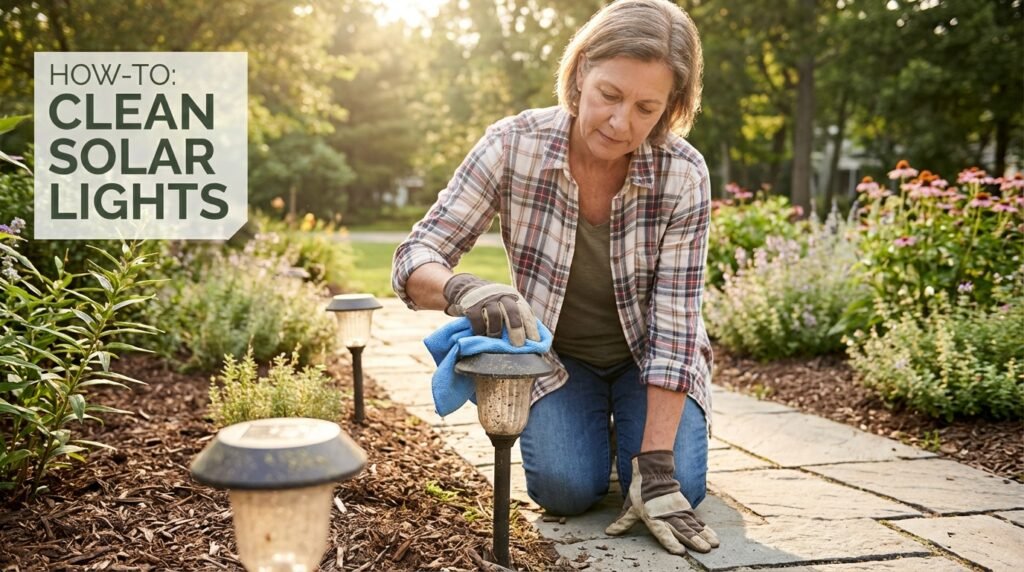
Monthly: clean the panel (yes, really)
Dust, pollen, sprinkler mineral spots, and bird “contributions” reduce charging. A quick wipe can materially improve runtime, especially on smaller panels.
Seasonally: check alignment and shade growth
That shrub that looked cute in spring can shade your panels by summer. Panels in partial shade don’t just charge less—they often charge inconsistently, which leads to dim, unpredictable performance.
Battery refresh: don’t wait for total failure
Rechargeable batteries lose capacity over time. If half your set is fading early, replacing batteries (with correct type/spec) can be the difference between “useless” and “totally fine.”
Water checks: after storms and sprinkler changes
If you adjust sprinklers or have heavy rain, spot-check the fixtures:
- Condensation under lens?
- Water inside battery compartment?
- Corrosion on contacts?
If you catch water intrusion early, you can dry and reseal. If you ignore it, corrosion wins.
For a deeper maintenance workflow that pairs runtime with reliability, tie this page into solar path light maintenance for reliable night lighting.
Real-world layouts you can copy
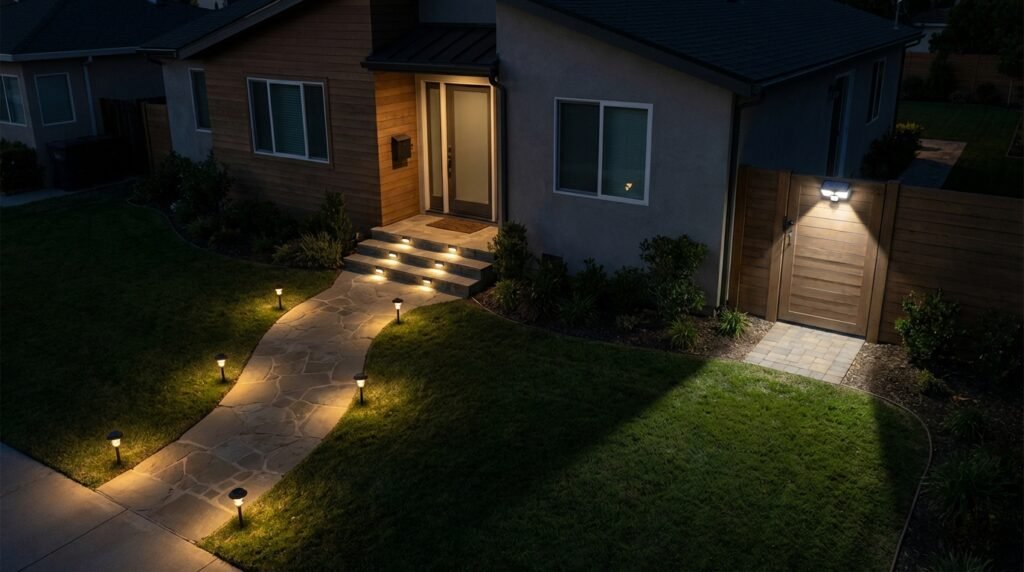
Below are field-tested layout patterns that balance safety, security, and “not annoying.” Copy these and adjust distances to your path width and fixture output.
Layout A: Small front yard with straight walkway
- Path lights spaced evenly along the walkway, staggered left-right slightly.
- Two step-specific lights (or low downcast fixtures) at any porch steps.
- One motion solar spotlight aimed downward near the mailbox/entry gate area.
Why it works: Consistent guidance reduces trips; motion adds attention at the boundary.
Layout B: Corner lot or exposed side yard corridor
- Low path lights along the corridor’s walking edge (not centered).
- Motion light near the side gate latch zone, angled to avoid neighbor windows.
- Keep shrubbery trimmed near windows so lighting isn’t “fighting” foliage.
Why it works: It removes concealment zones and improves camera usability without blasting the whole area.
Layout C: Backyard patio entry with steps
- Two lights marking the top and bottom of steps (not pointed at eyes).
- Short path lights leading 10–20 feet out from the door to define the route.
- Motion lighting covering the approach from the darker yard area.
Why it works: Steps become readable, and motion discourages creeping approaches from darker corners.
Layout D: Long garden path (the “runtime reality” setup)
- Use fewer, higher-quality lights spaced wider, plus reflective markers between.
- Prioritize decision points: turns, steps, gate.
- Skip lighting the entire path if solar exposure is inconsistent; light the critical zones instead.
Why it works: You stop gambling on battery capacity and build a dependable, low-drama system.
FAQ
Do solar path lights actually improve home security?
They can help by reducing concealment and improving visibility on approach routes, but they don’t replace locks, cameras, or an alarm. Think “supporting layer,” not “solution.”
Is brighter always better for safety?
No. Glare and harsh contrast can make you less able to see hazards. Even, downward light is usually safer than a few overly bright points.
Where should I place lights first if I’m on a budget?
Start with steps, turns, gate latches, and the last 20 feet before your main entry. Those are high-risk zones for trips and unwanted approach.
Should I leave solar lights on all night?
For guidance routes, dusk-to-dawn is fine if the lights can maintain usable brightness. For security, motion activation is often smarter and less disruptive.
Why do my solar lights die so early at night?
Usually one of four things: shade (even partial), dirty panels, aging batteries, or low-quality panels/cells. Clean, relocate for sun, and replace batteries before replacing the whole set.
What color temperature is best for outdoor safety?
Warm to neutral light is generally more comfortable and reduces harsh glare. Extremely cool light can feel brighter but often creates more discomfort and neighbor issues.
Can solar lights work in winter or cloudy climates?
Yes, but runtime drops. Use fewer higher-quality fixtures, prioritize critical zones, and consider hybrid approaches (solar for guidance + wired for core entry lighting).
Are lithium-ion solar lights dangerous?
Most are safe when well-made and used correctly, but lithium-ion batteries can fail, especially if damaged or poorly manufactured. Follow safety guidance, don’t use swollen/damaged units, and buy from reputable brands. See NFPA’s consumer guidance for practical safety rules. NFPA: Lithium-Ion Battery Safety
How do I stop solar lights from bothering my neighbors?
Use shielded downcast fixtures, avoid cool-blue light, and don’t aim bright spots toward windows. Motion lighting should be angled and sensitivity-tuned to avoid constant triggering.
Do path lights help security cameras?
Yes, if the light is even and not blasting into the lens. Avoid hotspots and glare; you want stable illumination so the camera doesn’t constantly adjust exposure.
Resources / Tools
Here are practical Amazon finds that support Solar Path Lights Safety and Security without gimmicks. These are search links (not direct product links) so you can compare options and prices.
- Solar path lights (warm white, shielded/downcast)
Benefit: Smoother visibility with less glare and fewer dark pockets.
Best for: Front walkways and guest routes where consistency matters.
Shop on Amazon - Solar motion sensor spotlight (adjustable head)
Benefit: Brighter light on demand for gates, side yards, and approach routes.
Best for: Side gate latches and darker corridors.
Shop on Amazon - Solar step lights (downcast)
Benefit: Makes stair edges readable without blinding you.
Best for: Porch steps, deck steps, and garden stair runs.
Shop on Amazon - Reflective address numbers
Benefit: Helps delivery and emergency responders find your home without adding more light.
Best for: Any home—cheap win with real safety upside.
Shop on Amazon - Rechargeable battery set (correct type for solar lights)
Benefit: Restores runtime and reduces the “dead by midnight” problem.
Best for: Refreshing an existing set before buying new fixtures.
Shop on Amazon - Weatherproof silicone gasket grease
Benefit: Helps maintain water resistance at seals and battery doors (when appropriate for your fixture design).
Best for: Extending life in wet climates or sprinkler-heavy yards.
Shop on Amazon - Microfiber cloth kit (panel cleaning)
Benefit: Quick panel cleanups that improve charging efficiency.
Best for: Dusty, pollen-heavy areas; anyone who wants reliable runtime.
Shop on Amazon - Solar fence/deck lights
Benefit: Adds controlled perimeter guidance without light spill into eyes or windows.
Best for: Along fences, deck edges, and side-yard boundaries.
Shop on Amazon - Ground sleeves / stake reinforcement kits
Benefit: Reduces wobble, misalignment, and water intrusion caused by loose installs.
Best for: Soft soil, windy yards, or frequently bumped path edges.
Shop on Amazon - Reflective outdoor tape (step edge marking)
Benefit: Improves step visibility with almost zero power and minimal light pollution.
Best for: Dark steps, garden stair edges, and transitions.
Shop on Amazon
As an Amazon Associate I earn from qualifying purchases.