How to Choose Long-Lasting Solar Path Lights (No-BS Engineer’s Guide)
If you’re googling how to choose long-lasting solar path lights, you’re probably tired of the same story: they look great for a month, then go dim, then die. how to choose long-lasting solar path lights isn’t about finding “the brightest” listing—it’s about avoiding design shortcuts that guarantee early failure.
The problem is most solar path lights are built like disposable party favors: tiny panels, bargain-basement batteries, and “waterproof” claims that crumble the first time a sprinkler hits them sideways.
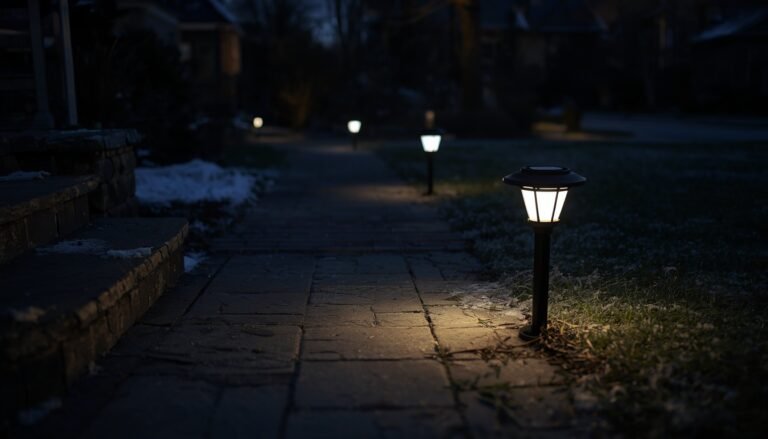
Fast forward to winter, and you’re walking a dark path thinking, “Cool. So I bought glowing yard trash.”
Table of Contents
- Quick answer (the real checklist)
- Start with the battery (because it’s the first thing to fail)
- Panel size & charging electronics: the “math” nobody markets
- Weatherproofing that doesn’t lie: IP ratings, seals, and condensation
- Materials & hardware: the boring stuff that decides lifespan
- Light quality that doesn’t annoy humans
- Marketing traps that produce short-lived lights
- Buying strategy: what I’d do with my own money
- Frequently Asked Questions
- Bottom line
Quick answer (the real checklist)
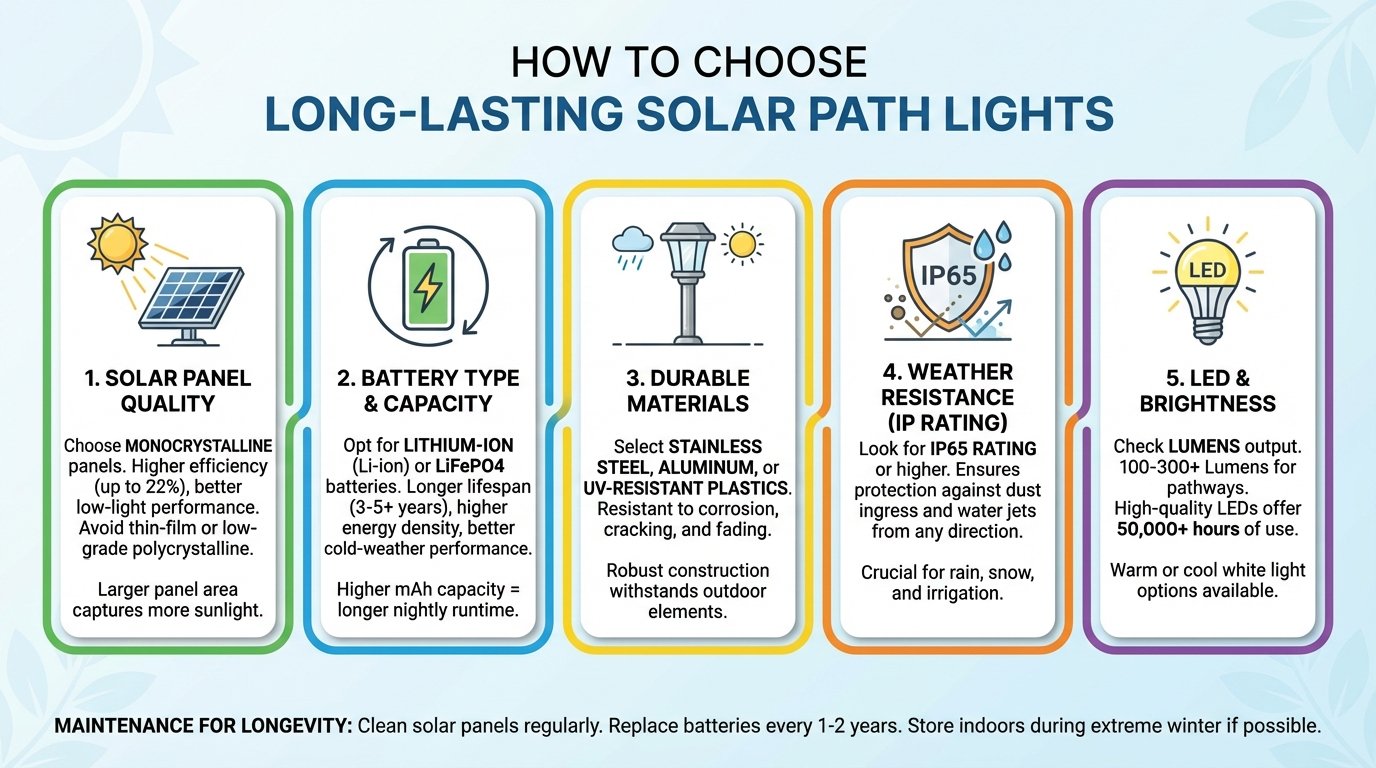
Buy solar path lights with a replaceable name-brand battery (NiMH or quality Li-ion), a panel that’s actually sized for the runtime claimed, honest weather sealing (ideally IP65+), corrosion-resistant hardware, and optics that spread light without glare. If the panel is tiny and the lumens are huge, it’s a longevity scam.
Before we geek out: if you’re using these lights for safety (stairs, driveways, or anything that can break an ankle), don’t wing it. Read this practical safety-and-security breakdown and treat “visibility” like a requirement, not a vibe.
Start with the battery (because it’s the first thing to fail)
Here’s the truth: the battery is the wear item. Not the LED. Not the plastic stake. The battery.
Most failures I’ve seen over the years boil down to one of these:
- Battery is tiny, so it deep-cycles hard every night (stress = short life).
- Charging circuit is dumb, so it overcharges/undercharges depending on weather.
- Battery is sealed-in, so when it dies you throw the whole light away.
NiMH vs lithium-ion: the unpopular truth
You’ll see solar path lights using either NiMH (often AA/AAA) or lithium-ion (often 14500/18650 in larger units). Both can work. Both can be abused.
- NiMH is usually the safer bet in cheap lights because it tolerates crude charging better. It’s also less dramatic in cold weather. Wikipedia has a solid overview of NiMH behavior and limitations if you want the chemistry basics: Nickel–metal hydride battery.
- Lithium-ion can be great… with a real charging design. But in bargain lights, lithium often gets a bargain controller, and heat accelerates degradation. Again, the chemistry isn’t magic—Wikipedia’s lithium-ion summary is a decent starting point: Lithium-ion battery.
If you want longevity, your priority isn’t “NiMH vs lithium.” It’s this:
Can I replace the battery easily with a standard size?
Because even a good battery won’t live forever outside. If the product forces you into a weird proprietary pack, that’s not a feature. That’s planned disappointment.
What to look for on the listing (even when they hide the specs)
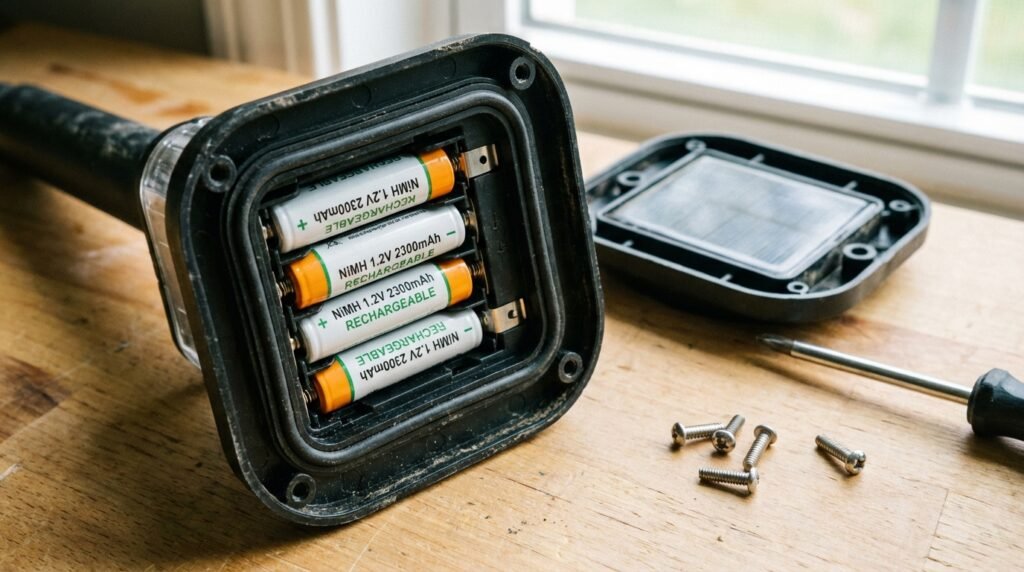
- Replaceable battery door with a gasket (screws beat snap tabs).
- Standard battery size (AA/AAA NiMH, or a known Li-ion size stated clearly).
- Battery capacity listed in mAh (if there’s no capacity, assume it’s tiny).
Panel size & charging electronics: the “math” nobody markets
Solar path lights live or die by two things: panel area and charge control. And yes, I know—none of the sexy listings lead with “panel area.” That’s why people keep buying lights that can’t possibly meet the runtime claim.
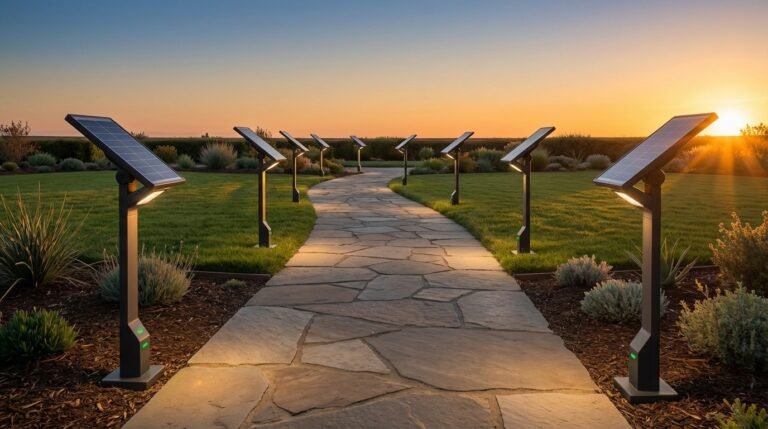
Quick sanity check: if a light claims “very bright” and “12–14 hours” but the panel is the size of a postage stamp, the physics don’t work. That’s not cynicism; that’s energy accounting.
If you want a credible technical reference on how PV works and why size/irradiance matters, the U.S. Department of Energy’s overview is straightforward: DOE: How does solar work?. And for deeper solar-resource context, NREL is the grown-up in the room: National Renewable Energy Laboratory.
What “good” looks like in practice
- A panel that’s proportional to brightness. More lumens requires more energy; no exceptions.
- A light that gets enough sun. If you’re planning layout, don’t guess—use a real install plan. This guide on solar lighting basics and installation planning will save you a lot of trial-and-error.
- Two-mode designs (dim all night, brighter on motion) often last longer because they budget energy intelligently.
Motion sensing isn’t just a security gimmick; it’s an engineering compromise that can actually help runtime. If you need path visibility all night, choose a design that does “low” reliably and uses motion for “high.”
Weatherproofing that doesn’t lie: IP ratings, seals, and condensation
“Waterproof” on a product page is meaningless. I can slap a “waterproof” sticker on a sandwich.
Look for an IP rating from a manufacturer that seems to understand what it means. IP is a standard describing ingress protection. If you want a quick definition, Wikipedia’s IP Code page is a good reference: IP Code.
My practical IP guidance (for path lights)
- IP44: “Okay-ish” for gentle environments. Expect more failures if you have sprinklers or wind-driven rain.
- IP65: The sweet spot when you want stuff to survive real weather and garden irrigation.
- Anything higher: Great, if it’s real. Fake ratings exist.
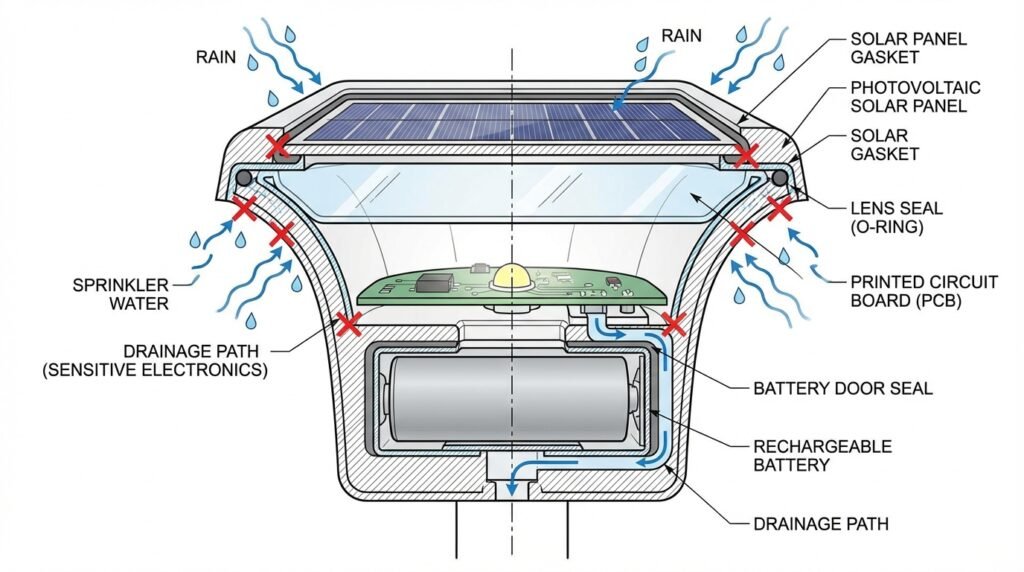
But IP ratings aren’t the whole story. The sneaky killer is condensation. Lights heat up in sun, cool at night, and breathe moisture. If the design doesn’t manage that (gaskets, vents, or smart sealing), you get fogging, corrosion, and flickering.
Also, avoid lights that have a “sealed top” but an unsealed battery base. Water doesn’t care where the marketing copy says it’s sealed.
Materials & hardware: the boring stuff that decides lifespan
Most “long-lasting” claims die at the hardware level. Literally. Screws rust, springs corrode, stakes snap, and suddenly your “premium” light is lying sideways like a fainting goat.
What I trust (and what I don’t)
- Stainless screws and corrosion-resistant battery springs: yes.
- Thicker polycarbonate lenses (less yellowing, fewer cracks): yes.
- Aluminum that’s actually powder-coated well: yes, if the coating isn’t thin garbage.
- “Stainless steel” bodies: sometimes. If it’s ultra-thin, it dents and warps. And if the internals are cheap, the body material won’t save it.
- Painted mystery metal: no. It will rust at the first scratch.
- Snap-fit everything: also no. UV + temperature cycling turns snap tabs into brittle regret.
If you want a reality check on models and common failure patterns, skim a curated roundup like this buyer’s guide and review hub—not because reviews are perfect, but because repeated complaints are rarely random.
Light quality that doesn’t annoy humans
Brightness sells. Optics and glare don’t.
Path lights are supposed to mark edges, steps, and direction. When they blast your retinas, you get the worst of both worlds: angry eyes and a path that still isn’t readable.
What to aim for
- Warm white (around 2700K–3000K) for most homes. It’s easier on eyes and typically looks less “gas station.”
- Diffused optics that spread light onto the path rather than straight up into eyeballs.
- Consistent output (not “bright for 30 minutes, then candle mode”). That’s usually a sign of better current regulation and energy budgeting.
If the listing only talks about “super bright” and never shows a beam pattern on a real path, be suspicious. Light distribution is what makes a walkway usable.
Marketing traps that produce short-lived lights
Let’s name names. Here’s what usually sucks, and why:
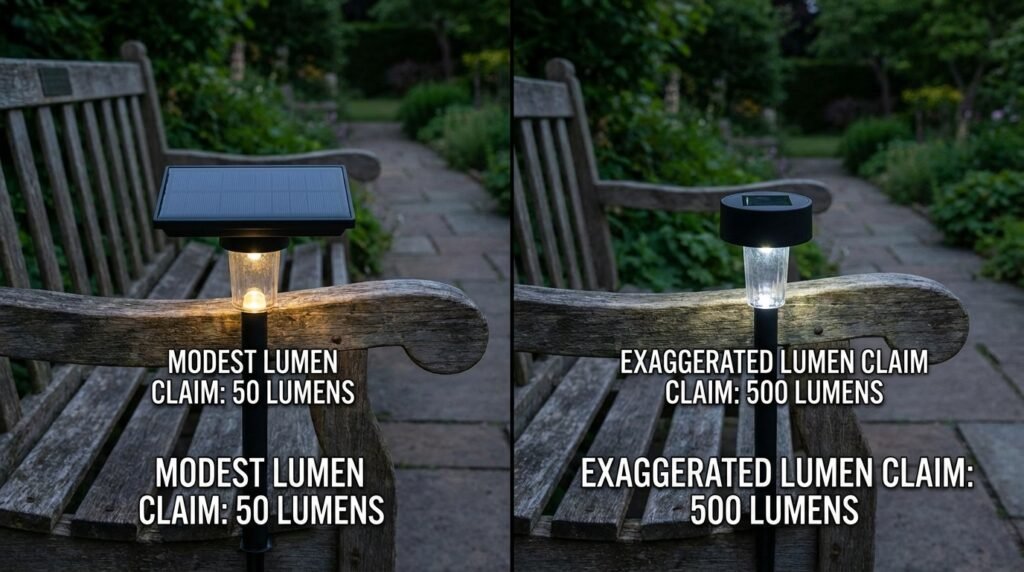
- “1000+ lumens” on a tiny stake light: Most of these are peak burst numbers, not sustained output. The battery can’t support it for long, so it sags fast.
- Sealed battery with “non-replaceable” wording: Translation: “We sell a new set next year.”
- All-caps waterproof claims, no IP rating: That’s not a spec; that’s shouting.
- Ultra-cheap multi-packs with identical generic photos: You’re buying the lowest-bid internals. Expect a high failure rate and mismatched color output across units.
Bottom line: longevity comes from honest engineering, not aggressive adjectives.
Buying strategy: what I’d do with my own money
If you want long-lasting solar path lights, buy like a mildly paranoid engineer:
Step 1: Decide the job (marking vs lighting)
Marking a path is different from lighting a patio. For safe navigation, you want reliable low-level illumination and good placement. For deals and realistic expectations, this no-BS deals guide is worth a read.
Step 2: Filter hard on serviceability
- Replaceable battery (non-negotiable if you hate waste).
- Spare parts vibe: screws, gaskets, standard cells. If it looks repairable, it usually is.
- Warranty clarity: vague warranty language often matches vague build quality.
Step 3: Buy fewer, better units (then add more)
Start with 4–6 good lights, not 16 questionable ones. Evaluate after a few weeks—especially after rain. Then scale.
Step 4: Use Amazon search links the safe way (no dead listings)
I can’t verify which exact SKUs are in stock right now, so here are safe Amazon search links. Use them to compare options that match the specs we just covered (replaceable battery, credible IP rating, better materials).
My personal rule: if a listing doesn’t show the battery compartment or mention replaceable cells, I assume it’s disposable unless proven otherwise.
Frequently Asked Questions
Are expensive solar path lights automatically longer-lasting?
No. Some expensive models are genuinely better built. Others are just the same internals in a nicer hat. Pay for sealing, serviceability, and real materials—not a fancy product photo.
What battery type lasts longer in solar path lights: NiMH or lithium-ion?
Either can last, either can fail. In small lights with simplistic charging, NiMH often survives abuse better. Lithium-ion can be excellent but is more sensitive to heat and poor charge control. The best predictor is a replaceable, standard-size battery plus a light that doesn’t trap water.
How bright should solar path lights be for a typical walkway?
Most walkways need “guidance,” not floodlighting. Think glare-free markers spaced consistently. If you’re choosing between two models and one claims absurd lumens with a tiny panel, take the modest-claim unit and sleep better.
What IP rating should I look for if I want them to survive rain and sprinklers?
Aim for IP65 from a manufacturer that appears competent. IP44 can work in gentle conditions, but sprinklers and sideways rain are brutal. Moisture intrusion is the silent killer that makes lights flicker, corrode, and die early.
Why do solar path lights die after one winter?
Winter exposes everything: weak seals, condensation cycles, corrosion, and batteries that hate cold. If your lights died after winter, it wasn’t bad luck—it was a design that couldn’t handle real outdoor life.
Bottom line
Here’s the truth: if you want to know how to choose long-lasting solar path lights, stop shopping by lumens and start shopping by serviceability, sealing, and energy reality. Replaceable standard batteries, credible IP ratings, corrosion-resistant hardware, and sensible brightness claims beat flashy listings every time.
Do that, and your path lights won’t become next season’s landfill décor.
Now go buy fewer, better lights—and when you see “1000000 LUMENS!!!” on a stake light with a thumbnail-sized panel, laugh gently and keep scrolling. That’s my personal sign-off.
As an Amazon Associate, I earn from qualifying purchases.