
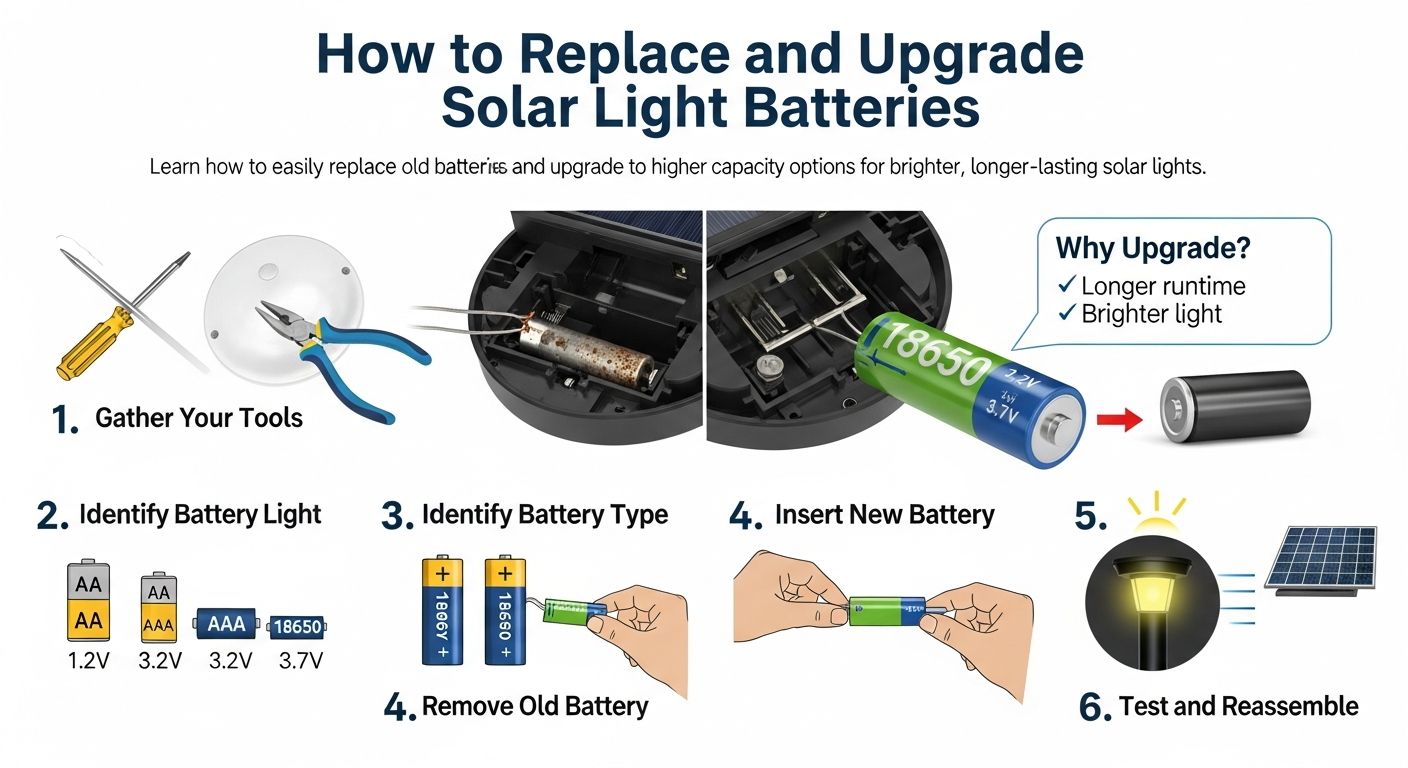
How to Replace and Upgrade Solar Light Batteries 101
Here’s the brutal truth: manufacturers ship solar lights with “demo mode” batteries. If your garden looks like a dim runway within three months of purchase, it’s rarely the solar panel’s fault; you just need to know how to replace and upgrade solar light batteries correctly.
Most people toss perfectly good fixtures into the landfill because they assume the “solar part” is broken. It’s not. The battery is just exhausted. But before you run to the store, stop. Buying the wrong chemistry or voltage can fry your circuit board or start a small fire. Let’s fix this properly.
Table of Contents
- The “Dirty Secret” of OEM Batteries
- Chemistry & Voltage: Don’t Burn Your House Down
- The Upgrade Strategy: NiCd vs. NiMH
- Step-by-Step Replacement Guide
- The Lithium Trap (Read Before Buying)
- Frequently Asked Questions
The “Dirty Secret” of OEM Batteries
When you buy a set of solar path lights, you aren’t paying for high-end energy storage. You are paying for the plastic housing and the LED.
To replace and upgrade solar light batteries, you must identify the current voltage and chemistry (usually NiCd or NiMH 1.2V), open the housing using a small Phillips screwdriver, clean the contact points of any corrosion, and insert a new rechargeable battery with a higher mAh rating for longer runtime. Never use standard alkaline batteries.
The stock batteries included in most box-store lights are usually 400mAh to 600mAh NiCd (Nickel Cadmium). That is pitifully low. It’s enough capacity to keep the light on for maybe 3 hours after a full charge. Worse, NiCd batteries suffer from the “memory effect,” where they lose maximum energy capacity if they aren’t fully discharged before recharging.
Since solar lights charge and discharge randomly based on cloud cover, NiCd batteries are doomed to fail quickly. This is why your lights are dim.
Chemistry & Voltage: Don’t Burn Your House Down
This is where 90% of people mess up. You cannot just grab any rechargeable battery and shove it in. You need to match the Voltage, even if you upgrade the Capacity (mAh).
Check the side of your old battery. You will see one of these three distinct types:
- NiCd (Nickel Cadmium): 1.2 Volts. The old standard. Toxic and low capacity.
- NiMH (Nickel Metal Hydride): 1.2 Volts. The modern standard. Higher capacity, eco-friendly, no memory effect. This is your target upgrade.
- Li-Ion (Lithium-Ion): 3.2V or 3.7V. These are for high-output lights.
Warning: If you put a 3.7V Lithium battery into a light designed for a 1.2V NiCd, you will instantly burn out the LED driver. The light will flash bright once and then die forever. Conversely, putting a 1.2V battery in a Lithium slot will do absolutely nothing.
If you’ve checked your current setup and realized the fixtures themselves are cracked or water-damaged, no battery will save them. It might be time to look at some solar path lights design inspiration that pros actually use to modernize your yard instead of fighting a losing battle.
The Upgrade Strategy: NiCd vs. NiMH
If your light uses 1.2V batteries (AA or AAA size), the single best upgrade you can make is swapping the old NiCd for a high-capacity NiMH.
Here is why NiMH wins:
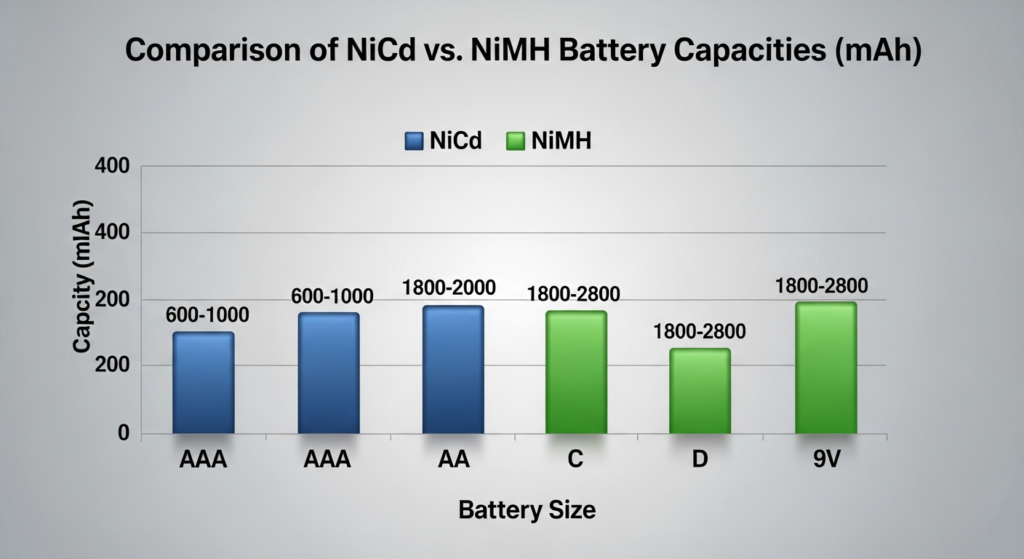
- Capacity (mAh): Think of milliamp-hours (mAh) as the size of your gas tank. Old batteries are 500mAh. A good Eneloop or AmazonBasics NiMH is 2000mAh+. That is 4x the runtime.
- Winter Performance: NiMH handles temperature fluctuations better than NiCd.
- No Memory Effect: They don’t mind the partial charges typical of cloudy days.
According to Battery University, NiCd batteries are environmentally hazardous due to toxic cadmium, making NiMH not just a performance upgrade, but an environmental one.
Step-by-Step Replacement Guide
Ready to perform surgery? Here is the workflow I use when refurbishing client landscapes.
1. The Setup
Bring the lights inside. You need a clean workspace. Grab a small Phillips head screwdriver, a stiff toothbrush (or wire brush), and a can of electrical contact cleaner.
2. Open the Housing
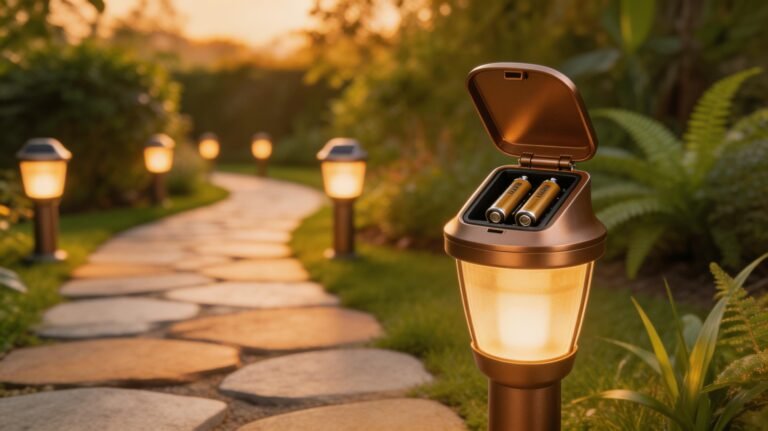
Most solar tops twist off. If there are screws, they are usually small and prone to stripping. Apply firm downward pressure while turning. Be careful: The wires connecting the solar panel to the battery housing are often hair-thin. If you yank the top off, you’ll rip the solder points.
3. Clean the Contacts (Crucial Step)
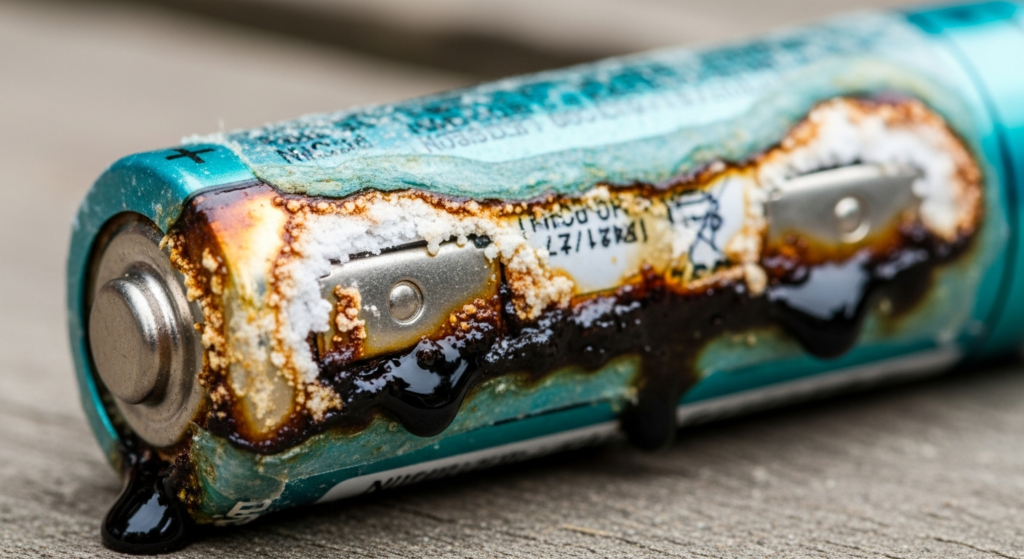
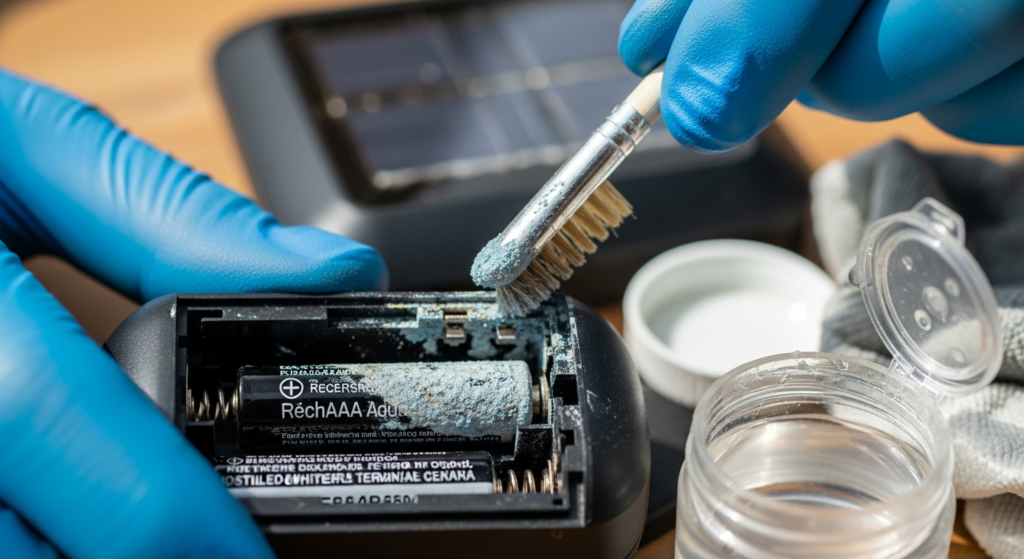
If the old battery leaked, you’ll see white or green crust on the metal springs. This is corrosion, and it insulates the connection. Even a brand new battery won’t work if the current can’t flow.
Scrub the contacts with the toothbrush and a little vinegar or contact cleaner. If the corrosion is severe, use fine-grit sandpaper.
4. Install and Seal
Pop the new NiMH battery in. I recommend adding a tiny dab of dielectric grease to the terminals to prevent future corrosion—a trick noted by marine mechanics and technical standards for humid environments.
Pro Tip: Cover the solar panel with your hand or lay it face down on the table to simulate night. The light should turn on immediately. If it doesn’t, check the On/Off switch.
The Lithium Trap (Read Before Buying)
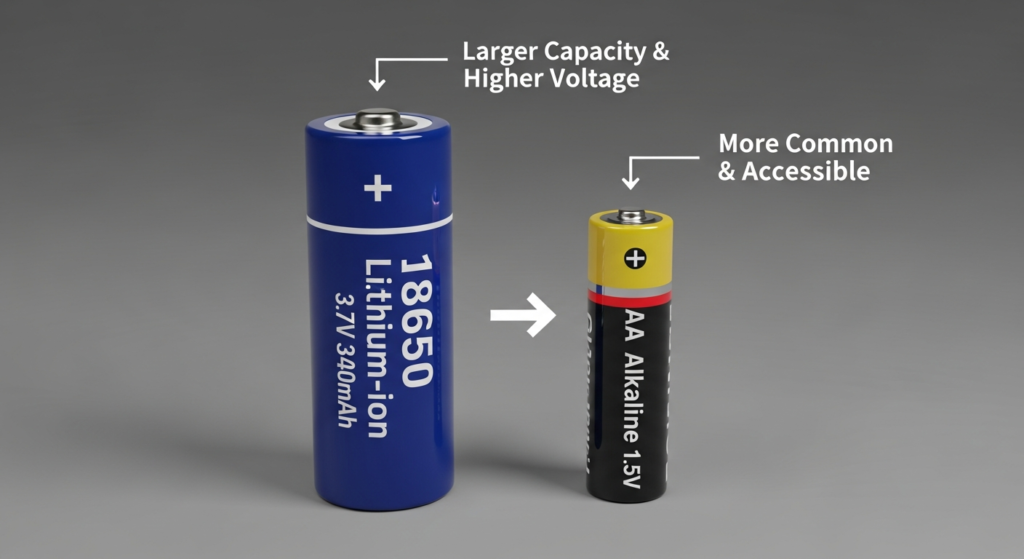
High-end spotlights often use Lithium Iron Phosphate (LiFePO4) or Lithium-Ion batteries. These look like AA batteries but are slightly different sizes (like the 14500 or 18650 cells).
Do not guess here. Lithium batteries are volatile. If your manual specifies a 3.2V 14500 battery, you must replace it with exactly that. Upgrading these is trickier because the solar panel and charge controller are tuned to a specific voltage curve.
If you are dealing with complex Lithium setups that are failing, it might be more cost-effective to check our comprehensive buyers guide and reviews. Sometimes, newer integrated LEDs with better thermal management are a smarter buy than sourcing obscure lithium cells.
Why Is It Still Dark?
You swapped the battery, cleaned the contacts, and… nothing.
Check the solar panel surface. If the plastic covering the panel has turned milky white (UV damage), it can’t let light through to charge the battery. You can try polishing it with automotive headlight restorer, but usually, that’s the end of the line for the fixture. Also, ensure the fixture isn’t placed in deep shade—Energy.gov reminds us that even the best batteries need direct sunlight to function efficiently.
Frequently Asked Questions
Q: Can I use regular alkaline batteries in my solar lights? A: No. Never. Alkaline batteries are not designed to take a charge. They will get hot, leak acid, and ruin your light permanently. Stick to Rechargeable NiMH or NiCd.
Q: Will a higher mAh battery make my light brighter? A: No. Brightness is determined by the LED and the voltage. Higher mAh (Capacity) just means the light will run longer. It’s the difference between a small gas tank and a large one; the engine (LED) runs at the same speed regardless.
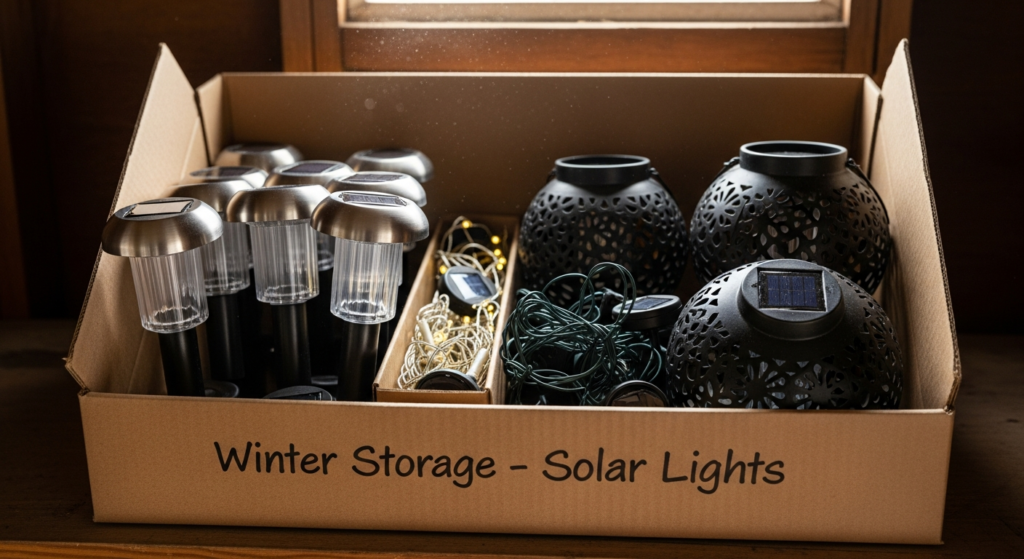
Q: Should I bring my solar lights inside for winter? A: If you live in an area with heavy freeze/thaw cycles, yes. Freezing temps can degrade battery chemistry and crack plastic housings. Store them with the switch in the “OFF” position.
Bottom Line
Replacing solar light batteries isn’t rocket science, but it does require attention to detail. Stop buying cheap bulk packs that die in a month. Spend the extra few dollars on high-capacity NiMH replacements, clean your contacts, and you’ll likely get another 2-3 years out of your existing fixtures.
Now, go grab a screwdriver and bring those lights back from the dead.
As an Amazon Associate, I earn from qualifying purchases.


One Comment
Comments are closed.