
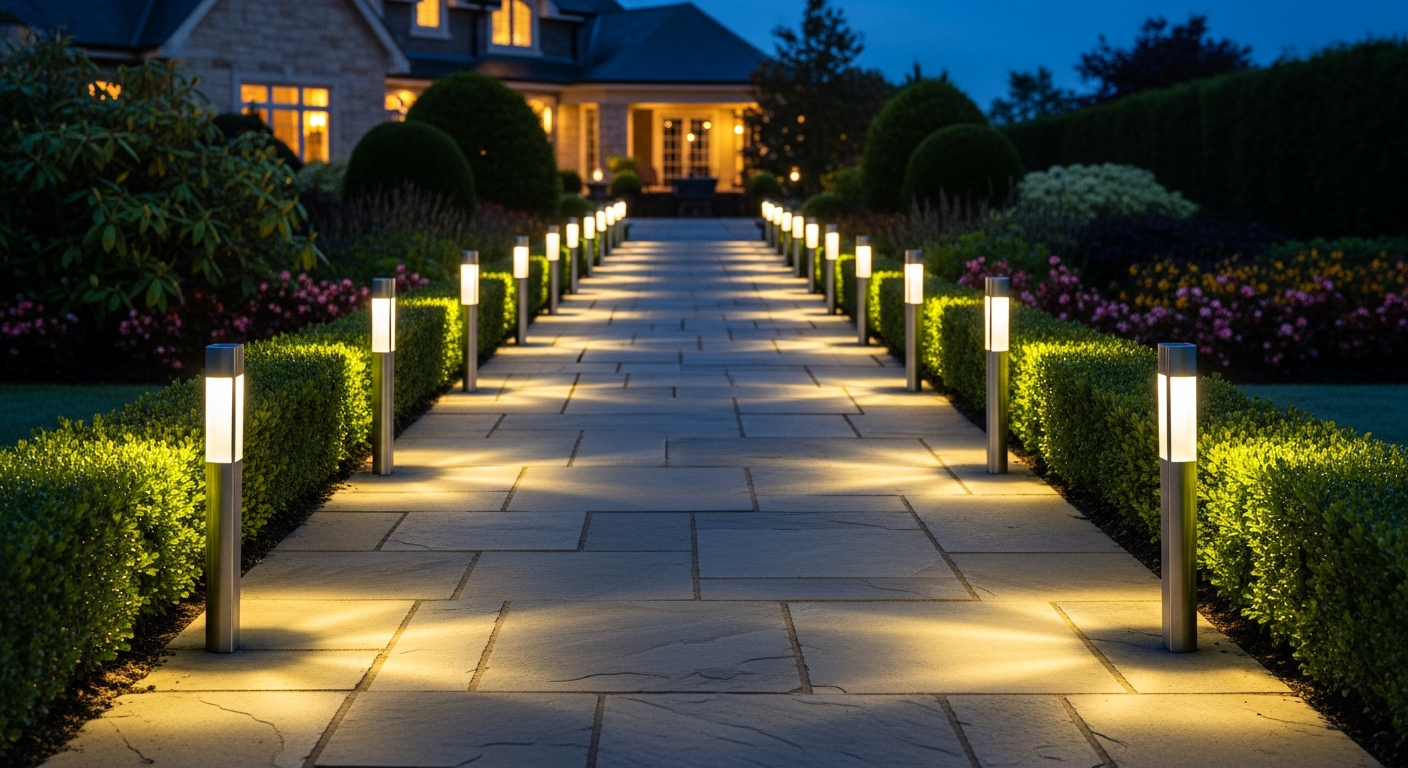
Solar Path Light Layout Ideas for Walkways With Perfect Spacing
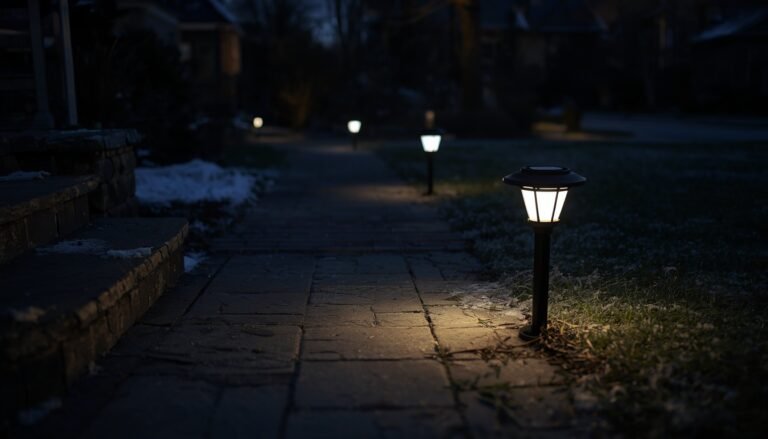
Solar path light layout ideas for walkways aren’t about slapping lights in the ground and hoping for magic. The problem is most walkways look worse after lighting—glare in your eyes, dark gaps underfoot, and fixtures that die after one winter. I’ve seen it too many times.
Here’s the truth: layout beats hardware. You can buy premium fixtures and still end up with a poorly lit mess if spacing, angle, and symmetry are wrong.
Table of Contents
- Why Layout Matters More Than Brightness
- The Spacing Math Pros Actually Use
- One Side vs Both Sides: What Works
- Beam Control, Glare, and Real Safety
- Choosing Fixtures That Match the Layout
- Common Walkway Lighting Mistakes
- Frequently Asked Questions
Why Layout Matters More Than Brightness
Quick answer: The best walkway layouts use controlled, overlapping pools of light spaced for human vision—not maximum lumens—creating consistent visibility without glare or wasted fixtures.
Fast forward past the marketing claims. Human eyes don’t need stadium lighting to walk safely. According to the U.S. Department of Energy, uniform illumination matters more than raw brightness for outdoor safety.
Bottom line: Bad layouts create contrast extremes—bright spots next to darkness. Good layouts create continuity.
If you want inspiration beyond cookie-cutter installs, this deep dive on professional solar lighting design patterns shows how real-world projects avoid the rookie mistakes.
The Spacing Math Pros Actually Use
This is where most DIY installs fall apart.
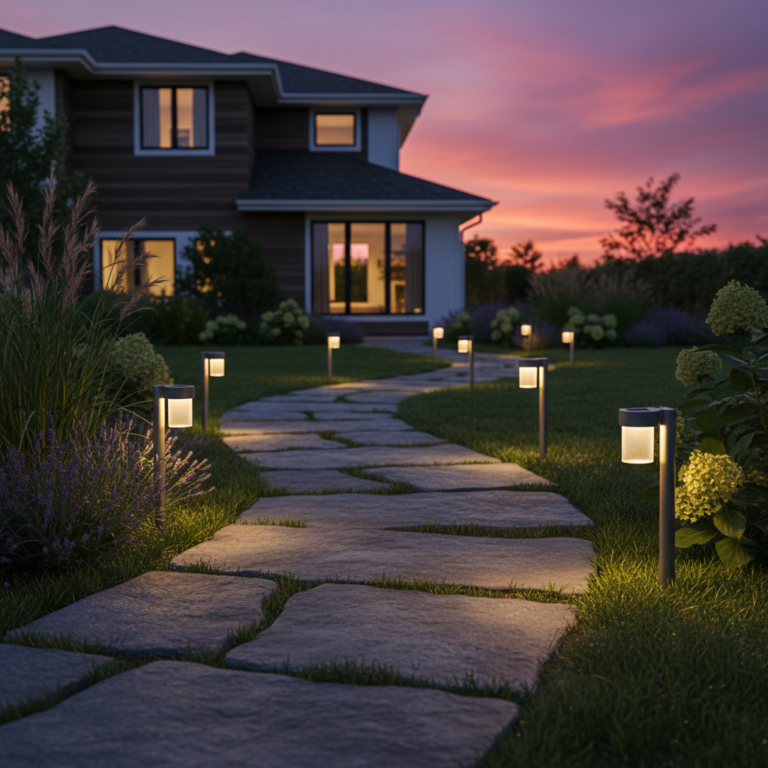
Rule of thumb: 6–10 feet between lights. But that’s just the starting point.
- Low-output lights (10–20 lumens): 4–6 ft spacing
- Mid-output lights (30–60 lumens): 6–8 ft spacing
- High-output lights (80+ lumens): 8–10 ft spacing
The Illuminating Engineering Society (IES) recommends low-level, even lighting for pedestrian paths to reduce trip hazards without glare. You can dig into their research via summaries on Wikipedia’s pathway lighting overview.
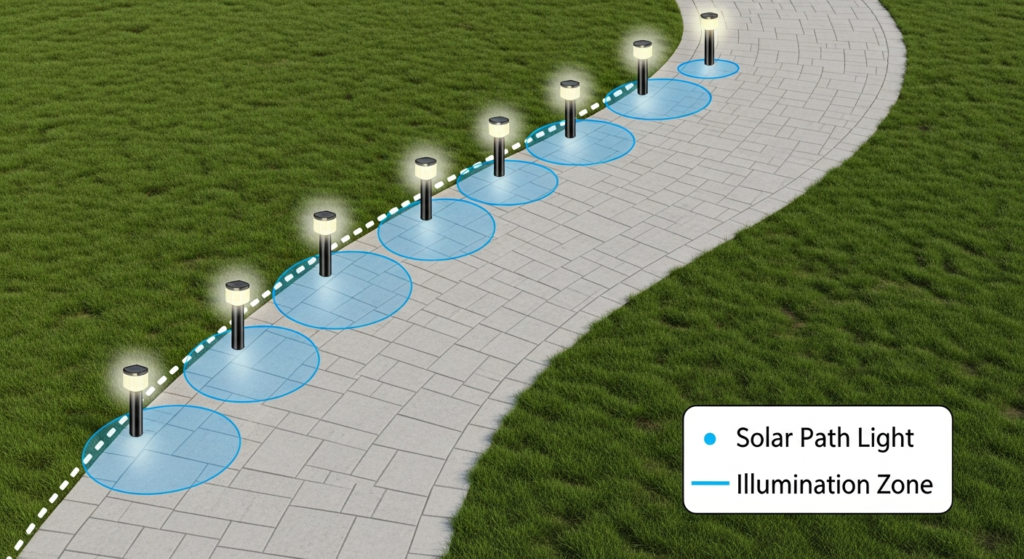
One-sentence truth: If your shadows look striped, your spacing is wrong.
One Side vs Both Sides: What Works
Both sides looks great on Pinterest. In real life? It’s often overkill.
Single-side staggered layouts are my default recommendation. Offset each fixture slightly forward or back to eliminate shadow bands.
Double-sided layouts make sense when:
- The walkway is wider than 48 inches
- You’re lighting a formal entrance
- You want visual symmetry more than cost efficiency
For installation planning details—depth, soil prep, and orientation—this guide on solar lighting installation fundamentals fills in the gaps most blogs skip.
Beam Control, Glare, and Real Safety
Here’s where cheap lights suck.
Clear lenses with wide dispersion throw light sideways and upward. That kills night vision and annoys everyone.
What actually works:
- Downward-facing lenses
- Frosted or diffused covers
- Defined beam cutoff at ankle height
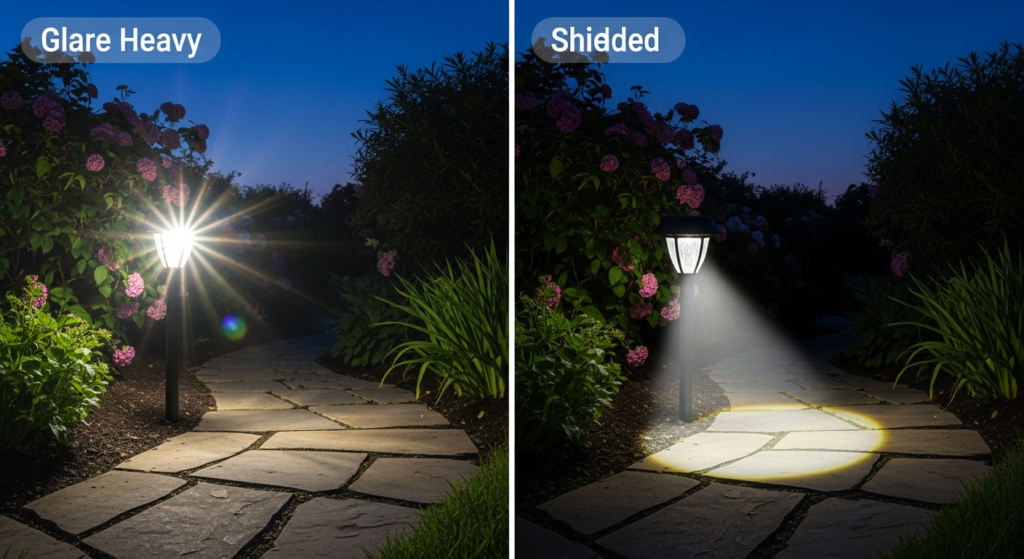
Studies referenced by the U.S. National Park Service show glare reduction improves depth perception at night. That matters on uneven stone or brick paths.
Choosing Fixtures That Match the Layout
Layout dictates fixture choice, not the other way around.
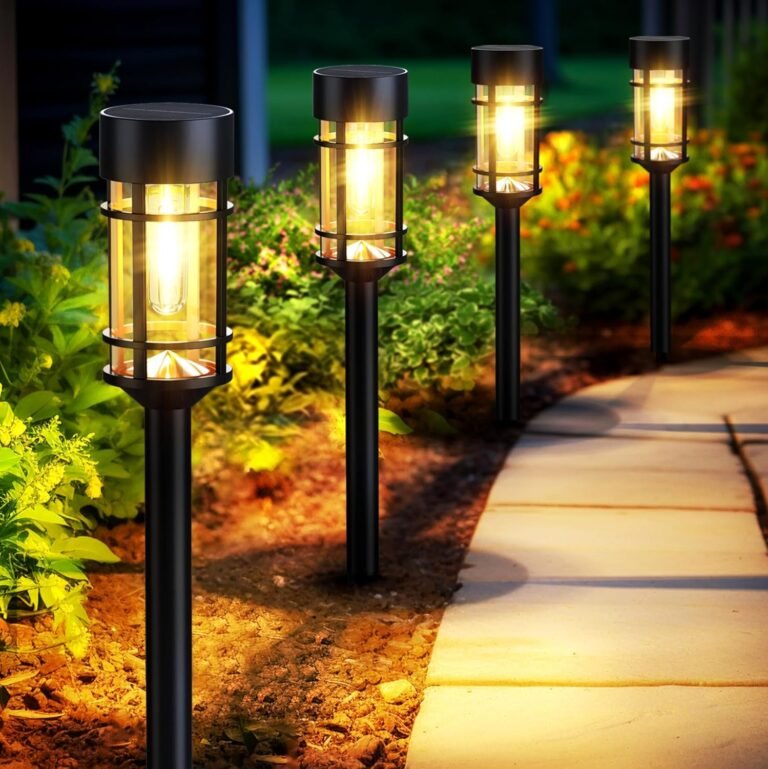
For straight concrete paths: Slim post lights with narrow beams.
For curved garden walkways: Dome-top or lantern-style with soft diffusion.
If you’re curious how newer tech affects layout flexibility, this breakdown of modern solar lighting upgrades explains why better batteries and optics matter.
Common Walkway Lighting Mistakes
I’ll keep this blunt.
- Over-lighting every 2 feet
- Mixing fixture styles randomly
- Ignoring winter sun angles
- Installing without a night test walk
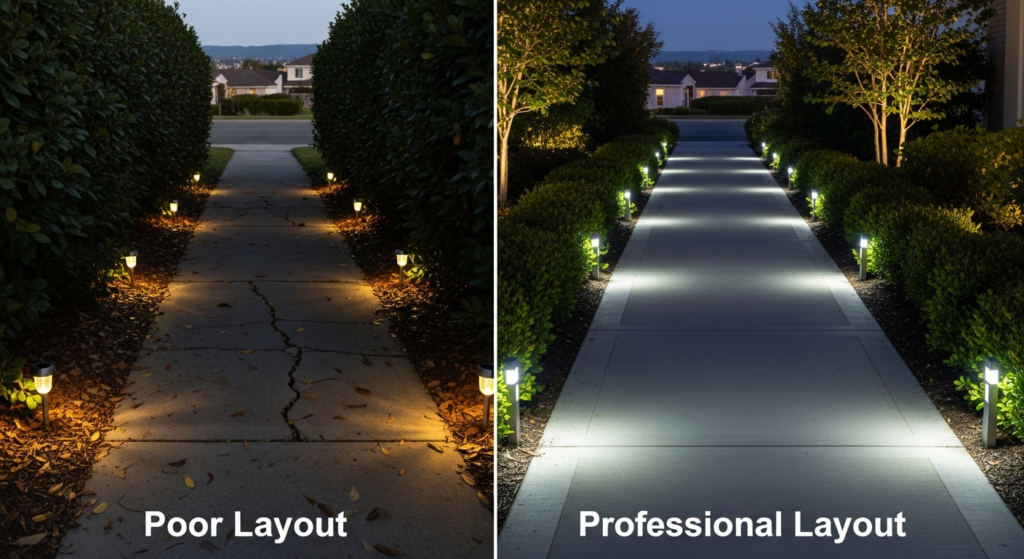
Bottom line: Walk your path at night before locking anything in.
Frequently Asked Questions
These come up every time.
How far apart should solar path lights be?
Start at 6–8 feet and adjust based on brightness and beam control.
Is more lumens always better?
No. Controlled light beats brightness. Glare ruins visibility.
Do solar lights work in shaded walkways?
Partial shade is fine. Full shade is a non-starter unless panels are remote.
Can I mix solar and low-voltage lighting?
Yes, but keep visual consistency or it looks hacked together.
Final takeaway: Great solar path light layout ideas for walkways come down to spacing discipline, beam control, and restraint. Light the ground—not the night sky. If you finish your install and it feels invisible, you did it right.
As an Amazon Associate, I earn from qualifying purchases.

One Comment
Comments are closed.