Solar Light Batteries: 7 Smart Fixes for Costly Mistakes
Solar light batteries are worth replacing when the fixture is sound, the charging panel receives enough sunlight, and a compatible fresh cell restores useful runtime. Buying the largest number on the wrapper before checking those conditions can leave you with the same dark path and another packet of unused batteries.
When choosing solar light batteries, start by photographing the original cell and finding the light’s model number. Match the specified chemistry, nominal voltage, physical size and terminal arrangement before considering capacity. Then test one light through several normal charging days before ordering enough cells for the whole garden.
The seven checks below separate a worn battery from poor charging, explain the numbers that matter, and help you decide when a repair is sensible. They apply to user-serviceable garden and pathway lights; sealed packs need the manufacturer’s replacement procedure.
Affiliate disclosure: As an Amazon Associate, I earn from qualifying purchases. Product choices below are based on published specifications, not hands-on testing.
Table of Contents
1. Identify solar light batteries before buying replacements
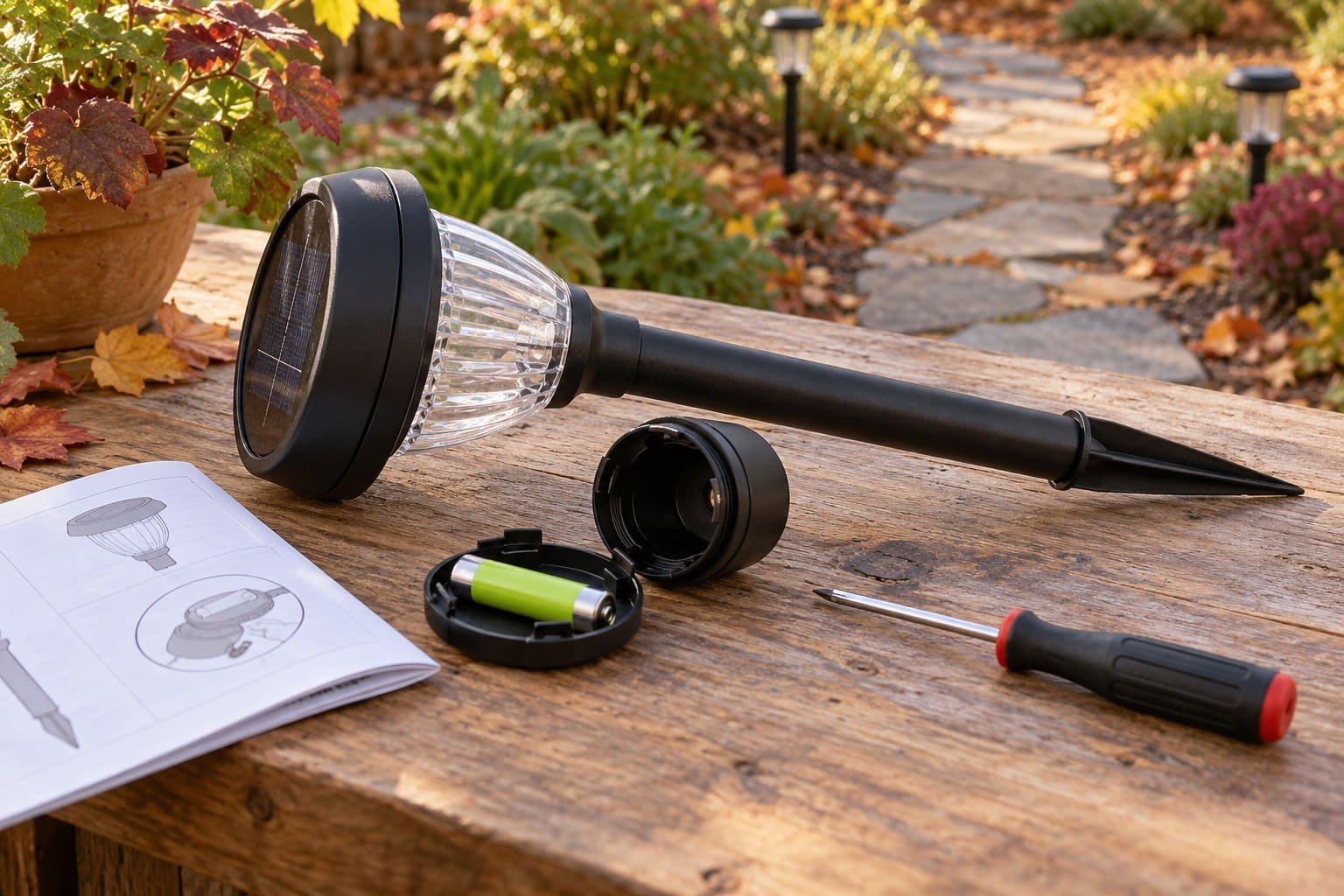
Take the light to a dry table and switch it off according to its manual. Open only the compartment intended for routine battery replacement. A removable stake or decorative lens does not necessarily mean the rechargeable pack inside is serviceable.
Write down the complete label, including any letters after the size. AA, AAA and shortened formats are different purchases. A cell that almost fits can strain the contacts or stop the cover sealing properly. For wired packs, the connector and polarity also need to match.
Read solar light batteries by chemistry, voltage and size
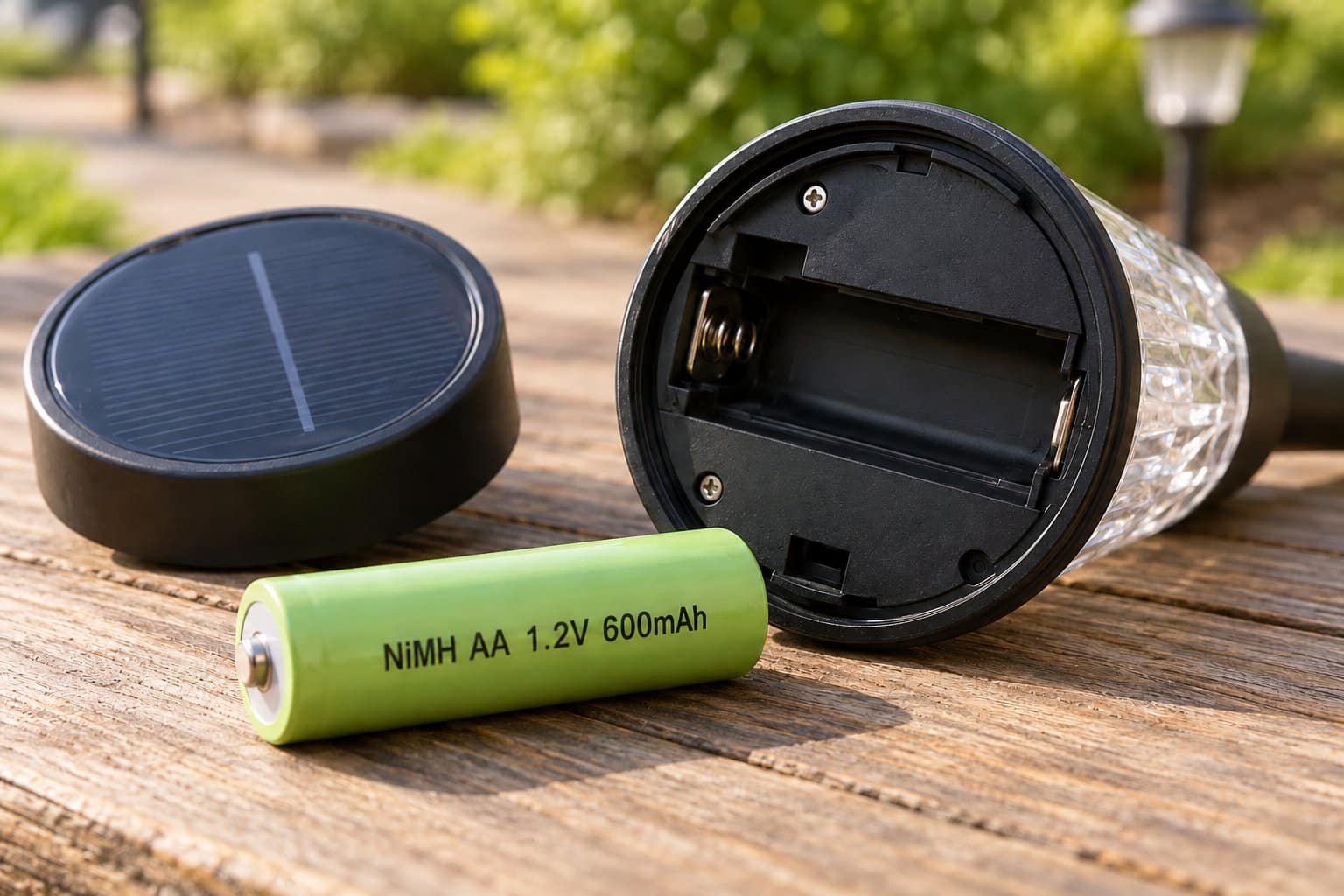
A label such as “NiMH AA 1.2V 600mAh” identifies nickel-metal hydride chemistry, AA size, 1.2-volt nominal voltage and 600 milliamp-hours of rated charge capacity. Those details belong together. “Rechargeable AA” alone leaves too much undecided.
Do not assume a similar-looking lithium cell is an upgrade. A light designed around 1.2V NiMH requires its specified compatible battery, not a different chemistry chosen because it fits. If the original label is unreadable, use the model’s manual or ask the manufacturer rather than copying a neighboring fixture.
Older NiCd lights need particular care. Some solar battery makers offer NiMH replacements for these applications, but that is not approval for every charging circuit. Follow the light manufacturer’s compatibility advice. Our guide to lights with replaceable batteries explains what to look for when buying a serviceable fixture.
2. Test the light before blaming the battery
One dark fixture in an otherwise working row is a useful clue, but it is not a diagnosis. Compare its position, switch setting and panel cleanliness with a working light of the same model. A shrub can shade one panel while every other unit charges normally.
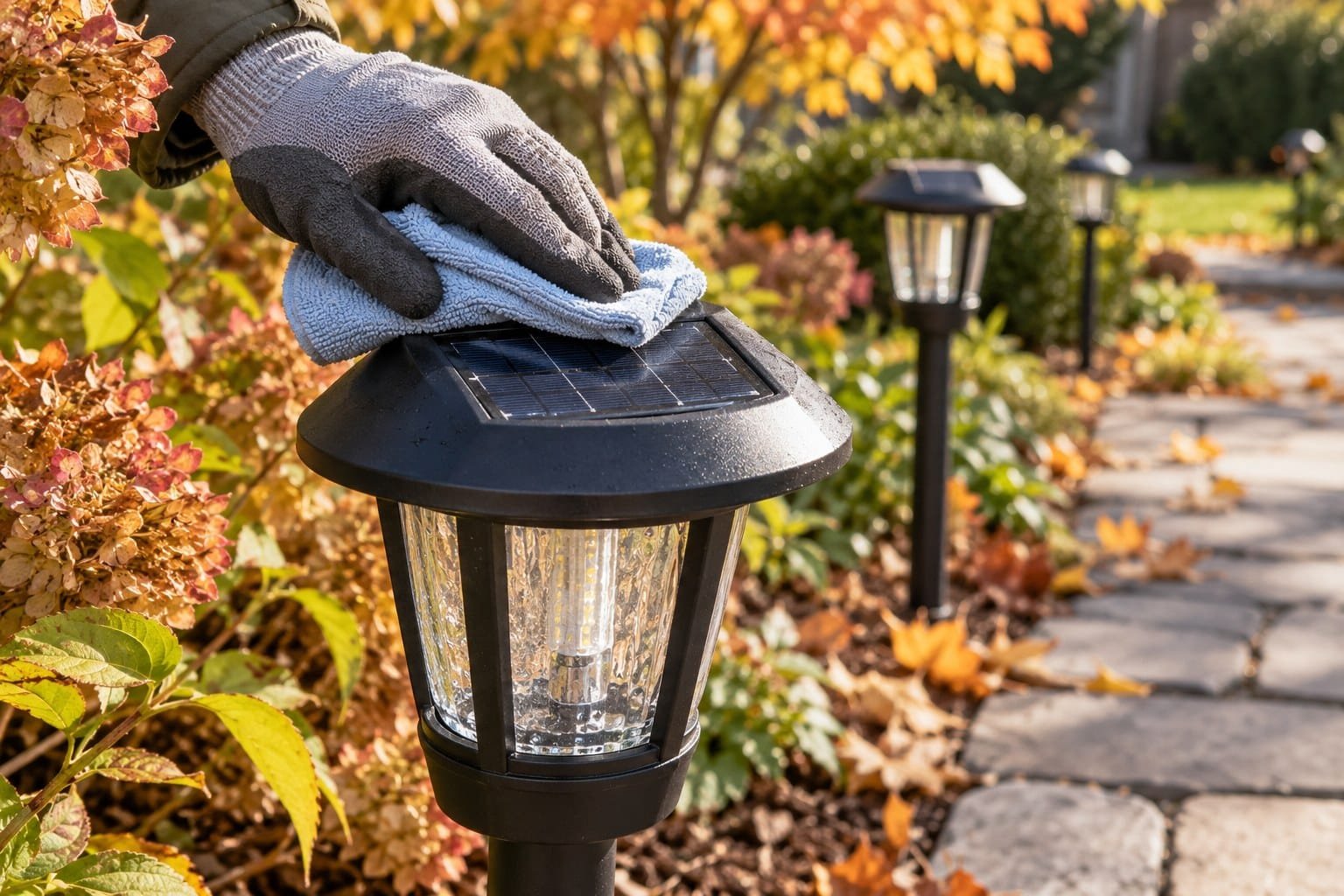
Clean the panel gently using the method permitted by the manual. Remove loose leaves and check whether a nearby porch lamp keeps the dusk sensor exposed to light. Covering the appropriate sensor can check whether the LED switches on, but it cannot prove that a battery retains adequate capacity overnight.
For solar light batteries in identical, undamaged, user-serviceable fixtures, a controlled swap can be informative. Use only cells with matching specifications. Label the lights A and B, keep their settings equal, and observe whether the short runtime follows the battery or remains with the fixture.
If the problem follows the cell, battery deterioration becomes more likely. If it stays with the light, inspect the charging position and contact condition before buying replacements. This is a practical comparison, not a laboratory capacity measurement; different charge levels can still affect the first result.
Skip the swap if either compartment contains liquid, leaking residue or damaged wiring. Do not put an otherwise good battery into a visibly compromised fixture. For problems affecting the whole row, start with our solar light troubleshooting guide.
3. Choose capacity for the charging conditions
For solar light batteries, capacity tells you how much charge a battery is rated to hold under stated conditions. It does not tell you how much energy today’s sunlight will deliver, how efficiently the light operates, or whether the LED driver can maintain its brightness. Larger capacity alone is not a brightness setting.
Consider a deliberately simplified example: a 600mAh cell supplying a constant 60mA would give 10 hours by division. That is arithmetic, not a runtime prediction. Real solar light batteries encounter changing voltage, conversion losses, temperature effects and a circuit cutoff before every nominal milliamp-hour becomes useful light.
Now imagine replacing that cell with 1200mAh. Its nominal storage capacity doubles, but the panel has not doubled. If the light spends each night using more energy than the next day replaces, both cells eventually run short. A larger cell can provide reserve when adequately charged; it cannot create a daily energy surplus.
A partly charged high-capacity battery is not automatically harmful just because it is not full. The relevant question is whether the entire light, battery and charging circuit are compatible and provide the runtime you need. Avoid universal panel-to-capacity rules without the manufacturer’s electrical specifications.
The conservative purchase is the original specified capacity or an explicitly approved alternative. For solar light batteries in persistently shaded positions, improving panel exposure may produce a better result than spending more on capacity. See our planning guide for solar path lights in shade before replacing an entire set.
Check temperature specifications separately from capacity. Tenergy lists a working range of −4°F to 122°F for its Solla AA cells. That published operating range does not establish a universal safe charging temperature for every light or battery. If your winters approach the limits, ask for the fixture’s charging restrictions and follow them.
For solar light battery replacement, keep a short purchase record: fixture model, approved cell, installation date and the result of your first runtime comparison. Save the manual with that record. When rechargeable batteries for solar lights fade again, you can distinguish a repeated charging problem from a different batch or a changed setting. This also makes a warranty enquiry more precise and prevents ordering incompatible solar light batteries next season.
4. Compare three compatible replacement options
The products below exist in manufacturer catalogs and Amazon listings. Choose only the one whose specifications your fixture allows. AA and AAA options are alternatives for different compartments, not interchangeable performance grades. Check the selected pack and seller before ordering; no price or delivery promise is assumed here.
Tenergy Solla AA: for approved 1.2V AA applications
Tenergy Solla AA 1000mAh rechargeable batteries, 12-pack are worth considering when your light accepts 1.2V NiMH AA cells at this capacity. The manufacturer specification identifies the chemistry, voltage and capacity, making compatibility easier to check than with an unmarked multipack.
Tenergy Solla AAA: for smaller battery compartments
Tenergy Solla AAA 600mAh rechargeable batteries, 12-pack suit fixtures specifying this smaller 1.2V NiMH format. They provide a clearly specified option when an AA recommendation would be physically wrong; verify capacity approval in your light’s manual.
EBL AAA: an alternative for a larger matching set
EBL AAA 600mAh rechargeable solar batteries, 20-pack are another option for compatible 1.2V NiMH AAA fixtures. A larger packet can make sense for a long row, but test a small number first rather than assuming every dark light has the same fault.
Check the EBL product specification against the selected listing variant. Packaging and pack counts can differ. Manufacturer longevity claims do not establish how many years these solar light batteries will last beside your particular path.
Buy for the lights you intend to repair, with a modest spare allowance. A large packet is poor value if the remaining fixtures have cracked housings or use a different cell. Calculate delivered cost per compatible cell, including any minimum order that would leave unwanted stock.
5. Replace solar light batteries without losing the seal
Work on one fixture at a time. Photograph the battery orientation and keep the screws and cover together in a tray. Read the molded polarity marks in the actual compartment; a product photo or a spring’s location is not a reliable substitute.
Remove the old cell as directed, keeping metal tools away from its terminals. Look for a displaced gasket, broken clips or dirt sitting across the sealing surface. If the housing cannot close correctly, new solar light batteries will not solve the underlying exposure problem.
For a clean, dry compartment, fit the approved replacement and confirm that it sits without force. With multiple cells inside one light, follow the manual on replacing them as a matched set. Do not mix old and new cells or different chemistries within that fixture.
Ordinary disposable alkaline batteries do not belong in a solar charging circuit. Tenergy’s rechargeable battery guidance warns against recharging normal alkaline cells and explains why matched cells matter. Do not use an alkaline as a quick outdoor test and then forget it inside the light.
Refit the gasket and cover as designed, then return the switch to the required operating position. Do not add improvised sealant over vents, drainage openings or removable lids. If water entered previously, use our checks for solar lights failing after rain to investigate the cause before returning the fixture outside.
The video shows the general idea of accessing a garden light’s battery compartment. Your model’s manual controls the opening method, polarity and replacement specification. A visual demonstration does not establish compatibility with your fixture.
6. Measure useful runtime over several nights
New solar light batteries can arrive with some charge already stored. A good first evening therefore proves that the LED can run, not that your panel can replace the energy it uses. Watch what happens after several ordinary day-and-night cycles.
Use a simple log: charging position, weather, operating mode, switch-on time and the last time the path remained usefully visible. Check at consistent times rather than estimating from a glance through the window. A faint LED glow is different from enough illumination to see a paving edge.
For example, observe a repaired light at dusk, two hours later and near the end of your usual evening use. If it fades progressively over comparable days, the panel or charging conditions may be unable to sustain that setting. If it performs well after sun but poorly after cloud, daily charging remains part of the explanation.
These observations cannot isolate every electrical fault. They do, however, give the manufacturer a more useful description than “new batteries do not work.” Include the original and replacement labels, fixture model, settings and the weather pattern when seeking support.
Do not compare a bright summer evening with a shaded autumn day and call the difference battery failure. Our winter solar light guide explains seasonal charging checks. Where a path must remain usable late at night, provide reliable backup lighting rather than relying on a battery label or an advertised maximum runtime.
Give solar light batteries a specific job in your test: lighting the route until your household’s last regular arrival. Record whether that target is met after sun and after cloud. This turns an impressive maximum-runtime claim into a practical decision about the lighting your entrance actually needs.
7. Decide whether to repair, store or replace the light
Replacing solar light batteries is sensible when the lens, panel, housing and seals are sound, the correct cell is available, and your test shows useful improvement. Stop buying batteries when a cracked cap, failed switch or damaged panel remains the limiting component.
Use a repair budget rather than comparing only cell prices. In an illustrative calculation, eight approved cells at $2 each cost $16. Add $6 shipping and the repair becomes $22 before your time. Those are example inputs, not current product prices; substitute the actual delivered quote and the number of serviceable fixtures.
Compare that total with a replacement set that meets your requirements for battery access, panel exposure and usable runtime. Replacing a repairable fixture is wasteful, but repeatedly feeding batteries into a water-damaged housing is not an economical maintenance plan either.
If the manual recommends seasonal storage, clean and dry the lights first and follow its battery removal instructions. Keep loose cells separated from metal objects. Our winter storage guide covers the practical preparation.
Retired solar light batteries need an appropriate collection route. The U.S. EPA’s household battery guidance says rechargeable batteries should not enter household trash or municipal recycling bins. It recommends protecting terminals with nonconductive tape or placing batteries separately in plastic bags; check local collection instructions, especially for damaged cells.
Questions about solar light batteries
Can I use regular AA batteries in solar lights?
Do not leave ordinary disposable AA batteries in a solar charging circuit. Use the rechargeable chemistry, voltage and size specified by the manufacturer. Physical fit does not make an alkaline battery suitable for recharging.
Can I put higher-mAh solar light batteries in my lights?
Only when the replacement remains compatible with the fixture’s charging system and approved specifications. Higher capacity can increase stored reserve, but it does not increase the solar panel’s daily output or guarantee longer light every night.
Why do solar lights stop working after new batteries?
Check polarity, switch position, contacts, panel exposure and sensor interference. A precharged replacement may work initially and then fade if the panel does not replenish its charge. Water damage or a failed charging circuit can also remain unresolved.
Are AA and AAA solar light batteries interchangeable?
No. They have different physical dimensions. Match the exact size, nominal voltage, chemistry and terminal arrangement specified for your light. Do not force a larger cell into the compartment or improvise spacers for a smaller one.
How long should rechargeable solar light batteries last?
There is no reliable lifespan that applies to every fixture. Chemistry, charging control, temperature and water exposure affect service life. Judge replacement need by a controlled runtime comparison and manufacturer guidance rather than a universal annual replacement rule.
Should I replace every battery in the garden at once?
Not necessarily. Diagnose individual fixtures first. Within a light that uses multiple cells, follow the manual’s matched-set instructions. Separate single-cell lights can be repaired individually, then compared under similar charging conditions before you buy a larger packet.