Solar Christmas Lights: 7 Proven Checks for Brilliant Nights
Solar Christmas lights look effortless on the box: no cords, no outlet, a warm glow from dusk until bedtime. Then mid-December arrives, the sun barely clears the neighbor’s roof, and the display fades before the first guests have parked.
The fix is rarely a pricier brand. It is matching the display to the sunlight your yard actually receives, the cold your battery can tolerate and the hours you genuinely need light. The seven checks below take about an hour spread across one weekend. They tell you whether solar Christmas lights can carry your display through the shortest days, or whether part of it belongs on a plug.
Affiliate disclosure: As an Amazon Associate, I earn from qualifying purchases through the product links in this article, at no extra cost to you.
Table of Contents
What solar Christmas lights can realistically do in December
A solar decoration runs on a small daily budget. The panel earns energy in daylight, the battery holds it, and the LEDs spend it after dark. In December, every part of that budget shrinks at once.
Take Chicago. On the winter solstice it gets a little over nine hours between sunrise and sunset, roughly six hours less than in late June, according to Chicago’s sunrise and sunset calendar. The sun also stays low, so its light strikes a small panel at a shallow angle and passes through more atmosphere. A cloudy week removes still more.
Demand moves the other way. The earliest sunsets of the year arrive in early December, before the solstice itself, and most families want the display glowing through dinner and beyond.
That mismatch explains nearly every disappointed review of solar Christmas lights. It also reveals the four levers you control: where the panel sits, how much the display draws, how long it runs and whether the battery can accept a charge in the cold.
A worked energy budget for solar Christmas lights
Here is an illustration with stated assumptions, not a measured specification. Imagine a string with a 1-watt panel that receives the equivalent of two hours at full rated output on a bright December day. Assume 60% of that energy survives charging losses. That gives 1 × 2 × 0.6 = 1.2 watt-hours of usable storage.
If the string draws 0.6 watt on steady-on, it runs about two hours. Switch to a fade mode averaging 0.25 watt and the same harvest stretches to nearly five. The panel did not improve; the spending did.
Listings rarely state panel wattage or LED draw. Until they do, treat any “8 hours” runtime claim as a summer figure measured in generous sun.
1. Map December sun before you stake anything
Panel placement decides more than any feature printed on the box. On a clear day, check the intended panel spot at 10 a.m., around solar noon and at 2 p.m. A position that looked open in October can sit in the house’s shadow for most of December.
The geometry is worth seeing once. At 42°N, roughly the latitude of Chicago or Boston, the noon sun on December 21 climbs only about 24.6 degrees above the horizon (90 − 42 − 23.4). A 6-foot fence then casts a shadow about 13 feet long at midday, and longer every hour either side of noon.
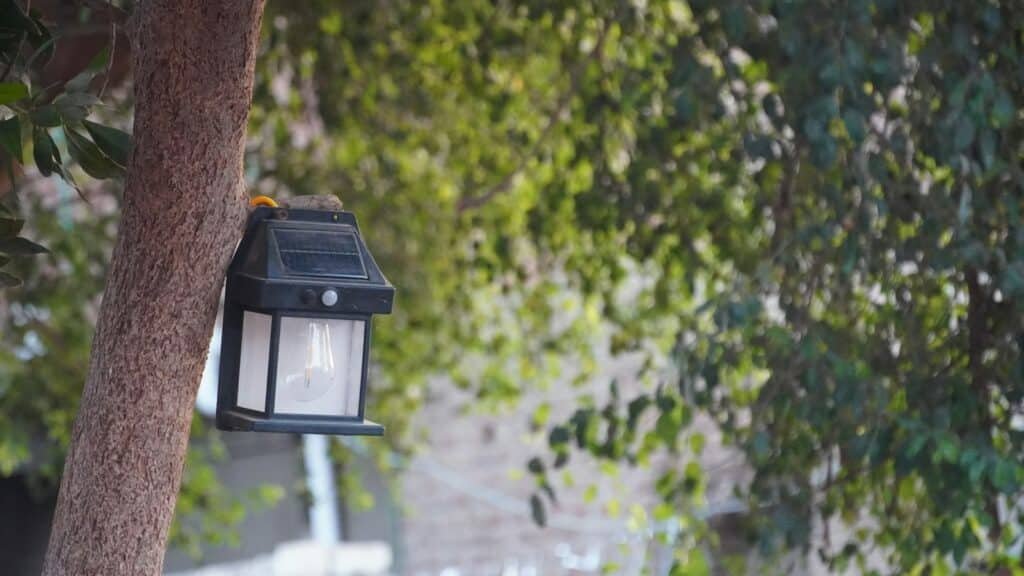
Most strings connect the panel to the lights with a lead cable, and that lead is your real constraint. The Joomer set recommended below, for example, lists a 6.5-foot lead. Choose the sunny panel position first, then drape the lights from there. Planning the reverse way is how panels end up under eaves.
In the Northern Hemisphere, face the panel south and tilt it more steeply than you would in summer, if the bracket allows. A low winter sun favors an upright panel. When no sunny spot sits within cable reach, our guide to solar path lights in shade explains remote-panel options.
2. Size the display to the panel, not the yard
The most common mistake when buying solar Christmas lights is shopping by length. One 72-foot string with 200 LEDs on a single small panel spreads the same harvest across more bulbs than a shorter set, so each bulb receives less.
Two shorter strings with their own panels usually outperform one long string, because you double the collecting area. They also fail independently: if one panel lands in shade, half the display still glows.
Joomer Solar Christmas Lights, 2-Pack, 144 ft, 400 LED (Warm White) — Each 72-foot string has its own panel and stake, IP65 weather protection and a memory chip that keeps your chosen mode, so a low-draw setting survives each daily restart. Splitting the display across two panels is exactly the sizing logic above.
Solar Christmas pathway lights vs. string lights
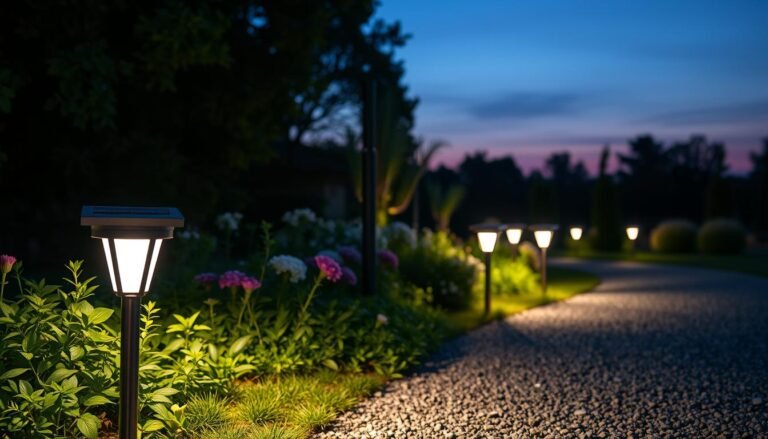
Stake-style solar Christmas pathway lights solve the panel problem differently. Each stake carries its own tiny panel and cell, so nothing shares a battery. One shaded stake goes dim while its neighbors stay lit.
The trade-off is panel size. A cap-mounted panel on a candy cane is far smaller than a string’s separate panel, so expect a cheerful marker glow rather than usable path illumination. Space them for rhythm, keep them out of the walking line and use our solar path light spacing steps to set an even pattern.
Eyrosa Solar Christmas Pathway Lights, 10-Pack Candy Cane (Red & Green) — Striped poles look festive by day, and the starburst heads throw color onto the ground rather than into guests’ eyes. Every stake charges independently, which suits a walkway with patchy shade.
3. Set the schedule your evenings actually need
Decide when you want your solar Christmas lights lit instead of chasing the hours the box promises. For most homes the useful window runs from dusk to about 10 p.m.: guests arriving, neighbors walking dogs, children heading to bed. A glow at 3 a.m. impresses no one and spends energy tomorrow evening needs.
If the controller offers a timer, use it. If it only offers dusk-to-dawn operation, a lower-draw mode becomes your schedule tool. Some sets also allow switching off overnight, but read the manual first, because certain circuits stop charging when switched off.
Sensors cause their own surprises. A panel near a porch lamp or streetlight may conclude it is still daytime and never switch on. Cover the panel with your hand at dusk. If the string lights, the fixture works and the location is the problem. Our sensor troubleshooting guide covers the less obvious causes.
4. Check the battery’s cold-charging limit
Here is the detail almost no listing mentions: a battery that discharges happily in the cold may refuse to charge in it. Battery University’s charging reference gives 0°C to 45°C (32°F to 113°F) as the charge range for NiMH, the chemistry inside many solar decorations. It also warns that consumer lithium-ion cells cannot be charged below freezing.
In practice, a bright morning at 25°F may add very little stored energy, even with a spotless panel. Useful charging often happens late morning and early afternoon, once the housing warms. That is why a sunny but bitter week can leave solar Christmas lights dimmer than a mild, overcast one.
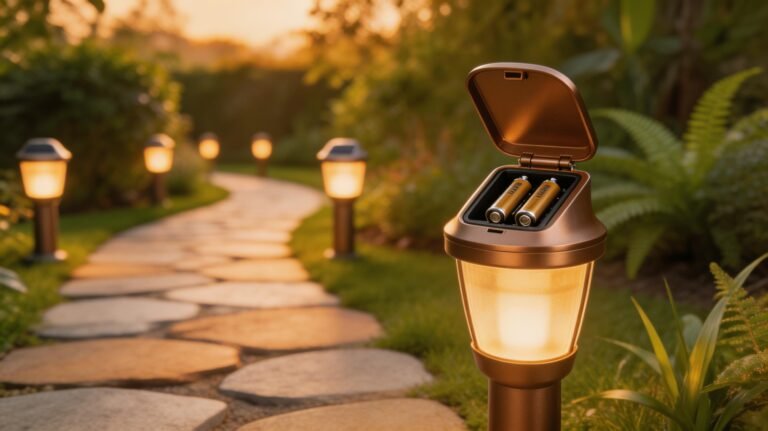
You cannot change the weather, but you can avoid making it worse. Keep battery compartments out of snowbanks, never warm a cell on a radiator, and replace batteries only with the exact chemistry, voltage and size the manual specifies. Our solar light batteries guide walks through those checks.
Tenergy Solla Rechargeable NiMH AA 1000 mAh (24-Pack) — Built for solar garden lights, with protection against the overcharge and over-discharge cycles that wear out ordinary cells. Choose them only if your fixture calls for 1.2 V AA NiMH; they are not a substitute for lithium packs.
5. Keep snow, frost and grime off the panel
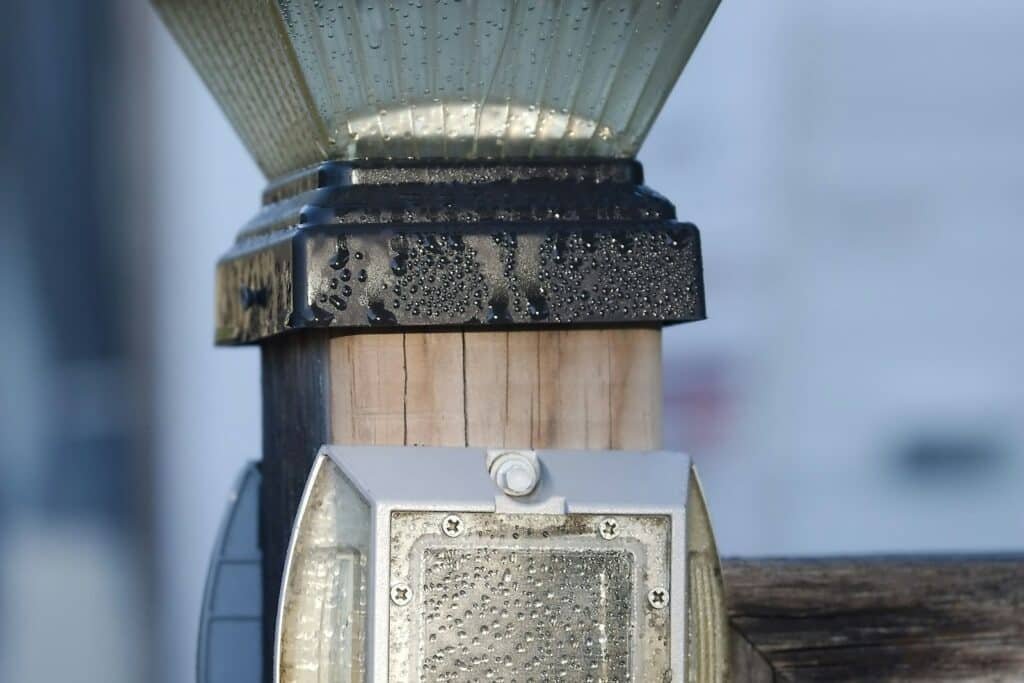
A light dusting of snow can cover most of the small panel on solar Christmas lights, and stake lights hold their panels low, right where drifts and slush settle. Check panels the morning after snowfall and brush them clear before the sun climbs.
Use a soft brush or a gloved hand for powder. Let bonded ice release on its own; scraping with a key or pouring hot water can crack the cover and let moisture reach the battery. Our after-rain checks show what water inside a housing looks like.
Road spray and dried leaf film are harder to spot. Wipe each panel with a clean, damp cloth when you set up the display, then again in mid-December.
Amazon Basics Microfiber Cleaning Cloths (24-Pack) — Non-abrasive and washable, so you can reserve a few for panels and avoid dragging driveway grit across the plastic cover.
What to look for before buying solar Christmas lights
Most listings bury the details that decide December performance, so read past the photos. A long-exposure product shot can make almost any string look dazzling.
- A separate panel on a lead cable: it lets you put the panel in sun and the lights in shade. Note the lead length before you plan the layout.
- Mode memory or a timer: without memory, many sets reset to a high-draw mode every morning.
- A stated battery type: NiMH AA cells are easy to replace; sealed lithium packs usually are not, and they cannot charge below freezing.
- An IP rating of IP65 or higher: our IP65 vs IP67 guide explains what each level actually covers.
- One panel per string: two modest strings beat one marathon string on a shared panel.
If a listing for solar Christmas lights hides the battery type or panel size, ask the seller before ordering, or buy one set first and run the three-evening test below before equipping the whole yard.
Price matters less than people expect. A cheap set with a good panel position will outshine an expensive set staked under an evergreen, so spend your first effort on placement and your second on the product.
6. Test solar Christmas lights before guests arrive
Set your solar Christmas lights up a week before you need them, and judge them late in the evening rather than right after dusk, when nearly everything looks bright. Our explainer on why a bright glow at 9 p.m. can mislead you covers the checks that matter.
Keep a three-evening log: that day’s weather, the mode, switch-on time and the moment each string becomes too dim to enjoy. If one string fades early while an identical one stays bright, compare panel shade and battery health before blaming the product.
The short review below follows one solar string through a full evening. Watch how mode choice changes the brightness, and remember your sunlight will differ from the reviewer’s.
7. Know where solar is the wrong tool
Solar Christmas lights excel at outlining beds, wrapping trees in open sun and reaching spots no extension cord can. They are a poor choice for front steps, an icy slope or any route someone must see clearly at 11 p.m.
Decorating carries its own risks. The U.S. Consumer Product Safety Commission estimates roughly 160 decorating-related injuries a day during the holiday season, a large share of them falls, as UCLA Health summarizes. A cord-free stake at ground level removes one ladder climb and one cord across the path, a genuine benefit even when its glow is modest.
For steps and entrances, keep dependable wired or plug-in lighting and let solar handle the decoration around it. Our dusk-to-dawn pathway safety tips show how to light a route without glare.
Where solar Christmas lights still win
Open lawns, south-facing hedges, mailbox posts and fence lines far from an outlet are where solar earns its place. So are rentals and homes where running cords through a window simply isn’t allowed.
Solar Christmas lights not working? A quick triage
- Stays off completely: check the switch, the pull-tab under the battery, a nearby porch light fooling the sensor, and water inside the housing.
- Lights at dusk, fades within an hour: look for shade, a dirty panel, a high-draw mode or a tired battery.
- Worked in November, struggles in December: the same panel spot now gets lower, shorter sun. Re-map the shadow.
- Only one string or stake is dim: compare it beside a healthy one under identical charging, as described in our winter fixes for solar lights.
When the season ends, clean, dry and pack everything before the batteries sit flat for months. Our steps for storing solar lights for winter keep the cells healthy for next December.
Questions people ask about solar Christmas lights
Do solar Christmas lights work in winter?
Yes, if the panel gets several hours of unshaded daylight and the battery is warm enough to charge. Expect shorter runtimes than in summer, and choose a low-draw mode or timer for December.
How long do solar Christmas lights stay on at night?
It depends on that day’s charge and the selected mode. After good sun many sets run several hours; after cloudy or freezing days, one to three hours is common. Treat 8-hour claims as summer figures.
Can solar Christmas lights charge on cloudy days?
They charge from diffuse daylight, but far more slowly. A run of overcast days can leave the battery too low for a full evening, so a dimmer mode helps stretch what the panel collects.
Why won’t my solar Christmas lights turn on?
Check the power switch and any battery pull-tab first. Then cover the panel at dusk: if the lights come on, a porch light or streetlight is fooling the sensor. Otherwise look for water ingress or a failed battery.
Can you leave solar Christmas lights out in the snow?
Sets rated IP65 or higher handle snow and rain, but buried panels cannot charge. Brush snow off each morning, keep battery compartments out of drifts and let ice melt naturally.
Are solar Christmas lights as bright as plug-in lights?
Usually not. Plug-in LED strings have unlimited power, while solar sets ration a small daily charge. Use solar for trees, beds and fence lines, and plug-in lighting where people need to see their footing.