Why Solar Path Lights Die in 8 Months — And How to Fix It
If your solar path lights went dark before their first birthday, you weren’t imagining it and you weren’t doing anything wrong. You bought eight of them. They looked great in April. By November, half were dead. By the next spring you pulled them out of the dirt and threw them in the garbage. So when someone tells you solar path lights are great, you roll your eyes.
Fair enough. Here’s the argument: you weren’t wrong about the lights you bought. You were wrong about the category. Those are two different things.
The $4 stake you grabbed off an endcap at the big box store was never designed to last. It was designed to survive one season and one return window. That isn’t a technology failure. It’s a product-tier failure. The gap between a disposable light and a seven-year light is about $12 and three things you can check before you buy.
For what it’s worth, I’ve had the same two solar path lights at the end of my driveway since 2018. One battery swap in year four. That’s the entire maintenance history.
Table of Contents
How Solar Path Lights Actually Work: The 4 Parts Inside
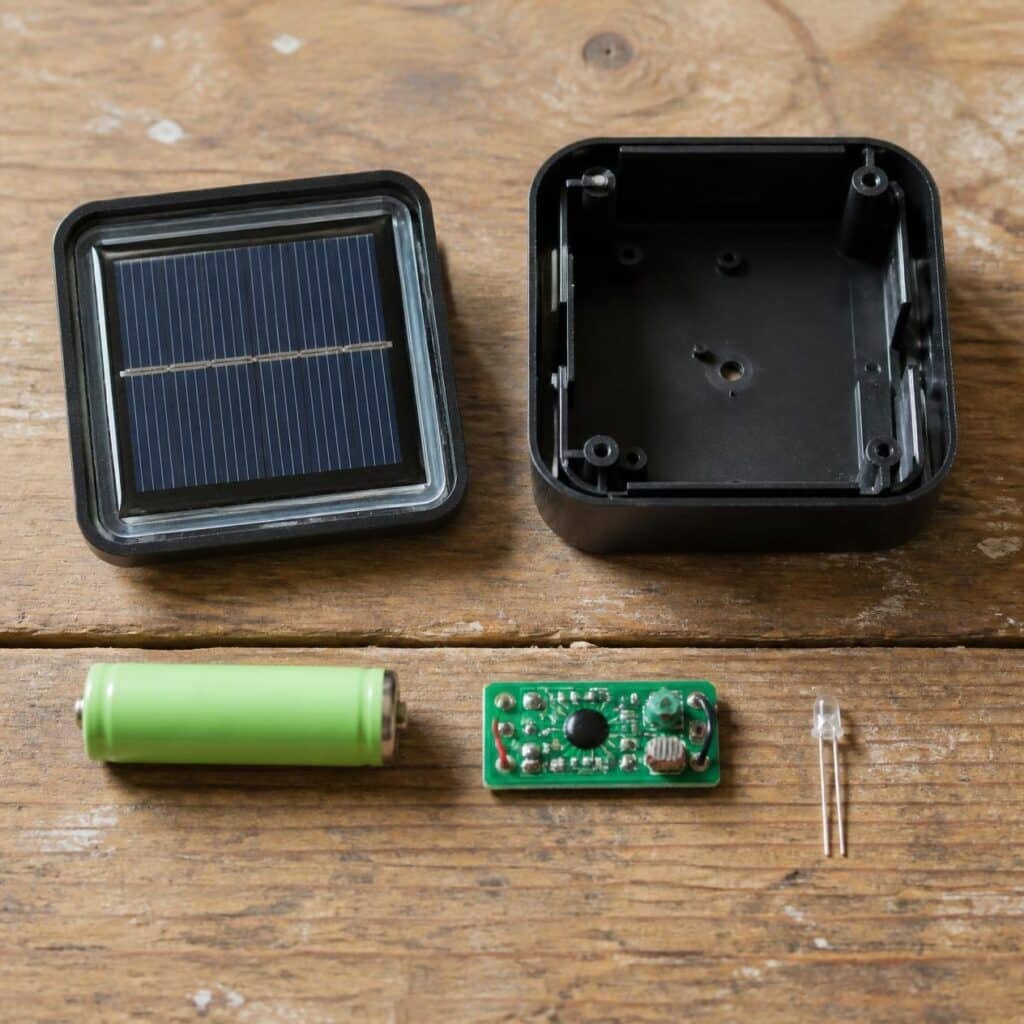
A solar path light is four parts in a plastic tube. That’s the whole machine.
- A photovoltaic panel on top. Sunlight hits it and it makes DC current.
- A rechargeable battery in the middle. It stores that current all day.
- A small circuit board with a light sensor. When the panel stops making power, the board knows it’s dark and switches the LED on.
- An LED that runs off the battery until morning.
No moving parts. Nothing that wears out mechanically. So how long do solar path lights last, and why do cheap ones die in a single season? Because three of those four parts are built as cheaply as physically possible on budget units, and they fail in a predictable order.
Why Do Solar Path Lights Stop Working?
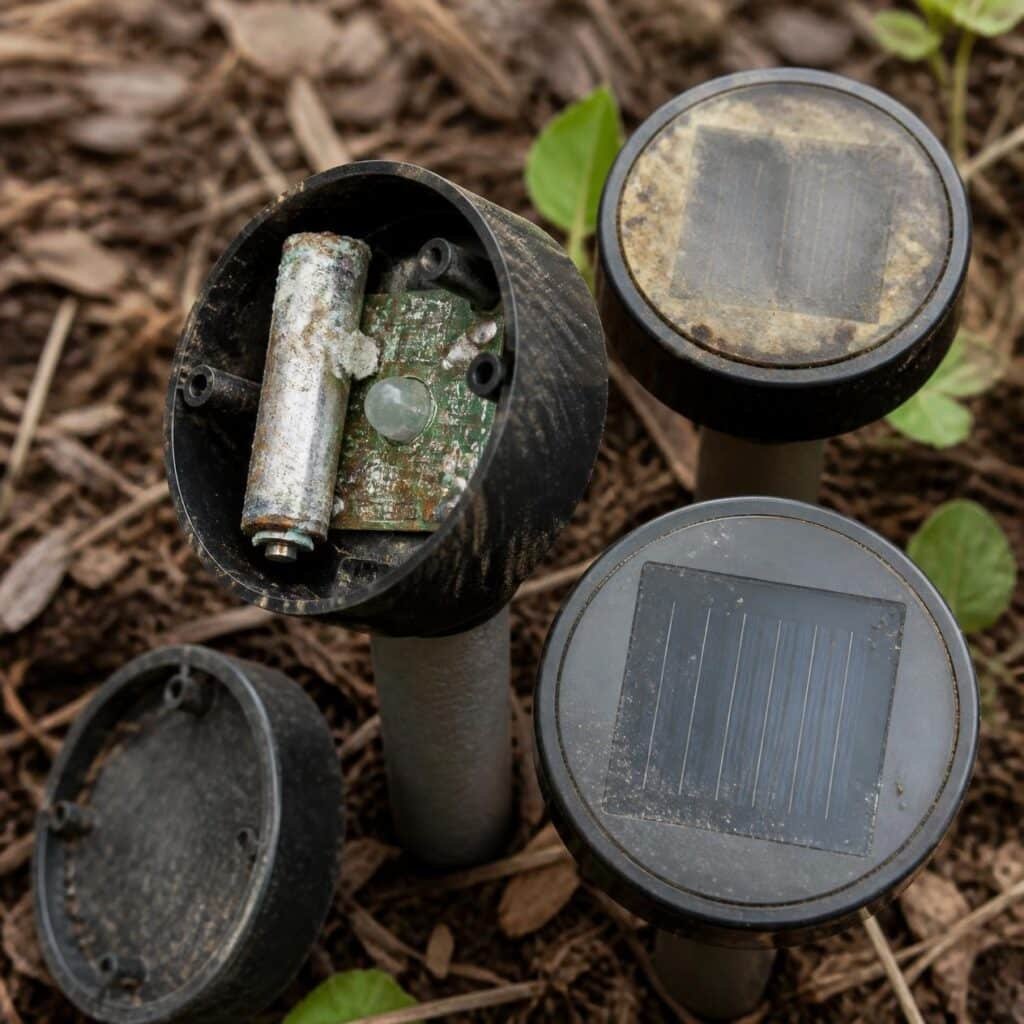
Solar path lights usually stop working because the rechargeable battery wears out, not because the LED fails. Water leaking past an unsealed panel seam and UV haze clouding a plastic solar panel are the next two causes. Swapping in a quality NiMH cell revives most “dead” lights for about $2.
I want to be specific here, because vague advice is how you got burned the first time. Here is the order they fail in.
Failure 1: The Rechargeable Battery Wears Out
Almost always the battery. Cheap lights ship with a NiCd or NiMH AA cell rated around 200–600mAh. That is a weak battery by any standard. Worse, a lot of them arrive already half-degraded because they sat in a warehouse for a year before you bought them.
NiCd cells have a second problem called memory effect. On a cloudy day the battery only takes a partial charge. Do that enough times and it stops holding a full one. A NiCd cell is rated for roughly 150–300 charge cycles — call it one season — and at the end of it you get 20 minutes of light instead of six hours.
Failure 2: Water Gets Inside the Housing
The second killer. Look at the seam where the solar panel meets the plastic body. On cheap lights that is a friction fit with no gasket. Rain works its way in. It corrodes the battery terminals and the circuit board. The light doesn’t dim first — it just dies one day.
Failure 3: The Solar Panel Clouds Over
Cheap amorphous silicon panels sit under thin plastic instead of glass. UV light yellows that plastic over 12–18 months. A hazy panel can lose 30–50% of its output, so the battery never reaches a full charge. The light gets dimmer every month until it’s useless.
Failure 4: The LED (Almost Never the Problem)
This one basically never fails. LEDs are rated for 25,000–50,000 hours, which is decades of dusk-to-dawn use, and the U.S. Department of Energy’s own lighting facts guidance treats LED life in that range as normal rather than exceptional. If your light is dark, the LED is the last part to suspect.
Notice what’s missing from that list: “the concept of solar lighting.” Every failure point above is a cost-cutting decision, not a physics limit. If yours are dark right now and you want to work through it step by step, start with our solar path light troubleshooting and maintenance posts.
How to Replace a Solar Light Battery in 5 Minutes
Here’s the part skeptics skip past. You can fix failure #1 yourself for about $2.
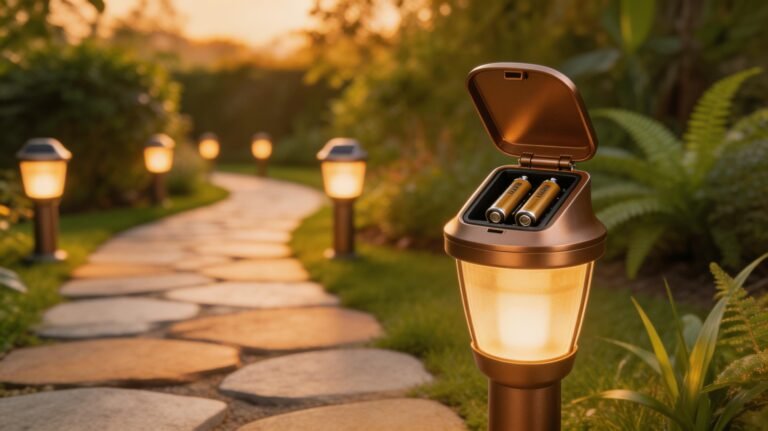
Most solar path lights run on a standard AA or AAA rechargeable cell.
- Unscrew or unclip the panel head from the stake.
- Pop the old cell out of its compartment.
- Drop in a quality low-self-discharge NiMH cell rated 1900–2000mAh — a Panasonic Eneloop AA or similar.
- Set the light in full sun for two full days before you judge it.
That swap roughly triples the battery capacity. Panasonic rates a standard Eneloop for up to 2,100 charge cycles against the 150–300 you started with. I’ve done this on four lights that were completely dead, including one that had been sitting in a bin in my garage for two years. All four came back brighter than new. The electronics were fine the entire time.
If you’d rather watch someone do it first, this walkthrough covers the same swap on a standard stake light: How to change the batteries in solar path lights.
This single fact undercuts most of the “solar lights are junk” argument. The part that fails is the one part you can replace in less time than it takes to make coffee.
How to Choose Solar Path Lights That Last 7 Years
If you’re going to try again, these six checks separate a seven-year light from an eight-month one. Run through them on the product listing before you buy anything.
- Look for glass over the panel and shade, not plastic. Tempered glass doesn’t yellow. This one feature roughly doubles useful life on its own, and it’s the same thing Bob Vila’s testers kept coming back to when they ran eleven sets of path lights through three weeks outdoors.
- Check the battery capacity. You want a real number on the listing. 1000mAh minimum, 2000mAh is better. Lithium-ion or LiFePO4 beats NiMH, which beats NiCd. If the listing doesn’t state the capacity, assume it’s terrible.
- Check that the battery is user-replaceable. Some sealed units are genuinely disposable. A light with an accessible battery compartment is a light you can keep alive for a decade.
- Look for an IP65 rating or higher. Under IEC 60529, the ingress protection standard, IP65 means dust-tight and protected against water jets from any direction. No rating listed means no sealing was engineered.
- Check the panel size, not the lumens. A bigger panel puts more charge into the battery each day. A tiny 2-inch panel bolted to a 2000mAh battery is a mismatch. It will never top that battery off in winter, when the sun sits low and the days are short.
- Choose metal or thick polycarbonate housing. Thin brittle plastic cracks in the first hard freeze.
Those six checks are the short version of the longer teardowns in our solar path light buying guides and reviews, where we go model by model.
Disclosure: some links below are Amazon affiliate links. If you buy through them we earn a small commission at no extra cost to you. We buy the lights we test with our own money, and nothing on this page is sponsored or paid placement. More about how we work is on our about page.
Solar Path Lights That Pass All Six Checks
Three things worth buying, scored against the rules above rather than against a lumens number on the box.
| Product | Why it passes | What to know |
|---|---|---|
| Beau Jardin Color-Changing Solar Pathway Lights (8-pack) | Real glass shades, rust-resistant steel posts and stakes, replaceable AA cell | Bob Vila’s testers rated it best overall and still had it running dusk-to-dawn after three weeks of rain and wind |
| Gigalumi Warm White Solar Pathway Lights (8-pack) | Clear glass shades on bronze metal, true dusk-to-dawn runtime, warm 2700K-ish output | Glass shades can snap off the post under a hard impact — not a weather problem, a flying-debris one |
| Panasonic Eneloop AA rechargeable cells (8-pack) | 2000mAh typical, rated up to 2,100 charge cycles, holds 70% of its charge for 10 years | This is the $2-per-light fix. Buy it with the lights, not after they die |
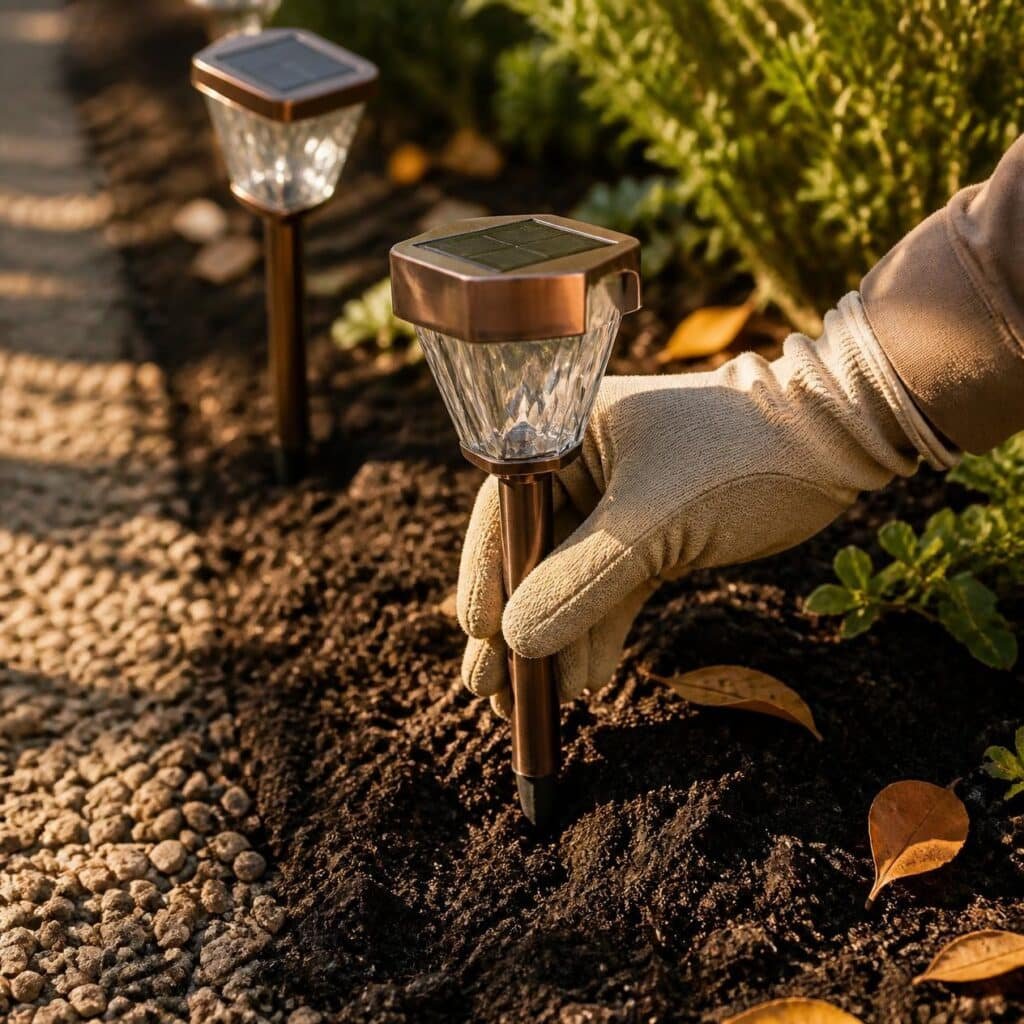
Solar Path Lights Cost: Cheap vs Quality Over 7 Years
This is where the skeptic usually has a point and then loses it. Eight lights, seven years, both routes:
| Route | Up-front (8 lights) | Replacements over 7 years | 7-year total | Lights in landfill |
|---|---|---|---|---|
| $5 budget stakes | $40 | $240 (six more sets) | $280 | 56 |
| $18 quality lights | $144 | $16 (one battery swap, year 4) | $160 | 8 |
You spend less money. You spend far less time. And you have working lights every single night instead of a slowly dying row of plastic stumps.
The cheap option is the expensive option. It just hides the cost in annual re-purchases.
Solar Path Lights vs Low-Voltage Wired Path Lighting
Fair question, and wired lighting is genuinely better in some ways. It’s brighter. It’s consistent every night of the year. There’s no battery to degrade.
It’s also a completely different project. You have to trench cable across the yard. You have to buy a transformer. You either hire an electrician or spend a weekend with a shovel. For a short path, expect $400–900 installed. Then you’re adding a small permanent draw to your power bill.
Solar path lights aren’t really competing with that. They’re competing with “no lights at all,” which is what most people actually have.
Are Solar Path Lights Worth It for Safety and Curb Appeal?
Here’s the part that never shows up in a spec sheet.
Walking up a dark path at night is a small, constant, low-grade stress. You watch your feet. You guess where the step is. Carrying groceries or a sleeping kid makes it worse. The CDC reports that about one in four adults aged 65 and older falls each year — roughly 36 million falls — and poor lighting is one of the home hazards it names.
A lit path removes that. Permanently. No wiring, no permits, no monthly cost.
And when guests pull into the driveway and the path glows softly up to the door, that reads as care. It says someone thought about your arrival. You can’t measure that in lumens, but it’s the actual reason most people buy these.
When Solar Path Lights Beat Wired Lighting Every Time
- Rentals. No permanent installation. You pull them out and take them with you.
- Long or curved paths. Trenching 80 feet of cable is miserable. Pushing 12 stakes into soil takes 10 minutes.
- Detached areas. Sheds, garden beds, back fences, mailboxes — anywhere running power is a nightmare.
- Testing a layout. Move them around until the spacing looks right. Try that with buried cable.
- Power outages. They just keep working.
The Installation Mistake That Kills Good Solar Path Lights
Even great lights fail if you put them in the wrong place.
They need six or more hours of direct sun. Not dappled shade under a tree. Not the north side of the house. A premium light in a shady spot will underperform a cheap light in full sun, every single time.
And wipe the panels twice a year. Dust, pollen and hard-water spray build a film you won’t notice until output has already dropped 25%. Spring and late summer, 30 seconds each, a damp cloth. That’s it.
Solar Path Lights FAQ
Why do my solar path lights stop working after a few months?
The rechargeable battery is the usual cause. Budget lights ship with a 200–600mAh NiCd or NiMH cell rated for 150–300 charge cycles, which is about one season. Water getting past an unsealed panel seam and a UV-hazed plastic panel are the next two causes.
How long do solar path lights last?
A $4 stake light typically lasts 8–18 months. A light with a glass-covered panel, an IP65 seal, a metal or thick polycarbonate body and a 1000mAh-plus replaceable battery will run 7 years or more, with one battery swap somewhere around year four.
Can you replace the batteries in solar path lights?
In most models, yes. Twist off the panel head, pop out the AA or AAA cell and fit a 1900–2000mAh NiMH replacement. Some sealed units have no battery compartment at all, which makes them genuinely disposable — check the listing before you buy.
What battery do solar path lights use?
Most take a single 1.2V AA or AAA rechargeable cell, usually NiMH, sometimes NiCd. Newer and better models use a 3.2V LiFePO4 or a lithium-ion cell. Always replace like with like, and never fit a standard non-rechargeable alkaline battery.
Do solar path lights work in winter?
They work, but they run shorter. Short days, a low sun angle and snow on the panel all cut the daily charge. A large panel paired with a 2000mAh battery handles winter far better than a tiny panel on the same cell. Brush snow off the panels.
How many solar path lights do I need for a walkway?
Space low-output lights (under 15 lumens) about 4 to 6 feet apart for a continuous glow, and brighter ones 8 to 10 feet apart for pools of light with gaps between. For a 30-foot walkway that’s roughly 6 to 8 lights. More on layout in our installation guides.
Are solar path lights bright enough to actually see by?
Path lights mark the edges of a path rather than flood it. Most produce 2–15 lumens, which is enough to show you where the walkway goes and where the step is. If you want to light the whole area, you want solar floodlights or wired fixtures instead.
The Bottom Line on Solar Path Lights
Your skepticism was earned. The shelves are full of solar path lights engineered to quit about a month after you stop paying attention. But “most products in this category are bad” and “this category doesn’t work” are two completely different claims, and only the first one is true.
The physics is fine. The LEDs will outlive the house. Every failure point is a line item somebody cut, and the biggest one costs $2 to undo.
So don’t buy another 12-pack. Buy two good solar path lights — glass panel, 1000mAh or better, IP65, replaceable cell — put them in the sunniest spot you’ve got, and run them through one full winter. If they’re still burning in March, buy the other six. If they’re not, you’re out $36 instead of another wasted season.
Go run the test.