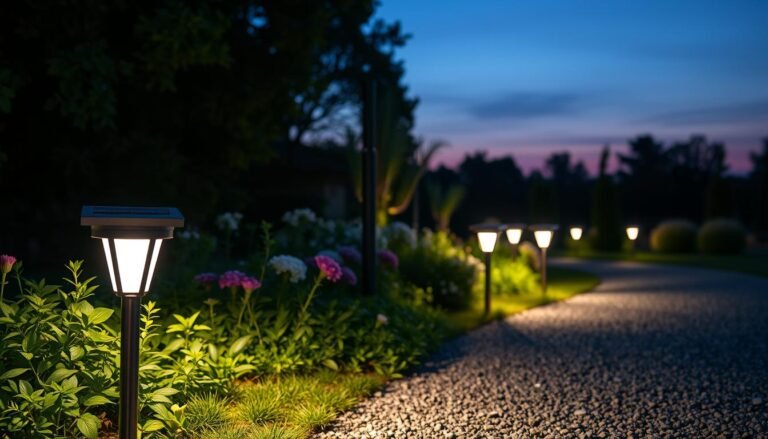
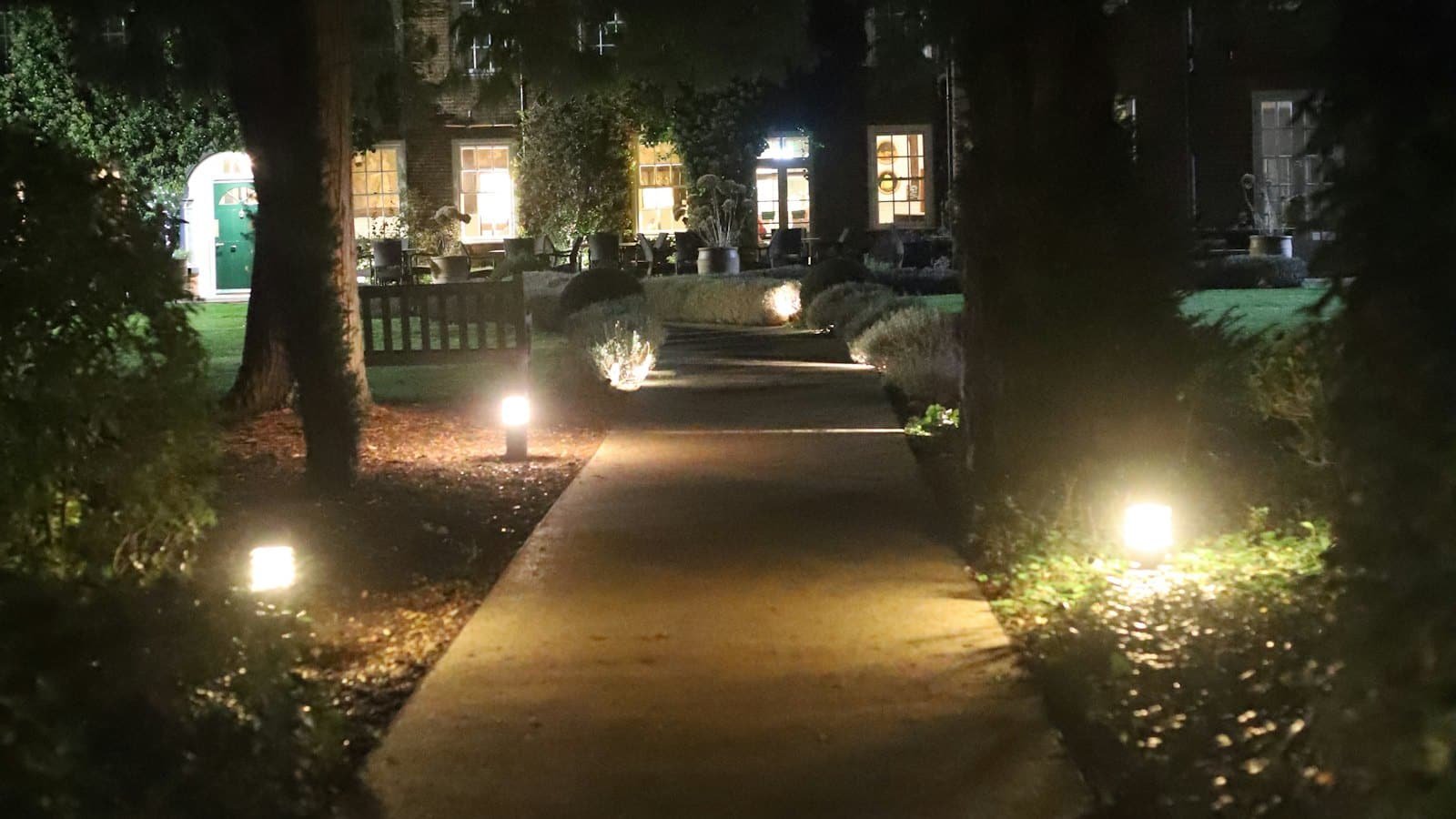
Christmas Pathway Lights: 7 Proven Tips for a Stunning Walk
Most Christmas pathway lights fail in one of three unglamorous ways: the stakes lean after the first thaw, the set ends four feet short of the front door, or a cord crosses the very path the lights were bought to make safer. None of that shows up in the photo on the box.
This guide works backward from your actual walkway. You will measure it, pick a power source that suits where your outlet (or your sunlight) really is, do the spacing math before you buy, and stake everything so it survives snow, shovels and a December thaw. Each step explains its reasoning, so you can adapt it to a curve, a slope or a rental.
Affiliate disclosure: This post contains affiliate links. As an Amazon Associate I earn from qualifying purchases, at no extra cost to you.
Table of Contents
What Christmas pathway lights can and can’t do
Christmas pathway lights are markers. Their job is to show where the edge of the path runs and to set a mood on the way to the door. Most give off only a few lumens per bulb or stake, far less than a porch fixture, so they rarely light the paving well enough to spot black ice or a dropped glove.
That distinction shapes every decision that follows. If the walkway has to be safe for an older relative arriving at 6 p.m., the festive row sits on top of real path lighting, not in place of it. Our dusk-to-dawn pathway safety guide covers that base layer.
So think in two layers: an even light for footing and a decorative row people remember. Plan the second around the first, or you get plenty of sparkle and a step that is still hard to see.
1. Choose the power source before the style
Style is the fun part, which is why most people choose it first. Power deserves that slot, because it decides where your Christmas pathway lights can go, how long they glow and what you will be fixing on December 23.
Plug-in C9 or C7 kits give the brightest, most consistent result. A typical kit is one cord with sockets at fixed intervals and a ground stake for each bulb. You need an outdoor outlet within reach and a plan for the cord, but the lights look identical on the greyest week of the year.
Solar stakes need no cord at all. Each stake carries its own small panel and rechargeable cell, so placement is free and nothing crosses the path. The trade-off is December sunlight: short days and a low sun can leave a budget stake glowing for only a few hours.
Battery markers with timers sit in between. They run on AA or C cells with a built-in six-hour timer and suit a shaded entrance far from any outlet. Across 30 stakes and five weeks, though, the battery bill adds up.
A practical rule: if an outdoor outlet sits within about 25 feet of the start of the walkway, use plug-in Christmas pathway lights for the main run. If not, or if the path is decorative rather than the main entrance, solar earns its place. Our comparison of solar vs plug-in pathway lights lays out the year-round trade-offs; the holiday version simply weighs reliability higher, because the display has a deadline.
When solar Christmas pathway lights make sense
Solar Christmas pathway lights work best where every stake gets open sky from late morning to early afternoon. A south-facing front lawn qualifies. A north-side path squeezed between the house and a fence usually does not, however good the product. Our guide to solar path lights in shade shows how to judge a spot before you buy.
Read the battery line in the listing before anything else. The DenicMic set below lists a 1.2-volt, 250 mAh Ni-Cd AAA cell in each stake. That is a small reserve, so expect a solid glow after a sunny day and a short one after three grey ones. The detail worth paying for is that the cell is user-replaceable: when it fades next season, you swap an inexpensive battery instead of binning the stake.
DenicMic Solar Christmas Lights, 10-Pack — Faceted lenses project a starburst pattern roughly three feet across onto the ground, so the color lands on the lawn rather than in guests’ eyes. Choose these for a sunny, decorative path where a cord would be a nuisance.
Our guide to solar Christmas lights works through the December energy budget behind every stake.
2. Do the spacing math before you buy
Measure the walkway with a tape, not by eye, and note three numbers: total length, outlet-to-path distance, and any break at steps or the driveway.
Plug-in Christmas pathway lights come with fixed socket spacing, and that spacing quietly decides the look. The Brightown kit below has 20 sockets at 15-inch intervals, giving roughly 25 feet of lit run. Home Depot’s popular candy cane set places its eight stakes 20 inches apart. Neither stretches, so buy to fit the length.
How far apart should Christmas pathway lights be?
For bulb-on-stake kits, 12 to 18 inches reads as a continuous glowing edge. Permanent path fixtures are usually set 6 to 10 feet apart, but they throw a pool of light onto the ground. A single C9 bulb does not, so it needs much tighter spacing to read as a line.
Larger markers such as candy canes, starbursts and lit trees need more room: 2 to 4 feet keeps each shape distinct. Crowd them and the silhouettes merge into a jumble once it is dark.
Here is the arithmetic for a common front walk that is 32 feet long, lit on both edges, with the outlet 10 feet from the start:
- Lit length needed: 32 ft × 2 edges = 64 ft.
- Bulbs at 15-inch spacing: 64 × 12 ÷ 15 ≈ 51, so three 20-bulb kits (60 sockets) with a few spare.
- Lead-in: 10 ft of outdoor-rated extension cord to the first kit, plus a short jumper that crosses to the far edge at the door end, never mid-path.
- Connection limit: check how many sets the label allows end to end. Brightown allows three. Go past the stated limit and you overload the first set’s wiring.
One edge or two? A path narrower than about 4 feet looks balanced with one lit edge and a lit feature, such as a planter or a small tree, on the other side. Wider paths and driveways usually need both edges. Our solar path light spacing guide applies the same logic to permanent fixtures.
Brightown C9 Christmas Pathway Lights, 25.7 ft with 20 Stakes — UL-listed, warm white, 15-inch spacing and replaceable E17 bulbs, with up to three sets connectable. It is a plain, dependable base for a plug-in walkway, and the spacing math above is built around it.
3. Pick a style that still reads at night
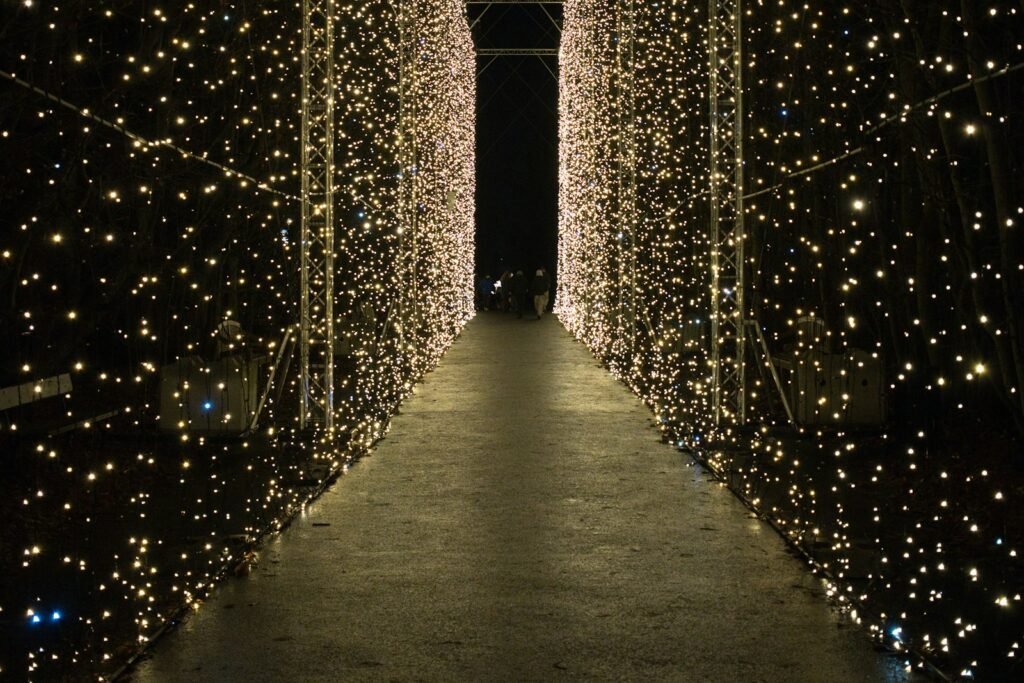
Shop for Christmas pathway lights with them switched on in your head. In daylight, a stake’s sculpted shape does the work; at 7 p.m. only the lit parts exist. A candy cane lit only in the hook reads as a row of glowing commas. A plain C9 globe reads as a clean dotted line.
- Warm white C9 globes: classic and calm, they suit almost any house and look best on a formal, straight walk.
- Starburst or kaleidoscope stakes: they paint color patterns on the ground, so they need a lawn or bed for the projection to land on.
- Lit candy canes, lollipops and trees: high character, low light output. Use them as accents at the start and end of a path, or at every third position.
Candy cane pathway lights: avoid the spacing trap
Candy cane pathway lights are the season’s bestseller and the style most often misplaced. Their hooks all face one way, so on a curved path half of them end up turning their backs to visitors. Rotate each hook toward the approach, so people see the lit face as they walk up.
They are also usually sold in short sets. Eight canes at 20-inch spacing cover only about 12 feet. For a longer path, buy enough for the full length, or reserve canes for the two ends and fill the middle with simpler bulbs. A half-dressed path looks unfinished; a deliberate pattern looks designed.
Color temperature is the final check. A cool-white set beside warm-white canes makes both look wrong. Choose one white for the whole walk and keep color for the accents.
4. Keep Christmas pathway lights out of the walking line
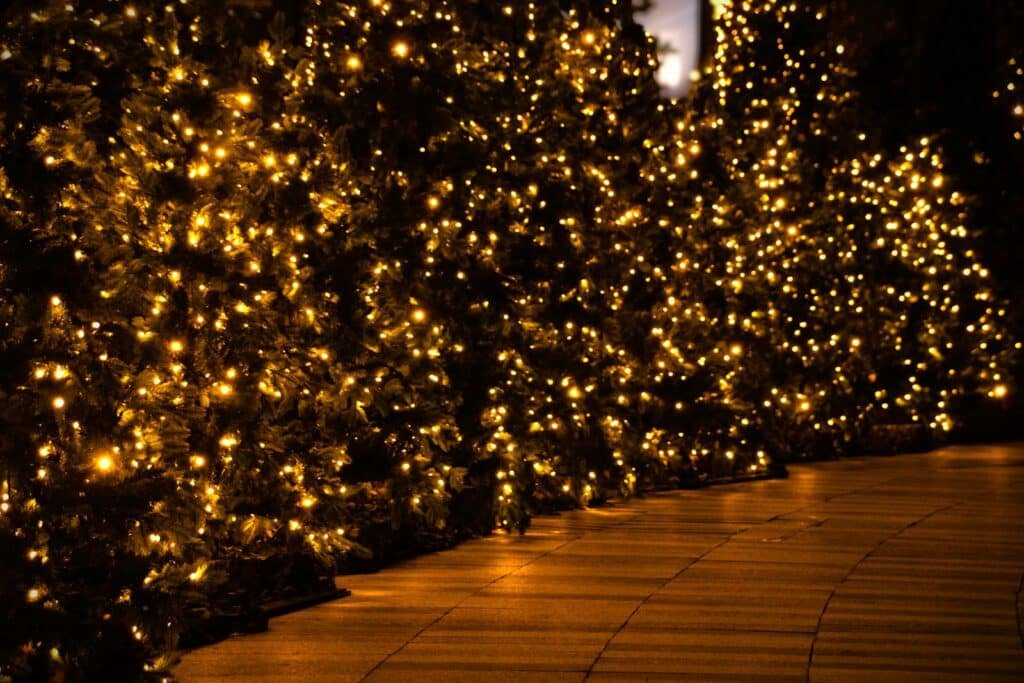
The edge of a path is where feet actually land, especially when two people walk side by side. Set Christmas pathway lights 6 to 12 inches outside the edge, on the soil or lawn side, and never in the joint between paving and grass, where a boot will clip them.
This is not a minor detail. The U.S. Consumer Product Safety Commission estimates about 160 decorating-related injuries a day during the holiday season, with more than 40% involving falls. Ladders account for many of them, but a stake or cord on a dark walkway is the same hazard at ground level.
Glare is the second hazard. A bright bare bulb at shin height dazzles anyone looking down to watch their step. Warm white, frosted or faceted bulbs and lenses that point at the ground all soften it. Our guide to path lights that prevent glare explains why surface-aimed light feels brighter.
Plan for the household too. Children cut corners and dogs follow scent lines, so leave a regular shortcut unlit and clear rather than staking a row across it.
5. Power plug-in sets the safe way
Plug-in Christmas pathway lights sit on wet ground with mains voltage, so the electrical basics matter more here than on the roofline.
Start at the outlet. Outdoor decorations belong on a circuit protected by a ground-fault circuit interrupter (GFCI). The Electrical Safety Foundation International also advises that every cord and decoration used outside be marked for outdoor use, and that the cord’s amperage rating match the load. If your outdoor outlet predates GFCI protection, a portable GFCI cord adds it without calling an electrician.
DEWENWILS 3 ft Automatic Reset GFCI Extension Cord — An auto-resetting GFCI on a heavy 12/3 SJTW outdoor cable with a three-outlet end. Plug it in at the wall so everything downstream is protected, including the timer below.
Route the lead-in cord around the path rather than across it. If it must cross, take it through the joint at a step where nobody plants a foot, or under a flat outdoor cord cover. Never pinch a cord in a door or window frame.
Next, add a timer. Running Christmas pathway lights from dusk to about 11 p.m. covers arriving guests and evening dog walks while roughly halving the hours compared with dusk-to-dawn. A photocell timer also tracks the earlier sunsets automatically.
BN-LINK Outdoor Light Timer with Dusk-to-Dawn Sensor — A weatherproof two-outlet timer that switches on at dusk and off after 2, 4, 6 or 8 hours, with no app or programming. Mount the sensor where the porch light cannot fool it.
If your Christmas pathway lights are still incandescent C9s from an old box, this is the year to switch. The U.S. Department of Energy says residential LEDs use at least 75% less energy and last up to 25 times longer than incandescent lighting. LEDs also run cool, which matters when bulbs sit in dry mulch or fallen leaves.
The short walkthrough below, from a professional installer, shows how a C9 walkway kit goes in, from laying out the line to setting each stake.
6. Stake into frozen ground and snow
Install Christmas pathway lights before the ground freezes hard if you can. Once it does, plastic stakes snap when forced. Make a pilot hole with a long screwdriver or a thin metal stake, then push the light stake into it. In deeply frozen soil, a cordless drill with a long masonry bit makes neater holes than brute force.
Snow changes the layout too. Every storm leaves a ridge where you shovel, and that ridge lands right on the path edge. Leave a 12- to 18-inch shovel lane between the paving and the row of stakes, or put the markers beyond the spot where snow usually piles up.
Keep plug connections off the ground. Join them inside a weatherproof connection box, or at least lift them onto a brick or paver. Electrical safety groups advise keeping cords and light strings clear of snow and standing water.
Solar stakes have their own winter needs: brush the panels clear after snowfall and accept that a buried stake is a dark stake. Our guide to solar lights in winter covers cold-weather charging, and our after-rain checks help when a stake goes dark after a thaw.
Checking Christmas pathway lights after a storm
After snow or freezing rain, walk the line in daylight. Re-seat any leaning stakes, ease ice off sockets by hand rather than knocking it with a tool, and look for a dark section. On a plug-in kit that usually means one loose bulb or a wet connection; on solar stakes, a covered panel.
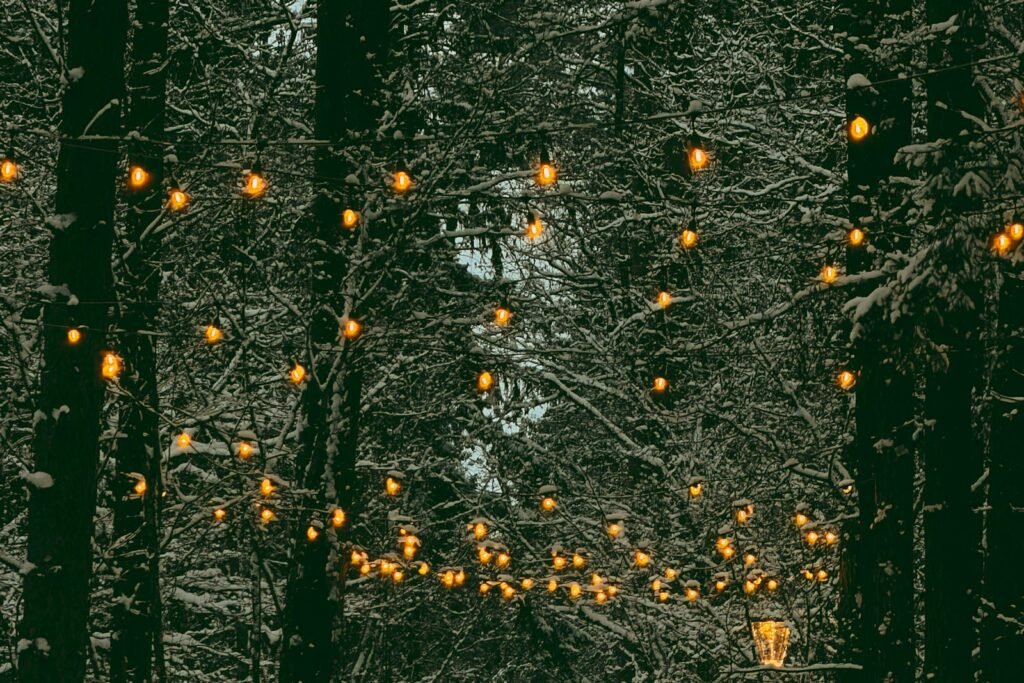
7. Layer a quiet path light under the festive row
The best-lit holiday walkways use more than one height. Christmas pathway lights draw the line at ground level; a warm glow in the shrubs, a lantern on the step or a lit wreath at the door gives the eye something to walk toward. Lighting designers interviewed by Homes & Gardens make the same case for mixing low-level and eye-level light.
Underneath, keep a modest year-round path light that stays put after the candy canes come out in January.
XMCOSY+ Dimmable Solar Pathway Lights, 6-Pack — Warm filament-style path lights with a knob that sets output between 10 and 40 lumens and a 2.4-inch monocrystalline panel. Turn them down in December so the festive row stays the star, then raise them once the decorations are packed away.
When the season ends, dry your Christmas pathway lights before boxing them and coil cords loosely. Our steps for storing solar lights for winter suit solar stakes. Plug-in kits just need dry bulbs, labeled bags and a note of what you want to add next year.
Christmas pathway lights checklist before guests arrive
- Switch on your Christmas pathway lights and walk the path at the hour guests arrive, not at dusk.
- Every stake sits 6 to 12 inches outside the edge, and none is in the walking line.
- No cord crosses the walkway, and a GFCI protects the circuit at the source.
- The timer is set, and no porch light shines on the dusk sensor.
- A single white color temperature runs the length of the path.
- The step and front door have real light that works independently of the decorations.
Questions people ask about Christmas pathway lights
How far apart should Christmas pathway lights be?
For C9 or C7 bulbs on stakes, 12 to 18 inches gives a continuous glowing edge. Larger markers such as candy canes, starbursts or lit trees look best 2 to 4 feet apart. Measure the path first and buy enough sets to fill it at that spacing.
Should pathway lights go on both sides of a walkway?
On paths narrower than about 4 feet, one lit edge plus a lit feature on the other side usually looks balanced. Wider walkways and driveways look better with Christmas pathway lights on both edges. Cross between edges only at the ends, never mid-path.
Are solar Christmas pathway lights bright enough?
They are bright enough as decorative markers when each stake gets several hours of open sky. They are not bright enough to light the ground for safe footing. After cloudy days, expect a shorter evening glow.
How do you put pathway lights in frozen ground?
Make a pilot hole with a long screwdriver, a thin metal stake or a drill with a long masonry bit, then push the light stake in. Do not hammer plastic stakes into frozen soil. Installing before the hard freeze saves the effort entirely.
Can Christmas pathway lights stay out in rain and snow?
Sets marked for outdoor use can, provided the circuit is GFCI-protected and plug connections are lifted off the ground or enclosed. Brush snow off solar panels after each storm, and check connections after a thaw.
How many pathway light sets can you connect together?
Use the maximum printed on the set’s label or packaging, which varies by model. The Brightown C9 kit, for example, allows three sets end to end. Exceeding the limit can overload the first set’s wiring.
Get the measurements, the power and the edge right, and Christmas pathway lights become the easiest part of the whole display: set once, glowing on schedule, with nothing to trip over. Measure your walkway this weekend, then buy for the length you actually have.