Solar Path Lights: Why Bright at 9 PM Means Nothing
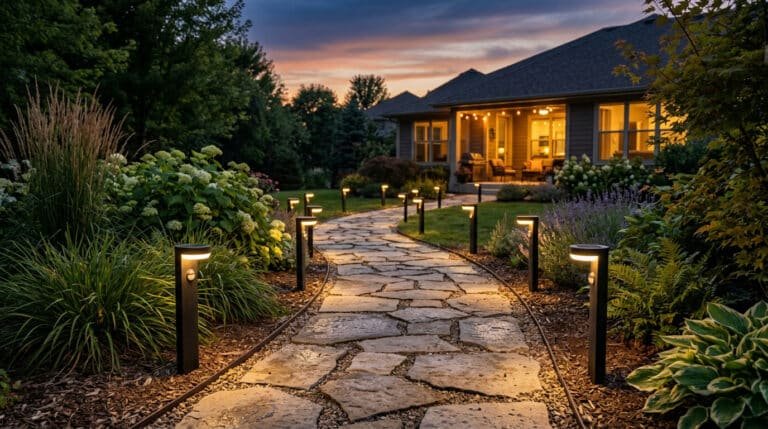
Solar path lights look great when you first set them out. You wait for it to get dark and look out the window. The walkway glows — bright, even, reassuring. Done. One less thing.
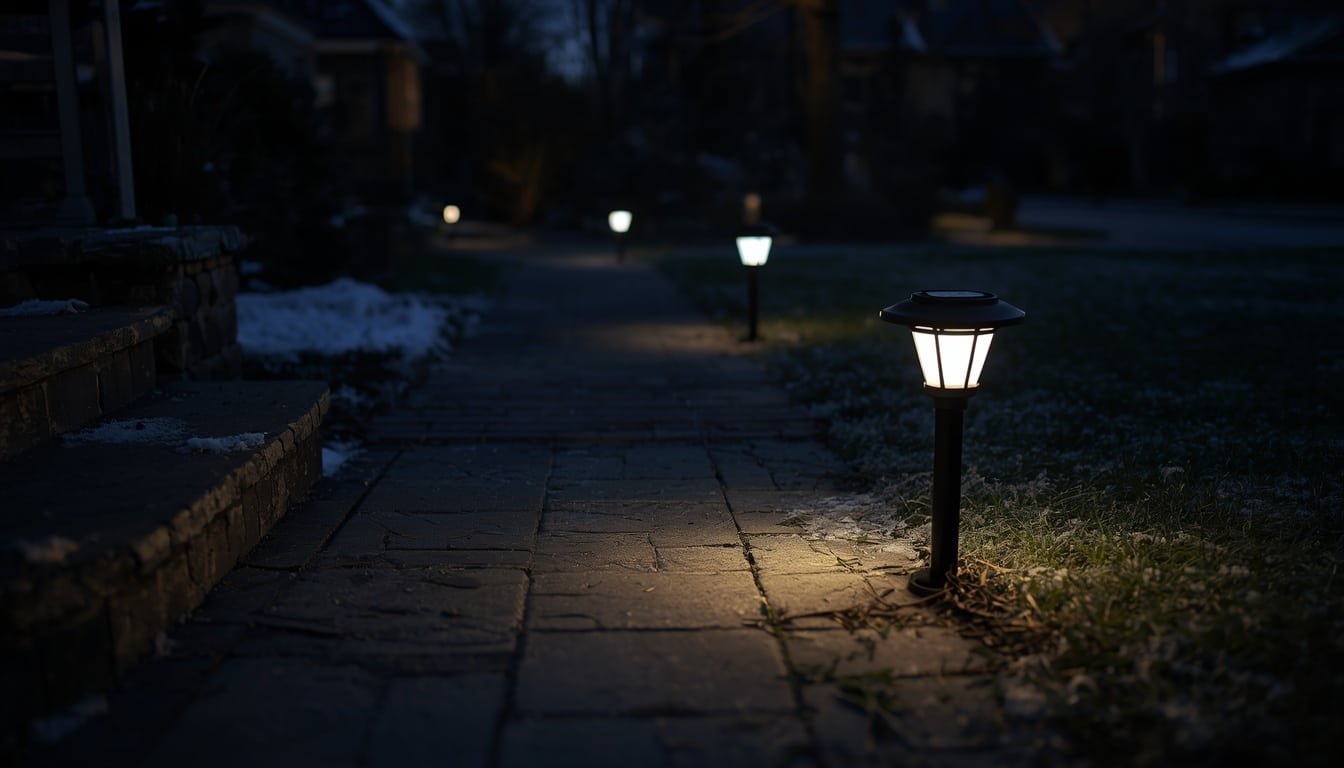
But the fall you’re actually afraid of doesn’t happen at 9 p.m. It happens at 2 in the morning, on the way to the bathroom. It happens at 6:40 on a black December morning, on a step nobody can see, going out for the paper. And on a lot of these lights, by the time either of those moments arrives, the glow you admired is a dull orange smear — or it’s just off.
That’s the part nobody warns you about when you buy them.
Table of Contents
You already know this, because you keep checking
Here’s the tell. If you fully trusted the lights, you wouldn’t think about them again. But you do. You get up for a glass of water and you glance out at the path. You peek through the blinds before bed. If it’s your mother’s house across town and not yours, you text — “are the lights on out there?” — and you read her yes, they’re fine three times without quite believing it.
The whole reason you bought them was to stop worrying about that path. Instead you’ve got a new thing to monitor. I shouldn’t have to keep going out to check these. And you’re right. You shouldn’t. The checking is your gut telling you the lights haven’t earned your trust yet.
The light is performing for the wrong person
Think about who these lights are actually lit for.
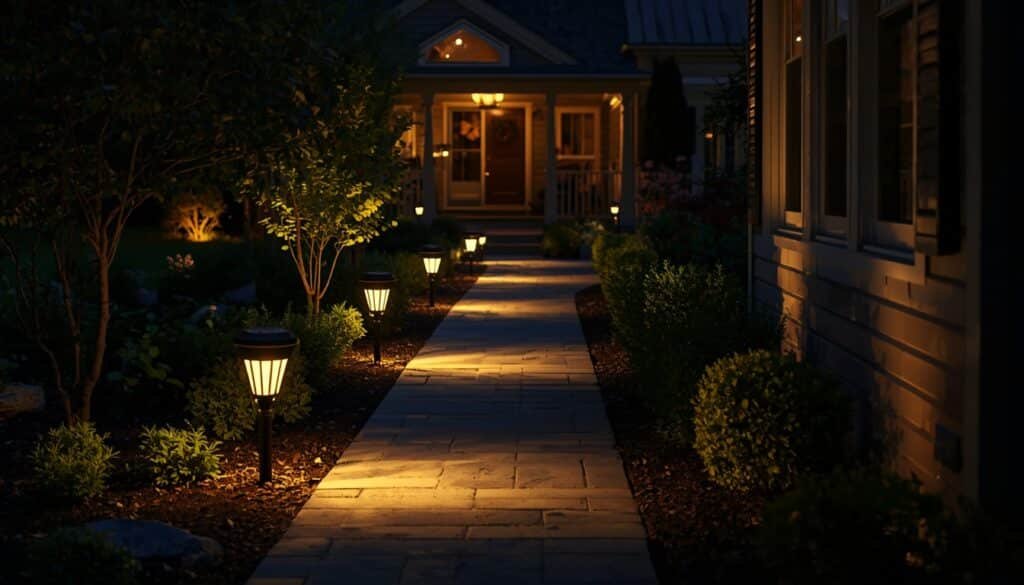
At 9 p.m., they’re lit for you — the person at the window deciding whether the job is done. And at 9 p.m., freshly charged from a long summer day, almost any light passes that test. They all look great in the driveway. They all look great in the product photo.
The person the lights are supposed to protect is somebody else, at a different hour: whoever’s on that top step at 2 a.m. with one hand on the rail. For an older adult that’s not a stumble you walk off — falls are the leading cause of injury for people 65 and older, and a bad one can mean a broken hip and the end of living independently. That’s the only audience that matters, and it’s the exact moment the cheap ones have already quit. They were bright when I went to bed — but were they still on at 4?
So you end up with a light calibrated to reassure the watcher and abandon the walker. It looks handled from inside the house. It isn’t handled on the step. And that gap — between looks-done and actually-safe — is worse than an obviously dark path, because a dark path you’d fix. A path that looks fine, you leave alone.
If you want to see the gap instead of just read about it, this is worth four minutes. Someone lined up a batch of outdoor solar lights and compared them on a full charge — then again about five hours into the night on the dusk-to-dawn setting. Watching the “bright” ones fade in real time is the whole argument in one clip:
That mid-night comparison is the test the product photo never shows you — and the one that actually decides whether the path is safe.
Even when they stay on, they might not be doing the job
Here’s the second trap, and it’s sneakier.
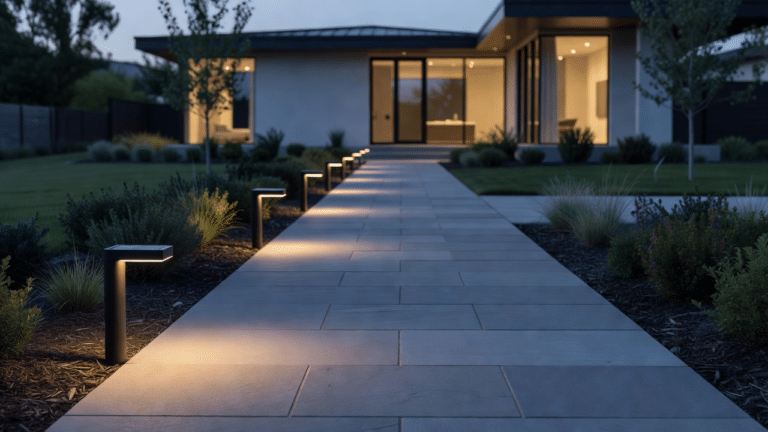
Say the lights do hold their charge all night. You still walk out and the fixtures are glowing beautifully — little pools of light up and down the walk — but the ground between them is shadowed. The lip of the top stair. The crack where the concrete heaved. The drop-off at the edge of the path. The light is showing off its own bulb while the tripping point stays dark. I can see the little lights, but I still can’t see the step.
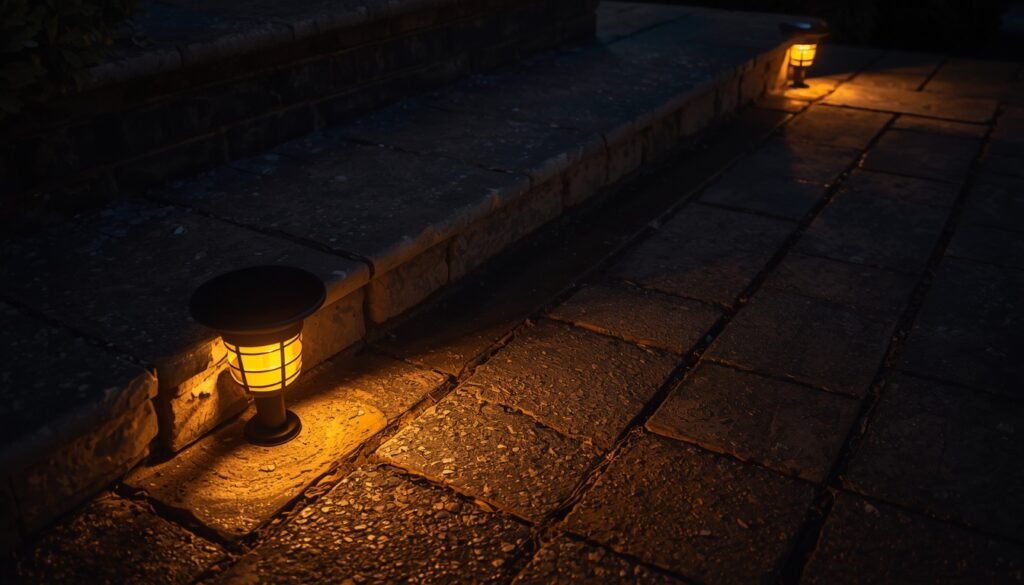
Decorative lighting and safety lighting look nearly identical in a photo and do completely different jobs. One makes the yard look nice. The other lands light on the surface where a foot is about to go — which is exactly why fall-prevention guidance stresses bright light on the top and bottom steps, the spots where falls cluster. You usually don’t find out which kind you bought until you’ve installed the whole row, waited for dark, and gone looking for the step you can’t see.
The season it’s built to fail is the season you bought it for
Then winter comes and calls the whole thing off.
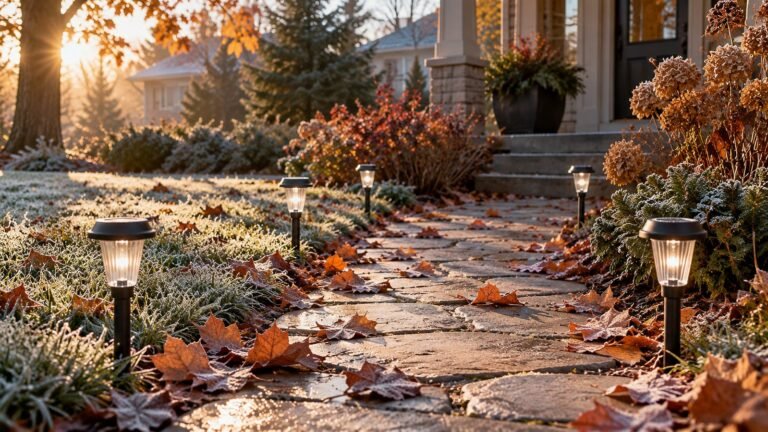
You bought in spring or summer, probably. For months it’s a success story. Then the days get short, the sun sits low and lazy, you hit a run of gray days, and the fixtures that used to blaze are barely glowing by ten — dead by midnight. This lands precisely when the path is icy, frosted, slick, and dark for fourteen hours a night. The icy months are exactly what I need these for — and that’s when they quit.
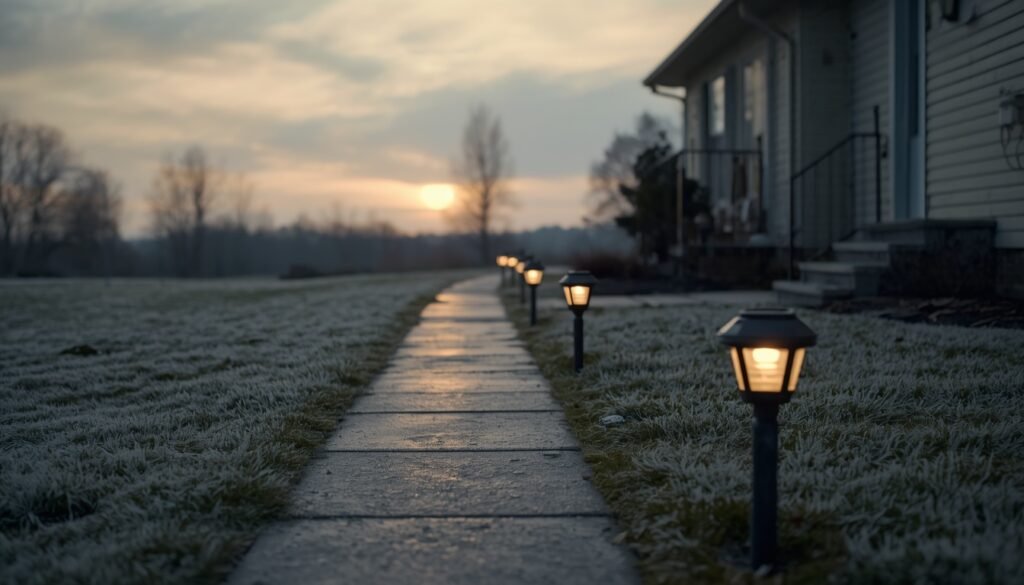
It feels personal, like the tool waited until the stakes were highest and then walked off the job. It isn’t personal — it’s short days, weak sun, a small panel, a cold battery. But the effect is the same: your protection is strongest in July, when nobody’s slipping, and weakest in January, when everybody is.
Why the next set probably won’t fix it either
By now a lot of people are on their second set. Or third. And this is the miserable part: every listing promises the exact things the last failures promised. “Super bright.” “Waterproof.” “Dusk to dawn.” “Long-lasting.” Those were the words on the box of the ones dimming in the yard right now. This is the third set — I’m done guessing.
You stand there comparing lumen numbers you can’t picture and battery specs you can’t verify, with star ratings that flat-out contradict each other, trying to guess which set finally works. And you can’t tell good from bad until it’s been through a real night — so a wrong guess costs you more weeks with the hazard still sitting there. For patio décor, trial and error is fine. For the reason your dad hasn’t fallen yet, it feels reckless. Because it is.
The fix starts with when you look, not what you buy
Here’s the shift. You can’t judge a safety light at the hour and season it’s designed to pass. From your window, at 9 p.m., in June, they all look handled. That view is useless. It’s the view that’s been fooling you.
So change when you look.
- Look at 2 a.m., once. Set an alarm one night and actually go out — or walk the path in the dark yourself. Not “does it glow,” but “can I clearly see the edge of each step and every change in level?” If the answer’s no, it doesn’t matter how nice it looked at bedtime.
- Look during a bad week, not a good one. Wait for a stretch of gray, cold, short days and check then. Summer performance tells you almost nothing. Winter performance is the whole point.
- Watch where the light lands. You want it on the surface — the tread, the edge, the crack — not fixtures aiming their bulbs at your eyes. If you can see the light but not the step, it isn’t doing safety’s job.
- Check the panel in the season that matters. A panel in “full sun” in June can sit in afternoon shade by November as the sun drops. The charge it holds in December is the charge that counts.
- Make sure it stays put on its own. A light you keep straightening after every rain or mow isn’t set-and-forget — it’s a recurring chore, and it’s exactly the babysitting you were trying to escape, especially if you don’t live there to do it.
None of that requires becoming an expert in lumens and battery specs. It just requires testing the light against the moment it’s actually for, instead of the moment that flatters it.
A few sets that fit the checklist
Quick note: the links below are affiliate links. If you buy through them I may earn a small commission at no extra cost to you — it doesn’t change which lights I’d point you to.
None of these is magic, and you should still walk the path in the dark before you trust any of them. But if you want a shortlist built for seeing the ground and surviving a real winter — not just looking good in the box — start here.
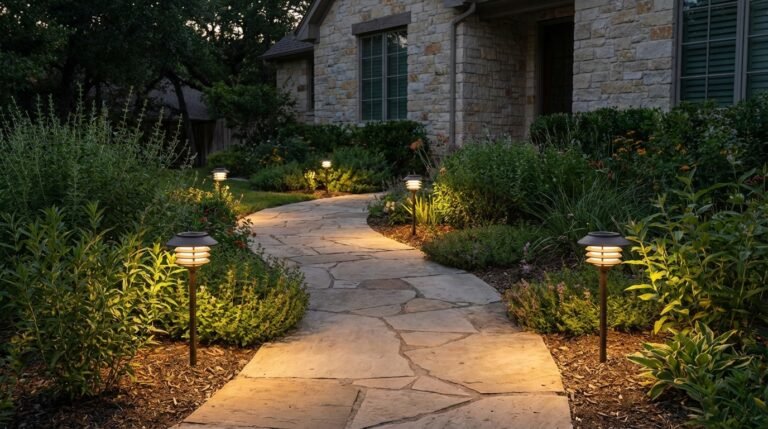
The “buy once” pick for the walkway: BEAU JARDIN 8-Pack Solar Pathway Lights, Warm White. Stainless steel and real glass instead of the thin plastic that clouds over and snaps at the stake after a season. The warm-white diamond-glass shade throws light down and outward onto the path rather than just glowing at you. This is the kind of build meant to outlast its first winter, which is the whole point if you’re sick of the rebuy loop.
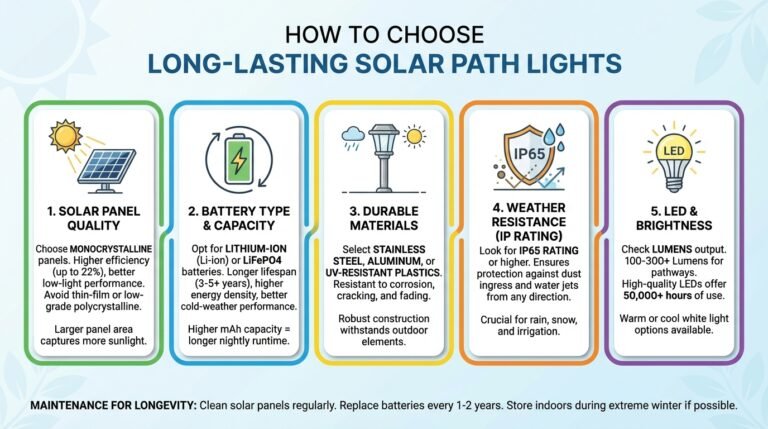
For cloudy weeks and cold months: GIGALUMI 6-Pack Metal & Glass Pathway Lights, IP65 Warm White. IP65-rated against rain and snow, with a larger panel and a 600mAh battery rated for 8–10 hours on a full charge — the spec that matters when the nights get long. Just remember to place the panel where it still catches low winter sun, not only where it looked sunny in June.
For the actual step or stair edge: 8-Pack Solar Stair Lights, IP67, 14-LED Dusk-to-Dawn. Stake lights glow beside a stair and leave the edge dark; these mount right on the riser or wall and wash light down onto the tread — exactly where a foot lands, and exactly the “pitch-black top stair” problem. Rated for rain, snow, and freezing temps, with far more LEDs than the dim single-bead versions.
If you only fix one thing, fix the step. That’s the spot that turns a stumble into a fall.
What “handled” actually means
The goal was never a walkway that looks lit from the kitchen window. It was to make one question — is the path lit right now, at the worst possible hour, in the worst possible week? — stop being a question you have to keep answering.
That’s the real thing you’re buying. Not brightness. Not waterproofing. The right to stop checking. And you don’t get that by trusting the box, because the box always says the right things. You get it by making the light prove it on the nights you’re not watching — the 2 a.m., the icy morning, the fourth gray day in a row.
If you’ve been getting up to peek out the window, that instinct isn’t paranoia. It’s the most accurate read you’ve got, and it’s telling you the path isn’t handled yet. So stop arguing with it. Go test the light at the hour it’s afraid of — and either it earns its silence, or it tells you the truth while there’s still time to fix it.
Frequently asked questions
Why are my solar path lights bright at bedtime but dim by 2 a.m.? Almost any light looks good on a fresh summer charge. The fade happens because a small panel and a low-capacity battery can’t store enough to run bright all night, so the output tapers off right as the dangerous hours arrive. Look for a higher-capacity battery, and check the lights yourself at 2 or 3 a.m. — not at 9 p.m. — before you decide they’re working.
How do I get lights that survive winter and cloudy weeks? Winter is a charging problem, not a light problem: short days, low sun, gray skies. Monocrystalline panels pull more from weak light than older polycrystalline ones, and a larger panel paired with a bigger battery buys you margin on the gray days. Just as important, re-aim the panel for the season — the spot that sat in full sun in June can be in shade by November as the sun drops.
Path lights or step lights — which do I actually need? Path lights line the walkway and handle the flat stretch well. But on stairs, a stake light beside the step usually leaves the edge in shadow. Step lights that mount on the riser or wall wash light down onto the tread, where feet actually land — so if your hazard is a specific stair or a drop-off, that’s the tool for it. Plenty of people end up using both.
How many lumens do I need to see the ground? There’s no single magic number, and lumens alone don’t tell the whole story — placement, color temperature, and how the light is aimed matter just as much. Warm white around 3000K reads comfortably and shows texture on the path surface. The real test isn’t the spec sheet; it’s whether you can clearly see each step and change in level when you walk the path in the dark.
How do I stop the stakes from leaning and the panels from ending up in shade? Soften or pre-drill hard ground before pushing stakes in so they seat straight, and favor metal-and-glass builds over thin plastic that tips with every gust. For panels, choose the spot by watching where the sun actually falls across the seasons, not just on install day. A few well-placed fixtures usually beat a long row you’re forever straightening.
I live far from my parent — how do I know the lights are working? You can’t fully verify from miles away, which is exactly why the setup has to be trustworthy on its own. Pick durable, weather-rated lights, place them once where they’ll charge year-round, and if you can, ask someone local to walk the path after dark in the first week and again once winter sets in. The aim is a system that holds itself together unattended — so “are the lights on out there?” stops being a question you’re texting about.